
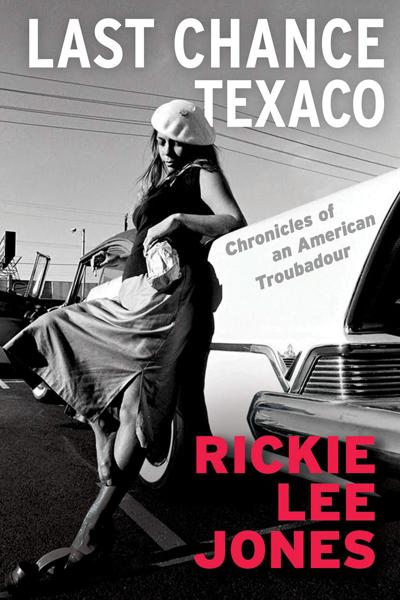


Memoirs and biopics about famous musicians follow a common arc. It all starts with a quick summation of the artist’s humble beginnings. Then there’s the nostalgic depiction of their ascent to stardom followed by a perils-of-fame period. Ultimately, we end with heartwarming scenes of redemption and a comeback tour. But Rickie Lee Jones gives us something entirely different with Last Chance Texaco: Chronicles of an American Troubadour.
Jones, who spoke with me ahead of her virtual event with the Southern Festival of Books, always meant for her memoir to be, as she explains, “the story of one American family.” “The stories of our lives had become mythology,” she says. “They had been told so many times amongst us.” Ten years ago, she had the first inkling to commit the Jones family history to the page, starting with her mother Bettye. As she writes in the book, “My mother’s stories are the heart of me, the country from which I come. Escapades of her ghastly childhood in the orphanage were the Grimm’s Fairy Tales of my own.” Readers are treated to these horrific tales of child poverty, an experience that hardened young Bettye in the Depression-era Midwest.
Much of Jones’ musical world is populated with tragic, morally conflicted characters. Her dad — Richard, a World War II vet and artist — could be one of them. Richard grew up in a show-business family. His father, Frank “Peg Leg” Jones, was a famous one-legged performer on the Chicago vaudeville circuit. As a boy, Richard hopped a train to escape the violent Peg Leg, pursuing a “hobo” existence and taking what Jones describes as “the hard road of adventure.” Richard and Bettye’s paths crossed in Chicago, where they started a family and gave birth to Jones in 1954.
Richard struggled with PTSD and alcoholism. In one scene, he beats teenage Rickie for wearing a supposedly immodest outfit around the neighborhood boys. A few years and chapters later, he drives across the country to bail her out of a Detroit jail and takes her in when Bettye refuses. Her “secretive” and “unpredictable” mother is the book’s most fascinating character. She’s a fierce matriarch, a force of love and rage. Jones writes, “One day Mom would fight for me like a lioness, the next she would slap me for spilling my milk.” Even after 100 pages of getting to know Richard and Bettye, it’s hard to know what to make of them.
Jones believes she’s “sculpted” the story the best she can to keep readers from harshly judging her parents. At 66, she brings new perspective to her childhood: “Some of us are born to live lives on an exaggerated scale. Even as children we have a larger suitcase in which to carry all the things that will one day be on our backs.”
The suitcase is an apt metaphor. Her parents gave her the gift — or curse — of an undying sense of wanderlust. Last Chance Texaco recounts the family taking to the road when Jones is 4. “Once they left Chicago they never stopped moving,” she writes. They head off to Arizona to answer the “siren call of the West.”
As a teen, Jones goes full hippie and flees home, hitchhiking along California’s Highway 1 in the summer of 1969. She survives creeps, jail and almost freezing to death. In 1973, the emancipated 18-year-old steps onto the dilapidated boardwalks of Venice Beach for the first time. Tanned and braless, it’s here that she starts her transformation from nowhere girl to overnight success.
In 1979, Jones released her debut album and graced the cover of Rolling Stone. She played Saturday Night Live, won the Grammy for Best New Artist, and the record went platinum. All of this is remembered in Last Chance Texaco. But so is the fact that she never achieved the same commercial or cultural significance again. The woman with the red beret, once deemed the “Duchess of Coolsville,” floated into obscurity only two albums into her career.
The memoir follows Jones as she takes the unglamorous road of recovery and overcomes a heroin addiction in the early ’80s. Inextricably tied to Tom Waits, the brooding lord of Venice Beach, Jones schleps around the moniker “Tom Waits’ one-time girlfriend” for much too long, her career marked by not-so-subtle sexism and associations with a man she dated for a year.
“I think before I wrote [the book] I might have had an ax to grind,” Jones tells me. But in writing Last Chance Texaco, that time of her life as a famous young woman has begun to “sparkle in a beautiful way,” she says. The process of writing the memoir “was heartbreaking and difficult, but as with all things, now that it’s over, it just seemed like it was great.”
To read an extended version of this article — and more local book coverage — please visit Chapter16.org, an online publication of Humanities Tennessee.



