

An effort to expand Tennessee’s school voucher program, which uses public dollars to fund scholarships for students to attend private schools, narrowly passed in the state's House of Representatives on Monday.
The House version of the bill would expand the total number of vouchers offered as a part of the state’s Education Freedom Scholarship Program to 35,000, as opposed to Gov. Bill Lee’s proposal of 40,000.

During State of the State address, Lee proposes $58 billion for 2026 budget; Democrats’ rebuttal focuses on affordability
The General Assembly initially approved a statewide program via legislation during 2025's special session, which allowed for 20,000 scholarships to be offered during the 2025-26 school year and an extra 5,000 to be added for the 2026-27 school year. Each voucher is worth $7,295.
The current House bill adjusts the order of prioritization for voucher applicants, which was previously split evenly between students with financial need and universal scholarship recipients.
Under the expansion bill, students who received vouchers during the previous school year would get top priority, followed by students whose household income falls below 100 percent of federal eligibility for free or reduced-priced lunch. After that come students whose annual household income is below 300 percent of that amount, and then students whose household income exceeds 300 percent of that amount and are currently enrolled in public school or entering kindergarten.
The lowest prioritization would be given to students whose annual household income exceeds 300 percent of the federal eligibility amount — meaning some vouchers could go to students who already attend private schools.
The bill was backed by Republicans who maintained their argument of "school choice" for parents in Tennessee.
“Let's not fool ourselves,” said bill sponsor House Majority Leader William Lamberth (R-Portland). “We've had school choice in this state forever, as long as you got a big bag of cash at home. ... That's not right.”
But not all Republicans were sold on the idea of expanding the program. A total of 22 Republicans voted against the bill, which passed 52-43 — a narrow margin considering the state’s Republican supermajority. One Republican who spoke against the bill was Rep. Monty Fritts (R-Kingston), who argued that the bill goes against the Tennessee Constitution, which says the General Assembly “shall provide for the maintenance, support and eligibility standards of a system of free public schools.”
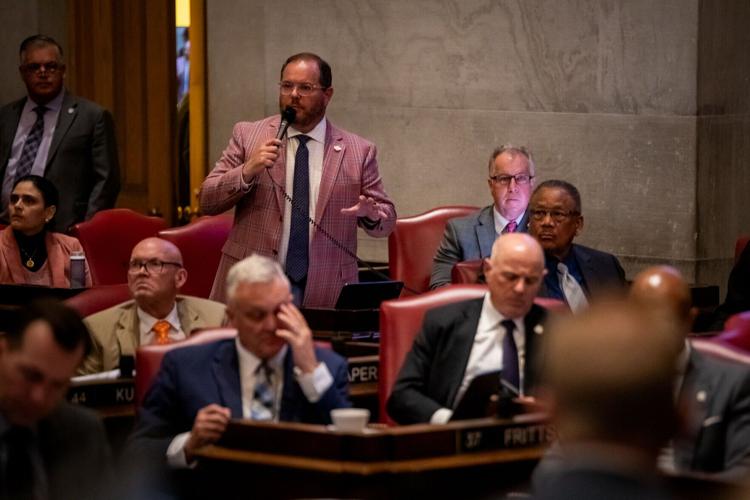
“We're reaching in one person's pocket to pay another person's choice,” said Fritts, who is also currently running for governor. “That doesn't align well.”
Democrats vehemently opposed the legislation, arguing that it diverts money away from public schools and depletes state resources.
“We're giving away free money like it's a broken ATM out here,” said Rep. Caleb Hemmer (D-Nashville). “And we don't have infinite resources, especially when we're not doing what we're supposed to do in the first place, which is fund our public schools. At the end of the day, I think vouchers are going to go down as one of the worst public policy decisions we make in this body.”

Plans to grow Education Freedom Scholarship program clear legislative hurdles while facing opposition from both sides of the aisle
More than 56,000 applications were submitted for the Education Freedom Scholarship program for the 2026-27 school year, according to data provided by the state, which has been clouded with transparency concerns posed by both Republicans and Democrats. Rural legislators have cited data that a majority of the vouchers have been allocated to students in more highly populated districts. Efforts to increase accountability and reporting requirements to determine who is benefiting from the program all failed in committees earlier in the session.
On Monday, the House tabled an amendment from Rep. Jody Barrett (R-Dickson) — who has been particularly critical of vouchers — that would have increased accountability measures. Additionally, the House rejected an amendment proposed by Rep. Gloria Johnson (D-Knoxville) to require students participating in the Education Freedom Scholarship program to take the Tennessee Comprehensive Assessment Program.
Lawmakers also rejected an amendment brought forth by Barrett to maintain the current funding floor for the program, which allocates funds to public schools that face disenrollment. He argued that provisions in the voucher expansion program would cut funds from public schools that lose students.
“It’s going to be death by a thousand cuts for your [local school],” Barrett said.

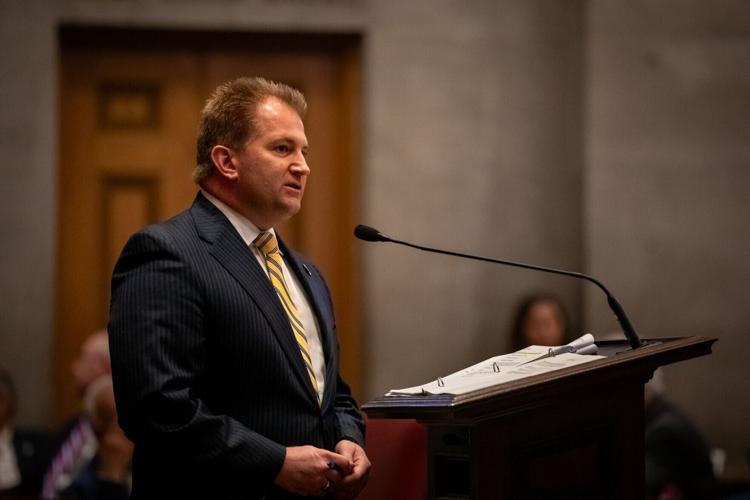
Rep. Jody Barrettt , one of the state Republicans who has opposed the Education Freedom Scholarship program, April 13, 2026
The House version includes an additional amendment from Rep. Ryan Williams (R-Cookeville) that allows schools to receive this funding only if they provide to the state proof of a Social Security number associated with students who disenroll due to the Education Freedom Scholarship program. This comes as a retooled version of a measure that would have required public school districts to provide proof of citizenship or legal immigration status of students who leave to attend private schools as a part of the Education Freedom Scholarship program. Williams later pulled that provision from consideration.
The House adopted a separate amendment from Barrett to prohibit vouchers from being used to enroll in a private school “that promotes or advocates for the support, adoption, or implementation of any foreign law, legal code, or system.” The bill’s text says this is to ensure that the funds are being used for “an education that does not threaten our American freedoms or American form of government.”
The Senate will vote Wednesday on its version of the bill, which rivals the House version. As currently written, the Senate bill would expand the program to offer 40,000 total vouchers and does not include the prioritization requirements and other provisions created through House amendments.
The Senate could vote to concur with the House bill, or — if the Senate passes its own version on the floor — the dueling bills would head to a conference committee so the two bodies can come to an agreement as this year’s session winds down.



Post a comment as anonymous
Report
Watch this discussion.
(0) comments
Welcome to the discussion.
Log In
Welcome to the discussion.
Keep it clean. Please avoid obscene, vulgar, lewd, racist or otherwise abusive language. Comments featuring hate speech or threatening or violent content will not be tolerated.
PLEASE TURN OFF YOUR CAPS LOCK.
Be truthful. Don't knowingly lie or mislead.
Be proactive. Use the “report” link on any comment that violates our comment policy.
Share with us. We'd love to hear your feedback.