
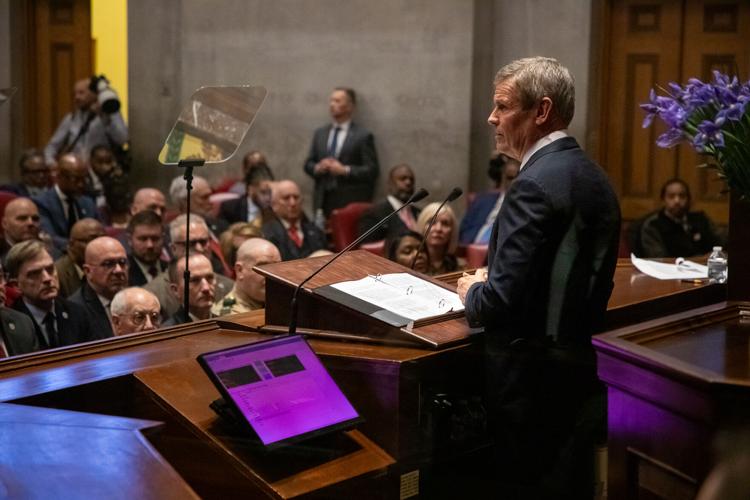
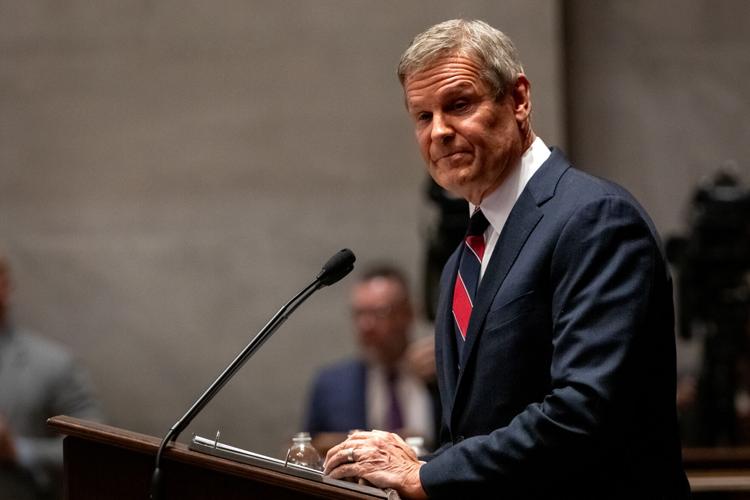
In a tense fiscal year, during his final State of the State address, Gov. Bill Lee proposed doubling the money for his school voucher program, which launched ahead of this school year.
The governor's budget rolls out $300 million for expanding Education Freedom Scholarships, which provide public dollars for private school education. That means increasing the money by $150 million over the previous year.
More than 50,000 applications were received for the program’s 20,000 vouchers in January ahead of the 2026-27 school year. The two pots of money proposed for expanding vouchers would equate to 20,000 additional spots; 5,000 of those additional scholarships are from the current law for vouchers, with the remaining 15,000 coming from new money in this year’s budget, if approved. This would bring the total number to 40,000 vouchers.
Lee proposed $170 million in new funds for the Tennessee Investment in Student Achievement Act, the state’s public school funding formula. The governor also said that beginning in 2027, public school teachers' starting salary will be set at $50,000.
“Last year, we gave families school choice with the Education Freedom Scholarship program, because parents know best,” said Lee. “Clearly, Tennesseans like freedom. Last year, we received more than 40,000 applications, and this year, 54,000 applications so far for 20,000 spots. That means right now, 34,000 students are still waiting for a shot at education freedom. We owe it to them.”
Additionally, the governor proposed $50 million in nonrecurring funds for public safety, $17 million for 50 new Tennessee Highway Patrol officers, $50 million for an AI enablement program, $81.9 million for state parks, and $425 million in new money for the Tennessee Department of Transportation.
$100 Million in Storm Recovery
Tennessee is in the midst of recovery from a severe winter ice storm. Roughly two dozen people have died, including five in Davidson County. Lee said he wants to provide $100 million in new money to bolster the Governor’s Response and Recovery Fund, which provides support to individuals, businesses and communities after natural disasters.

Our coverage of January's severe ice storm
The Federal Emergency Management Agency is not yet on the ground in Nashville to help individual residents and small businesses. Nashville Office of Emergency Management Director-Chief Will Swann said this week that gaining additional support has been a frustrating process for the city, now more than a week after the storm hit.
“There are Tennesseans who are still without power — some who are in this room tonight,” Lee said during his address.
“In the midst of the challenges of this storm, we have seen the courage and selflessness of the line workers, highway patrolmen, Tennessee National Guardsmen, TDOT crews, countless state employees, as well as everyday Tennesseans opening their homes to neighbors in need,” said Lee. “So let’s take a moment to thank these dedicated Tennesseans who embody the volunteer spirit and give us hope that the end will soon be in sight.”
Tight Budget Cycle
Revenues for the state of Tennessee didn’t land exactly as projected this year, according to the Department of Finance and Administration. This year's budget is around $58 billion — last year's was $64 billion.
"The budget makes major investments in Tennessee's future, while preparing for uncertain economic days ahead," Jim Bryson, commissioner for the Department of Finance and Administration, tells the Scene. "We consulted financial experts across our state who unanimously counseled for slow to moderate growth for Tennessee's fiscal year ’27."
Members of both the House and Senate tell the Scene a tight budget year is ahead.
Bryson says the primary loss in this year’s funding comes from lower federal appropriations. The majority of the proposed budget comes from state appropriations, which are serviced from sales taxes, franchise and excise taxes and gas taxes, among other revenue sources.

Gov. Bill Lee delivers his final State of the State address, Feb. 2, 2026
A Swan Song
Gov. Lee took a trip down Memory Lane during his final State of the State address, saying he was “a bit nostalgic about our time together and about the past 250 years of the greatest country the world has ever known.”
Meanwhile, protesters chanted outside the House gallery. Inside, state Rep. Justin Pearson (D-Memphis) held a sign reading “Feed Kids.”
Before the governor’s address, U.S. Sen. Marsha Blackburn — frontrunner to succeed Lee as governor next year — shook hands and took selfies with lawmakers, members of the judiciary and university presidents. Fellow gubernatorial candidate U.S. Rep. John Rose was not present for the governor’s final address.
Democrats Respond
In a “prebuttal” address delivered Monday by state Sen. Raumesh Akbari (D-Memphis), Democrats said they would rather the governor focus on affordability for average Tennesseans over the initiatives Lee has prioritized during his two terms.
“Your public dollars flow to private schools through vouchers,” Akbari said. “Corporate giveaways are measured in the billions. Public schools are underfunded. Rural hospitals are closing. Roads and bridges are falling behind.”
Akbari likened Lee’s Groundhog Day address to the movie Groundhog Day.
“You know the story,” she said. “Bill Murray wakes up to the same day again and again. At first he’s confused. Then frustrated. And finally, he learns. He grows. He changes. And he breaks the cycle. But here in Tennessee, too many families feel like they’re living the same day over and over. Waking up. Going to work. Paying more for groceries. More for rent. More for child care. More for electricity. And wondering, ‘Will it ever get easier?’ You know what I’m talking about.”
Democrats said they remain focused on affordable grocery prices, a higher minimum wage and more money for public schools.



Post a comment as anonymous
Report
Watch this discussion.
(0) comments
Welcome to the discussion.
Log In
Welcome to the discussion.
Keep it clean. Please avoid obscene, vulgar, lewd, racist or otherwise abusive language. Comments featuring hate speech or threatening or violent content will not be tolerated.
PLEASE TURN OFF YOUR CAPS LOCK.
Be truthful. Don't knowingly lie or mislead.
Be proactive. Use the “report” link on any comment that violates our comment policy.
Share with us. We'd love to hear your feedback.