
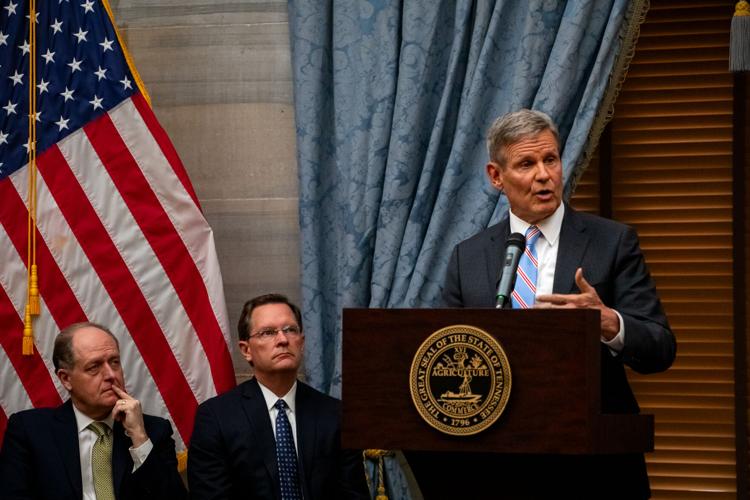

Lawmakers reconvened at the Tennessee State Capitol on Feb. 2 after a weeklong hiatus due to Winter Storm Fern. The third week of this year’s session kicked off with term-limited Gov. Bill Lee’s final State of the State address.

During State of the State address, Lee proposes $58 billion for 2026 budget; Democrats’ rebuttal focuses on affordability
The address outlined Lee’s $58 billion budget proposal, underscored by this year’s revenue shortfalls. Notably, the spending plan includes double the funding for the state’s school voucher program, also known as Education Freedom Scholarships. Among other notable funding recommendations were $100 million for storm recovery and hundreds of millions for the Tennessee Department of Transportation.
Democrats continue to criticize Lee’s budget, saying it does nothing to strengthen affordability for everyday Tennesseans.
“There's harder economic times coming, and this governor has not set a budget to deal with that at all,” said state Sen. Jeff Yarbro (D-Nashville) at a press conference Thursday. “Not only is the budget sort of fundamentally broken, the choices that are being made don't actually help any Tennesseans.”
The governor made another appearance at the state Capitol on Wednesday, when he appeared alongside U.S. Health and Human Services Sec. Robert F. Kennedy Jr. Kennedy spoke on the federal government’s new dietary guidelines, vaccines and rural health care.
An extensive list of bills on health care, education, prison reform and culture-war issues is working its way through committees. Here’s what did — and didn’t — advance this week.
Hospital Restrictions and Menstrual Product Access
During his State of the State address, Lee called on lawmakers to overhaul state rules to make it easier for new health care facilities to open. In 2025, Rep. Johnny Garrett (R-Goodlettsville) introduced a bill that would exempt acute-care hospitals from obtaining a certificate of need. While that legislation has seemingly petered out, it could be revitalized following Lee’s comments.

Local health care professionals protest as Health and Human Services secretary talks vaccines, rural health care at state Capitol
Sen. Raumesh Akbari (D-Memphis) brought a bill that would set up free period-product vending machines in high schools, which is headed to the Senate floor while awaiting action in the House. A bill brought by Rep. Gloria Johnson (D-Knoxville) that would have exempted menstrual products from sales and use tax failed this week.
A new bill (HB 2290/SB 2461) was introduced that would introduce requirements for fertility health care providers and restrict the use of genetic testing on embryos. Similar legislation failed last year.
Gun Permits and Health Insurance for Kids
A bill from Sen. London Lamar (D-Memphis) that would allow counties to enact rules to require those who carry guns to obtain a permit failed this week in the Senate Judiciary Committee.
A bill also brought by Lamar that sought to extend health insurance coverage to more children was killed in the Senate Health and Welfare Committee this week, after being rolled over from the 2025 session. The bill would have allowed the state to automatically renew TennCare coverage for kids under 18 rather than requiring them to recertify yearly.
Prison Education and Security
A prison-reform bill that has received bipartisan support advanced this week. The legislation passed the Senate State and Local Government Committee and would require the Tennessee Department of Correction to conduct an annual education assessment for certain people incarcerated in the state facilities.
Sponsored by Sen. Dawn White (R-Murfreesboro) and Rep. Kevin Raper (R-Cleveland), the legislation would require the assements to be conducted for those who are incarcerated and serving sentences for felony offenses. The bill would determine their highest level of education and gauge their interest in completing or furthering their education through department programs.
A joint fiscal review committee also heard a presentation from TDOC officials concerning a contract with Axon Enterprise Inc. for a variety of security upgrades to prisons, including AI-operated technology and drones to patrol correction facilities.
Religion in Schools
The House Education Committee passed a Republican-backed bill that would allow the display of the Ten Commandments in public schools. The legislation has been met by opposition from Democrats citing First Amendment concerns. The legislation also allows for schools to display the Declaration of Independence, the U.S. Constitution, the Tennessee Constitution, the Bill of Rights and other historically significant documents. The bill has been placed on the House calendar for Feb. 9.
Another Republican bill focused on religion and education, titled the “Protecting Religious Liberty and Expression in Public Schools Act,” passed the House Civil Justice Subcommittee along party lines. Sponsored by Rep. Gino Bulso (R-Brentwood) and Sen. Joey Hensley (R- Hohenwald), the legislation would require public schools to use the Bible in instruction and provide time for prayer and the reading of religious texts.
All students, other than those with written requests to be excluded, would be taught the teachings of the Bible “as literature,” according to the bill text. The legislation would also require students be taught the “moral and ethical teachings of the Old and New Testaments” and other aspects of the history of Christianity.
“This bill does not permit a public school to teach the Bible as religious dogma, coerce a student to believe or accept the Bible as divinely inspired,” the bill says. It will be considered in the House Judiciary Committee on Feb. 11.
Robotic Delivery Vehicles
More Tennessee roads may soon be open to robot delivery vehicles, like DoorDash’s “Dot,” after legislation advanced in committees of both chambers this week. A new bill opens up bike lanes, shoulders, parking lots and certain road edges for the commercial devices, so long as they are labeled and identifiable, and increases their allowable speeds from 10 to 20 miles per hour.
Senators heard from DoorDash lobbyist Brent Westcott and advanced the bill unanimously in the Senate Transportation and Safety Subcommittee on Wednesday. Westcott impressed senators with a DoorDash video showing an agile Dot obeying traffic laws, reacting to roadway hazards and delivering goods from businesses to customers. An amendment preserves the right of local municipalities to further regulate or ban the delivery robots for safety concerns.
Same-Sex Marriage Ruling ‘Clarification’
House Bill 1473, which states that “private citizens and organizations are not bound by the Fourteenth Amendment or the Supreme Court’s decision in Obergefell v. Hodges” passed the House Children and Family Affairs Subcommittee on Tuesday. Obergefell is the 2015 U.S Supreme Court decision that legalized same-sex marriage.
The bill, sponsored in the House by Rep. Gino Bulso (R-Brentwood) and in the Senate by Sen. Janice Bowling (R-Tullahoma), would also “prohibit the board of professional responsibility from disciplining or sanctioning an attorney for declining to officiate a marriage between two persons of the same sex.” Bulso said he’s “not aware” of any issues in Tennessee that would be addressed by the proposed legislation.

State GOP aims at undermining gay marriage, removing discrimination protections and more
Rep. Torrey Harris (D-Memphis) characterized the bill as not “being something that's about religious liberty, but about just figuring out a way to write discrimination into our Constitution.”
Bulso argues that the bill seeks only to “clarify” the Obergefell v. Hodges decision, and the 14th Amendment of the U.S. Constitution applies only to the state and not to private citizens — adding that the bill doesn’t aim to “nullify” the Supreme Court ruling.
Harris unsuccessfully moved to have the bill moved to summer study, and the subcommittee passed the legislation in a 5-1 vote, with Harris being the only no vote. Rep. Joe Towns (D-Memphis) was not present. The bill moves on to the House Judiciary Committee on Feb. 11.
“If it doesn't change anything, why not ask for an attorney general's opinion on the question to get this on the record or run a resolution?” Chris Sanders, executive director of Tennessee Equality Project, told the Scene following the vote. “The fact that it's being put in a statute, and the fact that [Bulso] has run several other anti-LGBTQ bills, makes us think there's something else at work here.”



Post a comment as anonymous
Report
Watch this discussion.
(0) comments
Welcome to the discussion.
Log In
Welcome to the discussion.
Keep it clean. Please avoid obscene, vulgar, lewd, racist or otherwise abusive language. Comments featuring hate speech or threatening or violent content will not be tolerated.
PLEASE TURN OFF YOUR CAPS LOCK.
Be truthful. Don't knowingly lie or mislead.
Be proactive. Use the “report” link on any comment that violates our comment policy.
Share with us. We'd love to hear your feedback.