
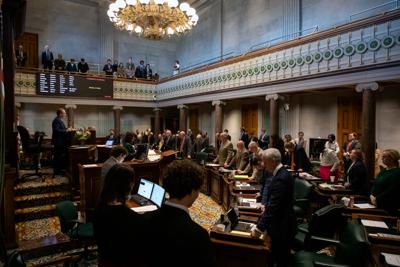

A bill to expand Tennessee’s school voucher program squeaked through in an 18-14 vote in the state Senate Thursday. It will soon land on Gov. Bill Lee’s desk to be signed into law.
The Senate conformed to the House version of the bill, which passed on Monday and is set to expand the program to offer a total of 35,000 scholarships for the 2026-27 school year — a backstep from the Senate’s original effort, and the governor’s proposal, to offer a total of 40,000. Last year’s legislation establishing the program created a mechanism adding 5,000 additional scholarships each year if the number of applications exceeds 75 percent of the number of scholarships available. More than 56,000 applications were submitted for the Education Freedom Scholarship program for the 2026-27 school year. Each scholarship will be worth roughly $7,500, an increase from last year’s value of $7,295.

Representatives advance bill to offer 35,000 Education Freedom Scholarships in close vote as senators prepare to discuss different version of legislation
Under the expansion bill, students who received vouchers during the previous school year will get top priority, followed by students whose household income falls below 100 percent of federal eligibility for free or reduced-priced lunch. After that come students whose annual household income is below 300 percent of that amount, and then students whose household income exceeds 300 percent of that amount and are currently enrolled in public school or entering kindergarten.
The lowest prioritization would be given to students whose annual household income exceeds 300 percent of the federal eligibility amount — meaning some vouchers could go to students who already attend private schools.
Sen. Ken Yager (R-Kingston) spoke in favor of expanding the program, saying it furthers school choice for families in Tennessee who otherwise couldn’t afford a private school education.
“I've heard from families throughout my rural district whose kids, who were eligible, didn't get a scholarship because there wasn't a capacity to accommodate them,” said Yager. “Expansion is the solution to this problem.”
Though school vouchers have remained a Republican-backed effort, not all GOP senators are on board with the plan to expand the program. Eight Republicans voted no in the Senate, including Sen. Richard Briggs (R-Knoxville), who cited concerns about lack of transparency surrounding the program.
“What we’re hearing all the time on trying to sell this program is that our public schools are failing, and we gotta get the kids out of the public schools so they can go to a private school where they can do better,” Briggs said. “Quite frankly, it's just not true, and we're not being given the statistics of who are actually getting these scholarships.”
The potential for a budgetary crisis if the voucher program continues expanding was also on the minds of some Republicans who had questions about what it could mean for the state’s finances.
“There's going to be a day of reckoning,” Briggs said. “We've been very, very proud of the fiscal responsibility that we've had in the state of Tennessee, and I guess I just hope we’re not going off the tracks with the program and someday we’re going to have to be scratching our heads and saying, ‘What are we going to do about this?’”
Efforts to increase accountability surrounding the program died in committee earlier this session, and many rural Republicans have cited data that a majority of the scholarships have been allocated to students in Tennessee’s wealthier urban counties.

After tucking a citizenship requirement into a public school funding section of the bill, Republicans have refocused on voucher expansion
Meanwhile, Democrats have long opposed school vouchers, voicing concerns that the program will slash funds from public schools.
“Obviously, the intention is to kill public schools, and that is the quiet-part-out-loud that people aren't saying here,” said Sen. Heidi Campbell (D-Nashville). “And that is very alarming, because I don't think public education is an entitlement. I think trying to live in a society that doesn't educate their children and their community is a very, very bad idea.”
Democrats have also opposed a provision within the legislation that allows schools to receive funding for students who disenroll due to the Education Freedom Scholarship program only if they provide a Social Security number associated with said students. The provision is a stripped-down effort spun off of a previously proposed measure that would have required public school districts to provide proof of citizenship or legal immigration status of students who leave to attend private schools as a part of the voucher program.
“I don't even provide a Social Security number to the doctor’s office when [my children] go to the pediatrician,” said Sen. Charlane Oliver (D-Nashville). “So we want to trust the [school] district with this sensitive data? I don't think so.”



Post a comment as anonymous
Report
Watch this discussion.
(0) comments
Welcome to the discussion.
Log In
Welcome to the discussion.
Keep it clean. Please avoid obscene, vulgar, lewd, racist or otherwise abusive language. Comments featuring hate speech or threatening or violent content will not be tolerated.
PLEASE TURN OFF YOUR CAPS LOCK.
Be truthful. Don't knowingly lie or mislead.
Be proactive. Use the “report” link on any comment that violates our comment policy.
Share with us. We'd love to hear your feedback.