

Councilmember Tom Cash carried legislation for a new Vanderbilt University “innovation neighborhood” through its first Metro Council reading Tuesday night. Some of his voters clamor for more concessions, while others welcome an upgrade to Vanderbilt's sea of parking lots along 31st Avenue. Cash's District 18 encompasses parts of Vanderbilt and surrounding residential neighborhoods, including a well-resourced enclave between 21st Avenue and West End Avenue that is rallying neighbors to the bill’s second reading on Aug. 4.
Residents organized under the Hillsboro-West End Neighborhood (HWEN) want greater concessions from Vanderbilt regarding maximum building height, traffic calming, parking, construction and green space. Vanderbilt pursued eminent domain claims in the 1960s and 1970s in its quest to acquire the acreage, which has long been surface parking lots for employees near campus athletic facilities. The HWEN board has formed a negotiating team and hired land-use consultants in the monthslong lead-up to Tuesday night’s official proposal.
Cash, an affable second-term councilmember, has played mediator between his neighbors and his biggest constituent, Vanderbilt — both powerful forces tugging the project in opposite directions.
“Vanderbilt conceded a bunch of things,” Cash shares with the Scene. “A lot of what neighbors wanted is covered in conditions from planning and other Metro departments. I also want to have a committee with in-person meetings to bring together Vanderbilt and HWEN — no veto power or big votes, but a place for neighbors to ask questions of Vanderbilt and strengthen that relationship.”

University’s ‘Innovation District’ would turn parking lots into office buildings; nearby residents want specifics
Multiple delays and deferrals pocked the university’s initial vision for a large-scale office park that integrates corporate investment into campus research, previously advertised as an “Innovation District.” The university bought dozens of key parcels of West End storefront over the years in a real-life game of Monopoly ahead of this summer’s push. After Vanderbilt shared a list of site concessions with Cash and HWEN — summing up months of back-and-forth, meetings and impassioned emails — the Metro Planning Commission unanimously stamped a regulatory Specific Plan (SP) District on April 23 outlining Vanderbilt’s comprehensive rezone.
Facing a generation of campus construction, Cash hopes that continued “authentic conversations” will prevent ill will from families as their institutional neighbor blasts, drills and builds. A June 15 email from HWEN leaders directs neighbors to public comment at Metro Council’s Aug. 4 meeting and raises outstanding concerns about reducing the development’s footprint — particularly along 31st Avenue, the district’s closest border to the neighborhood.
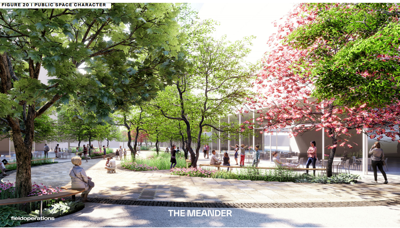
Slides filed with Cash’s legislation show Vanderbilt's latest renderings. Instead of asphalt, the proposal envisions a triangular block threaded by a leafy “meander” that’s somewhere between park and path. Buildings will range between 10 and 35 stories, with the tallest peaks plotted for the longtime West End Wendy’s. Campus power players, following universities like Harvard and the University of Pennsylvania, want to use the area to attract corporate investment for shared ventures.
“The goal of this project is to create a physical center of gravity for Nashville’s and Tennessee’s innovation ecosystem in a dynamic and creative neighborhood that broadens collaborations and leads to new discoveries for entrepreneurs, for corporate research & development, for the University, and for our community,” reads Vanderbilt’s promotional material. “Vanderbilt’s objectives are to advance our translational research, to grow our new ventures, to deepen our corporate partnerships, and to create a neighborhood.”



Post a comment as anonymous
Report
Watch this discussion.
(0) comments
Welcome to the discussion.
Log In
Welcome to the discussion.
Keep it clean. Please avoid obscene, vulgar, lewd, racist or otherwise abusive language. Comments featuring hate speech or threatening or violent content will not be tolerated.
PLEASE TURN OFF YOUR CAPS LOCK.
Be truthful. Don't knowingly lie or mislead.
Be proactive. Use the “report” link on any comment that violates our comment policy.
Share with us. We'd love to hear your feedback.