

We should have a Nashville History Month. I declare it to be August! Right now! Not because I have any authority to, but because there’s no one to stop me. Let that be a lesson, kids. People confuse audacity with permission. If you boldly declare August to be Nashville History Month, most people will just assume someone told you that you could.

Even if it weren't in the Morris Memorial Building, such a museum would be a boon for our city
Why do we need a Nashville History Month? Well, we have some really interesting history that many locals were never taught and that newcomers have no easy way of learning because we don’t have a city museum. (And let me be clear. I want a civil rights museum in Nashville, as I've written about before, but we also need just a regular old history museum. Where you can go learn about Nashville’s history so that, when you go to the civil rights museum, you know the bullshit people had been navigating that led to them protesting and sitting in.)
I was thinking about cheap and free things we could all do to commemorate Nashville history — like just one thing a day that, upon doing it, would make you feel like you knew a little more about Nashville than you did at the start of the month. But I can’t come up with 31 things! I did come up with 10 though. Here are some appropriate activities to get you started on your journey as a Nashville history fan:
- Kiss a philandering Frenchman. Listen, the page this links to is jacked up. But it’s jacked up in such a funny way that, for a second, I wondered if I had once written the best cliffhanger in the history of the Scene so I’m keeping it. (Editor's note: The Scene changed content management systems in 2016, leaving many of our blog posts with "jumps" permanently truncated. It sucks.)
- Lie down under the stars and eat some cheese and crackers. Bonus points if you have a horse to share with. Ever since I first read Joe Pagetta’s The Apostle of Tennessee, I’ve been charmed by Father Orengo, one of Nashville’s early Catholic priests, who ran around the countryside having wholesome adventures and helping to organize churches. Pagetta recounts how Orengo would snack on cheese and crackers at night, so it’s not just charcuterie — it’s Nashville history.
- Go fossil hunting. Nashville’s deep history goes back to a time when all this was under an ocean, and Davidson County is rich in fossils. You don’t need anything fancy — just a safe spot where a hillside has been cut into. Just pick up what’s fallen on the ground and see what you can find. You can also find good stuff just lying in the creekbeds.
- Visit Lock One Park. We have parks with playgrounds and playing fields. We have parks with old farm fields. We have parks that are old airfields. But we have only one park that only appeals to people in the history field. Lock One Park. Located right along the river, just across from MetroCenter, it’s a hidden gem for historians. It looks closed, but it’s not. Be courteous about parking, since there’s only street parking and people live right next to the park. The park contains the site of Heaton’s Station and the ruins of the old lock. It has the coolest staircase in all of Nashville. There are some random railroad tracks that run up the hillside. And there is plenty of other mysterious stuff. There aren’t any interpretive signs. You just have to go and look at a weird wall or a concrete slab and stroke your chin while you ponder what you could be looking at. It’s super interesting and a good reminder that there’s a lot of history just lying around that no one has done anything with yet.
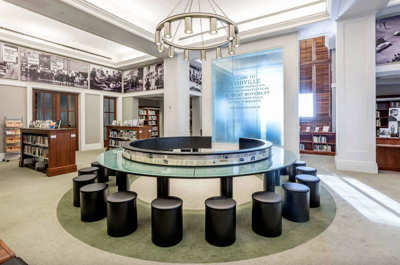
- Make your way to the downtown library. Finally back open after a mishap that, for some reason, no one has ever apologized for (involving, oh you know, blowing up the parking garage), the Nashville Public Library's Main Branch is a great place to learn about Nashville history. Up on the third floor, you have the city archives — where I guarantee you will find something interesting while you are looking for something else. I was recently in there reading city documents looking for information about the people Nashville enslaved, and I learned that, at city meetings in 1838, no one could speak if the mayor was standing. This was, as you can imagine, in an effort to get people to shut up so that city meetings could go more quickly. The more things change, the more they stay the same. On the second floor, you have the Nashville Room, flanked by the Civil Rights Room and the Women’s Suffrage Room.
- Go to the Tennessee State Museum. Yes, it’s for the whole state, but you can just cover your eyes for the parts that don’t pertain to Nashville. It’s free. The employees are lovely. And it is the place in town where you can see a bunch of William Edmondson’s sculptures for free.
- Wander around Fisk University. While my suggestion that we build a giant snow globe to put Fisk in so that it is protected has been met with looks of confusion and dismay, I still think that Fisk is a city treasure that’s hard to top in terms of Nashville history. The theater is made of three Civil War barracks put together. The Victorian masterpiece, Jubilee Hall, was built with money raised by the Fisk Jubilee Singers. Both the beautiful chapel and the gym have hosted more civil rights legends than you can shake a stick at. The library is the most charming midcentury retro-future Jetsons-looking building on the interior. And I’m not even mentioning all the great art, but there’s great art everywhere you look.
- An important but overlooked incident in Nashville history is when we went over to New Madrid and flirted with becoming a part of New Spain. Celebrate what might have been by eating at a Mexican restaurant. (Double points if you do this in conjunction with item 1 on this list. You win Nashville history if this results in a child you convince the city you gave birth to in a cave.)
- Visit the Nashville City Cemetery. Nashville has a ton of great cemeteries, but only the City Cemetery has good interpretive signage. You can walk along one of their lovely paved paths and read up on the Nashvillians who came before you.
- Check out Nashville Sites. Nashville Sites is a collection of self-guided walking and driving tours of different bits of Nashville history. Sure, it’s more fun to kidnap a historian and force him to point at things and tell you what’s cool about them, but you will go to jail. This is a free and legal way to get Nashville history delivered by the people who study it right into your ears. I especially recommend the Civil War driving tour and the McKissack Architecture driving tour. The McKissack one is self-evident. Obviously if you want to see buildings designed by the famous Black architectural firm, you need to go see those buildings. The Civil War one, though, I think is really crucial for understanding the Battle of Nashville and just how much of Nashville today is on the battlefield of yesterday.
We’re so lucky to live in a city where you can just go see stuff. I mean, yes, a lot of stuff has been torn down, and things certainly do look different now than they did back then (whatever "back then" you’re talking about). But a lot of stuff is still here, and you can just go look at it, walk around it, drive along it. You can see how people of the past solved or didn’t solve their problems, how they thought about their lived environments. And then you add to the story of the city. Just by being here. It’s great! And it’s worth dwelling on.
Happy Nashville History Month!



Post a comment as anonymous
Report
Watch this discussion.
(0) comments
Welcome to the discussion.
Log In
Welcome to the discussion.
Keep it clean. Please avoid obscene, vulgar, lewd, racist or otherwise abusive language. Comments featuring hate speech or threatening or violent content will not be tolerated.
PLEASE TURN OFF YOUR CAPS LOCK.
Be truthful. Don't knowingly lie or mislead.
Be proactive. Use the “report” link on any comment that violates our comment policy.
Share with us. We'd love to hear your feedback.