
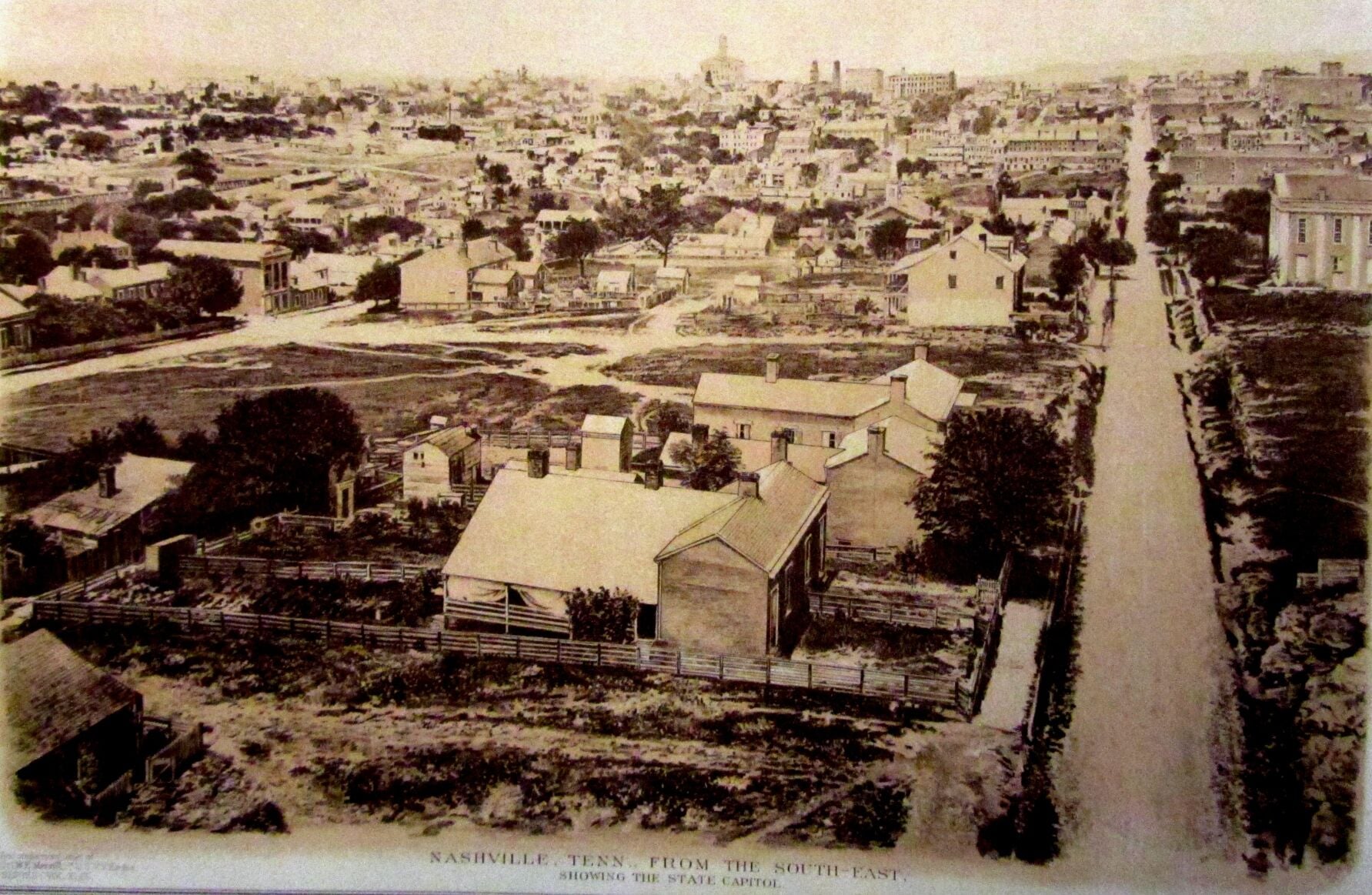

Last week I was trying to determine if prostitution had actually been illegal in Nashville before the Civil War. (We all know prostitution was legal during the Civil War after the boat incident, right?) I had been reading old newspapers about conduct that one might think would be indicative of a city that's fine with sex work, and that it wasn’t against the law to engage in it. But haha, turns out that’s just Nashville being Nashville.
It was illegal — just not the same amount of illegal for everybody. This was covered in Chapter 19 of The Revised Laws of the City of Nashville, 1850 Edition — titled “An Act to prevent gaming, to restrain disorderly houses and persons, and for other purposes.” That’s not terribly interesting. What’s interesting is the “other purposes” stuff covered in this act.
I present to you Section 8.
Be it enacted, That it shall not be lawful for any person to fly a kite, or being engaged in throwing long bullets, pitching quoits, or throwing any ball, or piece of iron or stone within the limits of this corporation, under the penalty of one dollar for each offence; and if a minor, to be paid by the parent, guardian, or employer.
You read that right. It was illegal to fly a kite in the city of Nashville, nor could you throw a ball. Now we see why childrearing was left to the mothers. The things a dad might do with his kids were all illegal.
I didn’t know what it meant to throw long bullets, but the good Harry Enoch of Winchester, Ky., explains: “‘Throwing long bullets’ probably holds the claim to the most unusual game of the period. The object was to see who could throw a heavy rock (the ‘bullet’) a specified distance in the fewest chances. If available, the game could be played with cannonballs, which could be thrown or rolled.” Enoch explains that you’d pick a distance, like a mile down the road, and just start heaving heavy objects. The person who could make the distance in the least throws won. And people gambled like mad on it.

From visiting the Nashville Public Library to taking a Nashville Sites tour and going fossil hunting, here are 10 ways to celebrate our history
Frankly, this seems like awesome fun. I’m adding to my list of things to do for Nashville History Month: Go break one of our old laws by hurling cannonballs down the road with your friends.
Now that I’ve also looked up “pitching quoits,” I think the next little bit is designed to keep you from doing anything like horseshoes or cornhole or bocce ball or croquet. Anything where you attempt to throw, toss or hit an object as close as possible to another object. Right out.
This makes sense lumped in with throwing long bullets. The city didn’t want you taking up a bunch of space in town with your shenanigans, and they didn’t want you hurling stuff where people were trying to live their lives. Plus, this is all stuff that is easily bet on, and based on earlier illegal things, the city was trying to cut down on gambling.
Wait. Can we, from context clues, guess what the problem with kite-flying was? Everything else in this section takes up a lot of public space, which — I guess, if you had too many people flying kites — could happen, or is about gambling. What is the most likely way that people would gamble on kite-flying? My guess? Kite-fighting.
I thought a quick search of the local papers would make things clear, but instead what I found was that the Nashville Banner back then was obsessed with kites — specifically carts powered by kites. On Oct. 26, 1826, the Banner brings Nashville the story of Professor Peacock, who traveled 20 miles an hour by attaching a number of kites to his carriage. On Dec. 29, 1827, the Banner is questioning why boats use sails and not kites. And then on Jan. 26, 1828, the Banner is back on Professor Peacock and his kite-drawn carriage. But by May 9, 1833, the Banner was reporting about a kid in New York who was flying a kite from the roof of his house when he slipped and fell. “This,” the Banner reads, “should prove as a caution to parents and others, to prevent the too frequent practice of boys flying kites from the roofs of houses, by which their lives are often placed in jeopardy.”
Like many people, I have flown a kite or two in my day. But I had no idea they were so exciting and dangerous.
I was talking to merely Braden Gall, my podcast co-host, about whether we as a city should bring back tossing long bullets, and he had a great idea that I endorse for Nashville History Month. Instead of tossing heavy things a long distance, what if in the new iteration, you just try to see who among your family and friends can toss something light, like a feather or a paper airplane (or hell, a kite) from one side of your yard to the other in the least amount of tosses?
Celebrating Nashville’s history should be fun, but in keeping with said history, it should also be a little weird. Bringing back modified long bullet tossing meets the moment.



Post a comment as anonymous
Report
Watch this discussion.
(0) comments
Welcome to the discussion.
Log In
Welcome to the discussion.
Keep it clean. Please avoid obscene, vulgar, lewd, racist or otherwise abusive language. Comments featuring hate speech or threatening or violent content will not be tolerated.
PLEASE TURN OFF YOUR CAPS LOCK.
Be truthful. Don't knowingly lie or mislead.
Be proactive. Use the “report” link on any comment that violates our comment policy.
Share with us. We'd love to hear your feedback.