
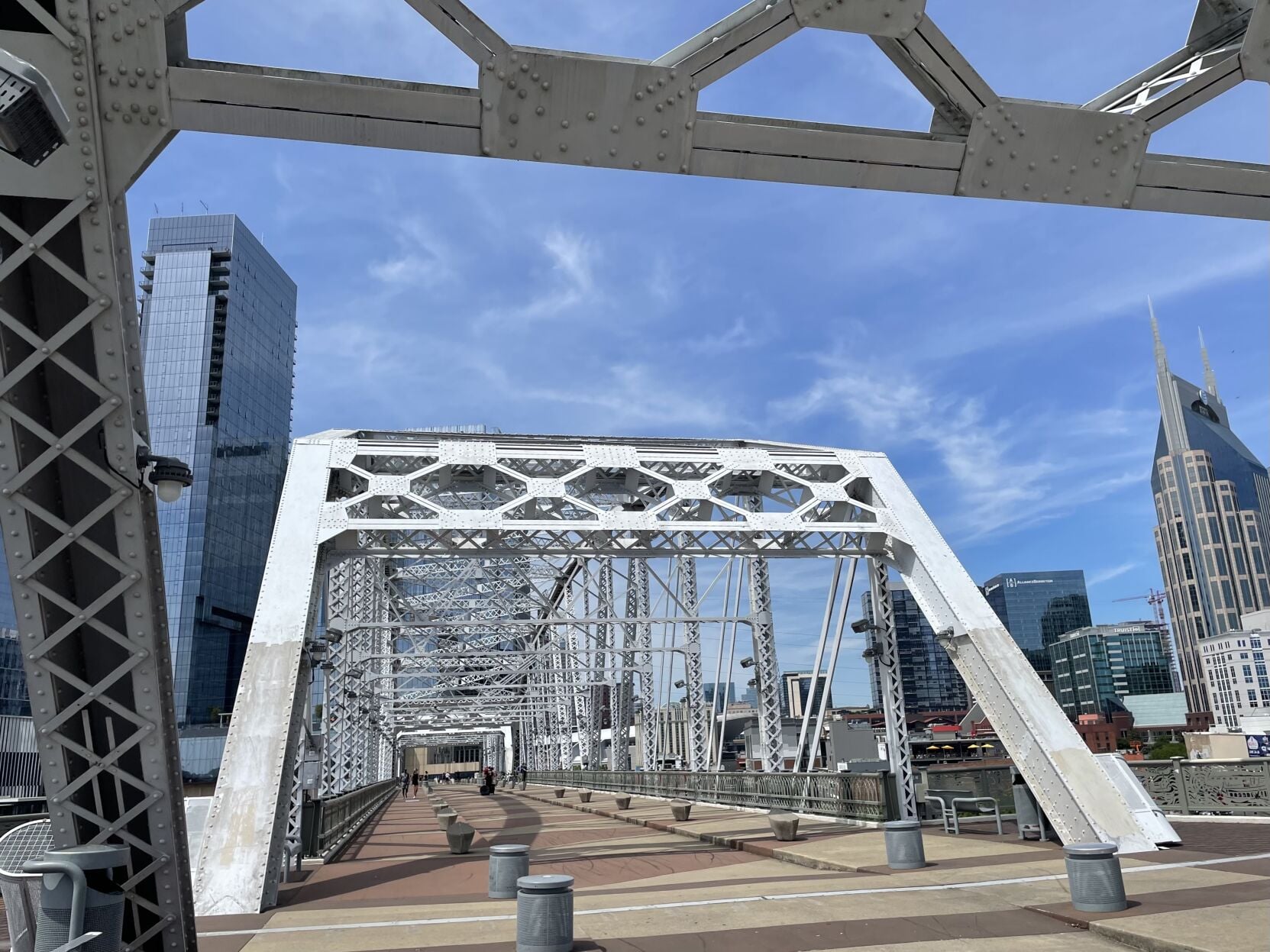

I read our own Eli Motycka’s coverage of the planned changes to the Seigenthaler bridge with a growing sense of bemused curiosity. The one thing that can get a place delisted from the National Register of Historic Places is “substantial alteration.” And completely altering and extending the eastern approach — as the Titans and the East Bank Development Authority are getting ready to do — would seem like the kind of thing that could lose the bridge its spot on the register. You’d think that there might be one line in one thing written about the bridge extension somewhere that talks about whether and how this affects the bridge’s listing, but I haven’t found anything.
I suspect everyone is just hoping it won’t come up. Don’t mention the National Register of Historic Places listing and maybe no one will ask if what we’re doing could get the bridge delisted.

A second tweak will extend the John Seigenthaler Pedestrian Bridge as Nashville prepares to host 2030 Super Bowl
I’m not a huge bridge enthusiast myself, so it’s hard for me to guess how much of a stink the bridge people might raise if the bridge is under threat. But I am a fan of vexing conundrums, and the city is trying real hard to ignore a large vexing conundrum.
The John Seigenthaler Pedestrian Bridge — previously called the Broadway Bridge (even though it’s not on Broadway), the Sparkman Street Bridge and the Shelby Street Bridge — was built between 1907 and 1909 by the Foster-Creighton-Gould Company, using a design by Howard M. Jones. My understanding, based on reading the National Historic Register nomination form and the Historic American Engineering Record on the bridge, is that if you took a bridge enthusiast to the Seigenthaler bridge, the enthusiast would ooh and ahh at all the metal overhead. These are Pratt trusses, which are cool for reasons I myself don’t really understand. But if you showed your bridge-enthusiast friend the concrete trusses on the west side of the bridge, under the part going over the railroad, your bridge-enthusiast friend would probably lose his or her shit with excitement.
This was the first bridge in the United States to use those concrete trusses, and people did not believe they were going to work. Local civil engineers told people it wasn’t stable. Howard Jones had to take to the pages of Engineering News in November 1909 to say that “it is believed by the writer [Jones, writing in the third person for some reason] the concrete truss will be found to be an economical solution to many problems of the future, as it will soon cease to be experimental and will graduate with honors from the ‘freak’ list.” He ran a series of showman-like weight challenges to prove they’d hold.
How’d that work out? Well, there’s a whole section in the Historic American Engineering Record on the bridge called “Recurrent Concrete Problems.” Problems with the concrete appeared during construction. The Engineering Record calls this “the inconsistent quality of the concrete,” noting that “in one instance, a ten-pound hammer dropped accidentally on the concrete slab deck, broke through the deck and fell into the river.” Apparently The Tennessean reported that the problems with the concrete were tracked to the Newsom's Station limestone quarry that supplied the rock for the concrete. According to the Engineering Record, “By the 1940s the limestone from this pit was considered to be unfit for use in concrete because of the soft, shaly layer of rock permeating the quarry.” In the area mined for use on the bridge, that layer had completely deteriorated. In the wild! In the ground! Like, just laying there, it broke apart.
OK, so here’s the issue: Though this bridge is cool, it’s not built how we’d build this same bridge today. We would, for instance, use better concrete. Due to the massive repairs they’ve done over the years, it’s not dangerous, but it’s not ideal. The value in the bridge is in all the amazing, historic feats of engineering — it's a marvel that they were able to do this [gestures toward bridge] in the first decade of the 20th century. If those engineering elements are altered or removed, the historic value of the bridge is gone.

Committee approves bridge extension and leans on Fallon Company to finish projects ahead of schedule
If the bridge doesn’t have any historic value, why keep it? Why not put in a pedestrian bridge that works better for what we need it to do? You can see the merry-go-round here. We’re keeping the bridge because it has historic value, so we have to alter the bridge and possibly destroy its historic value so that it fits our needs, so that we can keep the bridge because of its historic value. It is delicious.
But the bridge has a sadder, meaner history too. According to the Engineering Record, four men died building it. Those four men were among the ex-convicts or state penitentiary parolees put to work building the bridge.
And why was the bridge placed where it was — at the old Hay Market on Sparkman Street? Did the city hate carnivals, medicine shows and animal auctions?
No. As the Engineering Record reports:
“The Hay Market site also offered the city the opportunity to resolve a long-standing troublesome situation. The city block south of McGavock between Second and Fourth Avenues was in a low alluvial valley known locally as ‘Black Bottom.’ The Black Bottom was a notorious slum, housing nearly 1,800 poor African American residents in the quarter-mile square. An indignant citizen described the area as a ‘conglomeration of dives, brothels, pawnshops, second-hand clothing stores, and filthy habitations accompanied by the daily display of lewdness and drunkenness of the sidewalks and redolent with the stench of every vile odor.’”
The construction of the bridge gave the city an excuse to clear out the area.
So when you’re looking at the Seigenthaler bridge, you’re looking at the grave marker for Black Bottom. It’s like if, in another 50 years, Nashville finds creative reuses for the I-40 overpass that cut Jefferson Street in two because of its historic significance. Are we supposed to feel good about this — preserving a monument to the destruction of a neighborhood? (And I hope that, if you’ve learned one thing from reading all I've written lately about sex workers of the past, it’s that the way people carried on in Black Bottom was how people carried on all over town — Black or white, rich or poor. The idea that the problems in Black Bottom were so unique and terrible that the neighborhood had to be cleared out is racist and willfully naive to the city’s history.)
I’m not talking myself into loving the Seigenthaler bridge (or maybe I am a little), but I am starting to appreciate how quintessentially Nashville it is — how it’s the amazing feat of engineering that folks thought wouldn’t work, but did, facilitated by the sacrifice of human lives, made out of our shitty local rock. So, of course, it wasn’t quite the miracle we sold it as, that we destroyed a neighborhood for, so that all that could be forgotten. You’re so Nashville if… you don’t remember all the ways it cost to build a bridge or why you kept it.



Post a comment as anonymous
Report
Watch this discussion.
(0) comments
Welcome to the discussion.
Log In
Welcome to the discussion.
Keep it clean. Please avoid obscene, vulgar, lewd, racist or otherwise abusive language. Comments featuring hate speech or threatening or violent content will not be tolerated.
PLEASE TURN OFF YOUR CAPS LOCK.
Be truthful. Don't knowingly lie or mislead.
Be proactive. Use the “report” link on any comment that violates our comment policy.
Share with us. We'd love to hear your feedback.