

Street View is a monthly column taking a close look at development-related issues affecting different neighborhoods throughout the city.
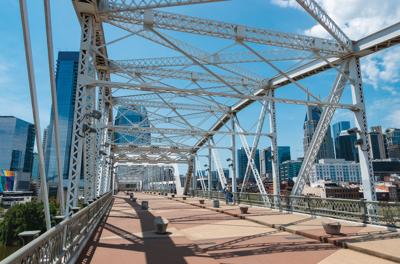
Though it’s been called several different names, the John Seigenthaler Pedestrian Bridge has been a part of Nashville for more than 100 years, and like many historic landmarks, it has gone through plenty of changes. Pretty soon, it’s going to change again. On Sept. 22, the East Bank Development Authority voted to allow a $75 million extension to the bridge, extending its eastern side to reach the new Nissan Stadium on the Cumberland River’s East Bank. As Scene columnist Betsy Phillips recently asked, could the substantial changes to the bridge’s structure proposed by the Tennessee Titans mean that it loses its place on the National Register of Historic Places?

With the Titans hoping to extend the 100-plus-year-old pedestrian bridge, here's a look at the structure's greater context
Beyond that, this update might feel like a typical case of development changing a landmark that characterizes the Nashville landscape. But that characterization is perhaps too reductive: The Seigenthaler Bridge has gone through many changes before, and its history is as complex and surprising as its neighborhood.
Originally called the Sparkman Bridge, the Seigenthaler Bridge was built between 1907 and 1909 by Foster-Creighton Company as a way of further connecting newly incorporated Edgefield to downtown. (It was built alongside a bridge that had been built decades prior in the location of what is now the Woodland Street Bridge.) According to its National Register application, the Sparkman Bridge was built by “inexperienced laborers, many of which were ex-convicts or parolees,” including people incarcerated in the Tennessee State Penitentiary. It was dangerous work: Four men died during construction; others suffered injuries. The city also used its location as an excuse to clear a slum called Black Bottom on its western side.
But why does the bridge have such historic value? Part of it comes from the style. The Seigenthaler Bridge is known for its use of Pratt trusses, a particular style of supportive beams that share the load of a structure in triangular formations — often used for railway bridges and pedestrian bridges. Though the Pratt truss style gave the bridge its historical significance, the structure’s load-bearing capacity was debated, and some city officials worried about its ability to carry cars. The bridge saw repairs in 1960 but closed in 1998 because of its poor condition.
But in the 1990s, an all-too-familiar scene was unfolding in downtown Nashville: fierce debate over public funding for the city’s new NFL stadium. Still, despite attempts by grassroots advocates to defeat the stadium by referendum, Adelphia Coliseum (which changed names a few times before becoming Nissan Stadium) was built for the newly relocated Tennessee (née Houston) Oilers. And once the stadium was built, the bridge was a convenient way to get people to it. So in 2003, it was refurbished and reopened to pedestrians.
From there, the Seigenthaler Bridge (then called the Shelby Street Bridge) had an eventful 20 years — thanks in large part to its proximity to an increasingly chaotic downtown. In 2004, horses from the music video for Big and Rich’s “Save a Horse, Ride a Cowboy” caused $23,000 of damage to the bridge’s pavement. More recently, police spotted two men — one in a gorilla suit and another in a Hawaiian shirt — crossing the bridge after physically assaulting a victim downtown and stealing his shoes. They were later arrested.
In 2014, the bridge was renamed in honor of journalist and civil rights advocate John Seigenthaler. In 1954, Seigenthaler saved a man named Gene Bradford Williams, who had threatened to jump off the bridge and wanted to speak to a journalist. When Seigenthaler saw that Williams was going to jump, he grabbed him by the collar and held him until reinforcements came to help. Seigenthaler told The Tennessean that Williams initially said, “I’ll never forgive you,” but later had a change of heart, writing from the hospital, “I owe you eternal gratitude for having saved me from the briny deep.”

Committee approves bridge extension and leans on Fallon Company to finish projects ahead of schedule
A similar incident made headlines in 2024 when Jon Bon Jovi helped persuade a woman to come off the ledge of the bridge to safety. At the time, the musician was shooting a music video there.
There are countless other moments the Seigenthaler Bridge has seen in its long, weird history, including a Dolly Parton music video and multiple weddings. In many ways, it exemplifies a story that’s told so many times in Nashville — a past that’s complicated and difficult, and a present that’s full of contradictions and surprises.
But historic landmark status aside, the Seigenthaler Bridge seems perfectly emblematic of Nashville’s character. The city is constantly redefining itself in unexpected ways. At the same time, it feels like city officials are grappling with the same political issues again and again — in this case, a weird rerun of a drawn-out scene from the 1990s.
This isn’t the first time our NFL team has changed the shape of this downtown landmark. It probably won’t be the last time, either.



Post a comment as anonymous
Report
Watch this discussion.
(0) comments
Welcome to the discussion.
Log In
Welcome to the discussion.
Keep it clean. Please avoid obscene, vulgar, lewd, racist or otherwise abusive language. Comments featuring hate speech or threatening or violent content will not be tolerated.
PLEASE TURN OFF YOUR CAPS LOCK.
Be truthful. Don't knowingly lie or mislead.
Be proactive. Use the “report” link on any comment that violates our comment policy.
Share with us. We'd love to hear your feedback.