
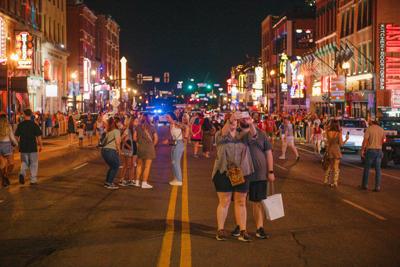

When explosive growth in the Nashville real estate market showed up in tax bills last year, the sticker shock hit like an earthquake. Entrepreneur Christian Paro says that, as of this week, he’s organized more than 400 business owners desperate for relief.
“ I would like to be at 500 by the time we go talk to [state House Speaker Cameron] Sexton or someone at the state who understands what we're going through,” Paro told a sympathetic room on Wednesday at Studio 615, one of his many East Side commercial properties. “It's basically like a gritty, grassroots little chamber of commerce we got going here.”
Paro says he’s been working as much as 20 hours a day since Jan. 1 on building the Nashville Property Tax Coalition. Davidson County assessed Paro’s properties at more than $20 million in the 2025 reappraisal cycle, saddling him with a six-figure tax bill that he failed to lower through the county appeals process. Paro now joins the lineage of backlash groups that blame the mayor's office and tax assessor for the steep reckoning that hits after each reappraisal cycle. Other efforts — advanced by groups like 4GoodGovernment, No Tax 4 Nash and Low Tax 4 Nash — sprang up to fight then-Mayor John Cooper after the last reappraisal hit in 2021. The campaigns’ disorganization backfired spectacularly, suffering a failed recall petition and a class action lawsuit for illegal robocalls.
Now, NPTC and another group, Nashville Neighbors United, are laying political groundwork for 2027, Nashville’s next round of municipal elections. While NPTC grounds itself in business owners’ concerns, NNU has laundered property tax concerns into larger, specious-politics saber-rattling against America’s “slide into socialism” championed, as they see it, by New York City Mayor Zohran Mamdani.
“Thankfully, Nashville is organizing and fighting back,” proclaims an NNU video from late last year. “In organizing, two things matter: time and space. Time: We have 21 months until the next Metro election. Space: We’re building the capacity, the talent, the resources and the message.”
While Paro’s coalition has built momentum, NNU’s bluster may have fizzled out. After collaborating on two videos highlighting property tax concerns at Arnold’s Country Kitchen and Mitchell Delicatessen, NNU has largely gone dark. Davis Hunt, one of NNU’s organizers, directed the Scene to Paro for comment.

House Speaker Cameron Sexton’s office confirms leaders are discussing possible session to address Broadway honky-tonk taxes
The state has already expressed sympathy for business owners’ plight. Sexton, who rarely misses a dig at Mayor Freddie O’Connell, floated a special session on the issue earlier this month. Other ideas endorsed by Paro include a separate local board to hear business appeals. This cycle, the Davidson County Board of Equalization’s 20,000 appeals have created a massive queue for owners wishing to argue why, and how, their valuation differs from the assessor’s. It’s big business in itself; Clint Westwood, who helps owners win appeals with The Aegis Group, was Paro’s featured guest at this week’s NPTC meeting. Westwood praised the local assessor’s office, explaining that they face an impossibly vast task and rely on broad market analytics in the “mass appraisal” process, inevitably leading to imperfect outcomes that can be debated.
“Property owners have the right to appeal their values, and we encourage property owners — residential and businesses — to appeal their value,” Davidson County Property Assessor Vivian Wilhoite tells the Scene. “We want them to share with us anything that we are not aware of about their property. No one here is interested in sticking it to them — if they show us why it should be adjusted, we show how we arrived at that value. If new information is provided, we adjust the value.”
Wilhoite redirects this year’s property tax debate to the Metro Council and Mayor O’Connell. Appraised value is only one piece of the equation.
Tennessee’s revenue-neutral property tax requirement, a rarity among U.S. states, tests any mayor who wants to realize increased values. Reappraisals tackle more than 280,000 parcels in Nashville with a broad brush, returning estimates that form the basis of the city’s ad valorem tax rate. The mass appraisal process puts the burden on the owner to dispute the resulting value. Massive spikes in commercial property sales since 2021 — particularly from prime Lower Broadway lots that have recently set price-per-square-foot records — have sharply driven up parcel values across the urban core.
“Revenue-neutral” means that, if property values increase, the state’s certified tax rate proportionally decreases to return the same total revenue to city coffers; after the 2025 reappraisal, the rate dropped from $3.254 to $2.22 for the urban services district (USD) per $100 of assessed value. (There is some variation for the general services district and between residential, commercial and industrial properties.) The mayor and the Metro Council must pass a rate increase for additional revenue — the city’s foundational income for basic government function. Following mayors in the past, O’Connell did this, adjusting the tax rate back up to $2.814 — well below the previous rate, the lowest this century and among the lowest urban tax rates in the nation.
Disclosure: Christian Paro owns Center 615, where the Scene leases office space.



Post a comment as anonymous
Report
Watch this discussion.
(0) comments
Welcome to the discussion.
Log In
Welcome to the discussion.
Keep it clean. Please avoid obscene, vulgar, lewd, racist or otherwise abusive language. Comments featuring hate speech or threatening or violent content will not be tolerated.
PLEASE TURN OFF YOUR CAPS LOCK.
Be truthful. Don't knowingly lie or mislead.
Be proactive. Use the “report” link on any comment that violates our comment policy.
Share with us. We'd love to hear your feedback.