
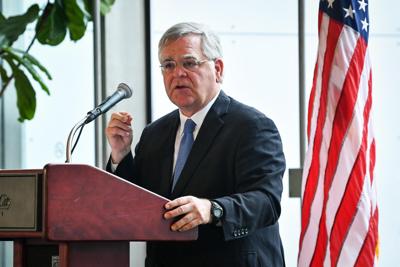

Mayor John Cooper will address the city tomorrow at the Southeast Community Center in Antioch. It’s the first time in more than a decade that the State of Metro will take place outside the downtown core.
The State of Metro is a chance for the city’s chief executive to tout accomplishments, address concerns, and lay out this year’s vision for Nashville. Its fiscal counterpart, the mayor’s budget, is expected later this week for debate ahead of Metro’s July 1 fiscal new year.
Cooper has been on defense since September 2019. Elected as the city’s fiscal conservator, he contended with natural disasters and COVID-19 the following spring, taking on an already reactionary stance with FY2021’s “crisis budget.” Austerity measures included a hiring freeze, departmental cuts and reduced capital spending. Cooper’s sharp property tax rate hike inspired a failed recall effort by dark-money libertarian opposition groups 4GoodGovernment, NoTax4Nash and LowTax4Nash.
A year ago, Cooper’s FY2022 budget looked like a bridge between managing a crisis to managing a city. He lowered the tax rate, made some progress replenishing the city’s depleted fund balances and delivered limited but overdue salary bumps for public school teachers. Meanwhile, federal CARES and ARP money has offered a way to patch holes in Metro departments, though a rickety allocation process has led to boondoggles like MNPD’s proposed spending spree on TASER devices and funds that appeared headed toward surveilling and clearing homeless encampments in West Nashville in November.
Wednesday morning, Cooper will have a chance to lay out an agenda no longer defined by short-term crisis response. A mysterious “restoration and resilience” line item in the fall’s capital spending plan put the East Bank on the public’s radar. It turned out to be $45 million for a new road between Spring Street and Woodland Street, the “signature boulevard” that would anchor one of the administration’s major projects, the redevelopment of the primarily industrial area around Nissan Stadium. Metro’s vision for the East Bank has come further into focus recently with talks about a new $2 billion home for the Titans and a potential $100 million bridge into Napier, mentioned last week in a grant application to the federal Department of Transportation. In that same capital spending plan, Cooper got $23 million to purchase and redesign 88 Hermitage, a controversial piece of property that Cooper opposed as a councilmember at $11 million.
Cooper’s proposed interstate cap of Jefferson Street, a project that has since been shelved, suggested the mayor’s interest in using infrastructure to redress areas of the city that have not historically been invested in. Last week, the Metro Council approved $46 million to purchase the Global Mall, formerly Hickory Hollow Mall, a huge site in Antioch that Metro aims to lease to Vanderbilt University Medical Center. It shares a parking lot with the Southeast Community Center, where Cooper will give the State of Metro. These ambitious real estate projects have defined the work of the mayor’s office over the past year and are starting to shape Cooper's legacy. Tomorrow is the mayor's chance to explain that focus to taxpayers without COVID, a tornado or the threat of a state takeover sucking up all the oxygen.
As a candidate, the mayor’s platform centered affordable housing, education and transportation, billing a neighborhood-level focus on the issues affecting Nashvillians inside and outside the urban core. Early in his term, Cooper expressed interest in guiding the city through the climate crisis. Serious efforts might include drastically rethinking the city's car-centric transportation infrastructure and lobbying the Tennessee Valley Authority, which generates Nashville's power with coal and natural gas, out of fossil fuel expansion. Watch for a return to some or all of these points tomorrow.
Amid a historic shortage of units and a Metro Homeless Impact Division that has churned through employees, Nashvillians will be looking for a path forward on housing. Cooper has the chance to win back credibility after a highly public gaffe in November, when his office appeared to be organizing tours of an encampment at Brookmeade Park, which soured many advocates on Metro’s outreach efforts.
When Cooper releases the budget later this week, readers will be able to compare it with the school board’s proposed budget, passed a couple of weeks ago. Many schools are understaffed and under-enrolled, with several facing closure in recent years. A bigger charter-school footprint has adversely affected public school enrollment, which in turn negatively affects funding and nudges schools towards closure, particularly in North Nashville. A new Bellevue high school was funded last year. This year’s budget focuses on pay increases across the staff, beyond just teachers, though much is up in the air for MNPS amid the state’s formula redraw.
Growing the city also means scaling the infrastructure that keeps it running. Requests from the fire department and emergency personnel indicate critical understaffing. Metro 911 dispatchers are handling more than double the recommended call load and need 40 more staffers, according to this year’s requests by department. Codes asked for 29 new employees to keep up with new construction, and the fire department put in a ticket for five more ambulances (each requiring personnel), more inspectors and basic equipment. Police requests topped $22 million, including $8.6 million to cover overtime and expenses related to staffing special events and the Entertainment District Initiative, outflows of downtown tourism.
Details about Metro’s fiscal wellbeing translate less easily into a speech, but the budget will clarify details around debt service and bond obligations. On Sunday, Councilmember At-Large Bob Mendes explained cracks in Metro’s financial cement largely a result of deals in which the city gives away future revenue to incentivize immediate development, like TIFs and PILOTs. There is still not a full picture of the debt Metro will issue to prepare the East Bank for development or to support the Titans stadium directly, perhaps the biggest potential example that looms in the near future. The pressure for a deal is mounting, though, as the state rubber-stamped $500 million for the stadium last week and FIFA prepares to choose 2026 World Cup host cities by early June.
In-person attendance is limited to media, councilmembers and invited guests, according to a mayor’s office press release. There has been some confusion about this last category, which seems to exclude the general public from attending in person without an invite. An invitation has floated around that includes an RSVP email address (mayorscheduling@nashville.gov) that has not been made public. As of this week, applicants who have emailed this address have both been accepted and turned away with little or no explanation. The Scene has confirmed that there will be in-person seating available to the general public, but the majority has already been allocated to invitees. Press staffer Brandon Marshall encouraged interested Nashvillians to watch on a streaming platform, like Metro Nashville Network.



Post a comment as anonymous
Report
Watch this discussion.
(0) comments
Welcome to the discussion.
Log In
Welcome to the discussion.
Keep it clean. Please avoid obscene, vulgar, lewd, racist or otherwise abusive language. Comments featuring hate speech or threatening or violent content will not be tolerated.
PLEASE TURN OFF YOUR CAPS LOCK.
Be truthful. Don't knowingly lie or mislead.
Be proactive. Use the “report” link on any comment that violates our comment policy.
Share with us. We'd love to hear your feedback.