
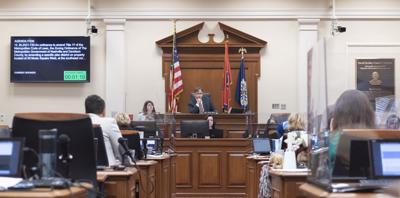

The COVID-19 Financial Oversight Committee — a nine-member group of Metro councilmembers and mayor-appointed community leaders established in 2020 — makes recommendations to the council regarding how federal relief dollars should be spent. Requests for funding must go through the committee before making their way to the council for final approval.
With hundreds of millions of dollars at stake, the committee wields immense power, and its work could ultimately shape Nashville’s future. But the process through which requests make their way to the committee for review may stymie the potential for truly transformative investments.
The committee’s origins date back to the receipt of roughly $121 million in CARES Act funds in early 2020. Councilmember At-Large Bob Mendes, the chief architect of the committee, says he wanted to set up a transparent process for determining how to spend federal relief funds that would generate buy-in from the community and the council. CARES Act funds had to be expended by December 2020, and by the time the money made it to Nashville, there were fewer than eight months left in the year.
Rarely is a city tasked with this type of rapid-fire deployment of such huge sums of funding, and Mendes thought establishing a solid process would ensure broad support for the expenditures. “For the first round,” Mendes says, referring to the CARES Act funding, “I think it worked. You can find low-grade griping about how the money got deployed, but we got $121 million deployed into the community in what turned out to be six months — from July to the end of the year — and by and large, no substantial controversy over how that happened.”
With the passage of the American Rescue Plan Act of 2021, and the hundreds of millions in additional funding coming to Nashville, the committee was reconvened. The process stayed the same, but differences in the CARES Act and ARPA led to some controversial recommendations and heightened scrutiny from councilmembers. One committee recommendation to use $6 million to purchase TASER weapons faced such public backlash that the administration abandoned it before it reached the council.
ARPA funds come with far fewer strings attached, opening the door to a wide variety of funding requests that wouldn’t have been allowable under the CARES Act. The timeline for expending ARPA funds is also elongated; local governments have until December 2024 to allocate the funds, and until December 2026 to spend them. And the anticipated total amount of ARPA funding for Nashville — roughly $260 million, to be disbursed in two equal tranches of funding — is more than twice what Nashville received through the CARES Act.
District 30 Councilmember Sandra Sepulveda says, “This amount of money cannot only be used to save lives, but to cause generational change.” Her focus is on community benefit, with an eye toward bolstering historically underserved communities. District 26 Councilmember Courtney Johnston is concerned with serving the community in a fiscally responsible way. “These dollars are a gift,” Johnston says, “and it’s incumbent upon us to make sure that we allocate in an impactful way that not only meets the current need but also leverages these dollars into the future.”
Councilmember Mendes thinks disputes over funding recommendations are largely a result of mission drift in the mayor’s office. “I think they started running it like it was purely their deal,” he says, “and somehow the committee members got themselves in a position of, I think, saying yes without enough critical thinking.”
With all the talk of generational change and leveraging funds for maximum impact, it’s unclear whether the requests that make it to the committee — and the recommendations that make it out of the committee — fit the bill. And the process for making those requests may exclude potentially transformative proposals from nongovernmental entities.
According to deputy finance director Mary Jo Wiggins, who staffs the committee, department heads make requests to the finance department, and the department filters those requests based on perceived urgency and alignment with administration priorities. There’s no formal application available for nonprofit organizations to request ARPA funds. Instead, those requests come through an informal network of contacts with Wiggins, councilmembers or the mayor’s office.
Since there is no clear overarching public strategy for appropriating ARPA funds — aside from a broad “guiding principles” document with a bulleted list of suggested priorities — some councilmembers have taken it upon themselves to try to direct the work of the committee. Councilmembers Kyonztè Toombs and Sharon Hurt recently filed a resolution requesting that the committee recommend a $70 million appropriation to the mayor’s office of economic and community development.
Toombs says that while she has “full faith” in the committee, “with so many requests coming in and the balance of the first half of our ARPA funds dwindling down, I wanted to make sure that small businesses were addressed, especially those in my district.” The resolution has since been withdrawn, after ECD received $20 million in ARPA funds for a small business recovery fund, but it signals a tension between the committee’s recommendations and the priorities of councilmembers and the communities they represent.
At a recent meeting of the committee, Wiggins reported that lawmakers in Congress were considering rescission of some ARPA funds as part of budget negotiations. While it appears that particular threat has been avoided — the proposed rescission was removed from the bill passed by the House — it does indicate that the second round of funding might be more tenuous than previously anticipated. Only $4.9 million remains from the first tranche of funding.
Asked if he would have pushed back harder on some funding requests — like $8.5 million for police vehicles — had he known the second round of ARPA funding might not come, Mendes responds: “Like in A Few Good Men, where she objected, and then she strenuously objected? Yeah, I would’ve strenuously objected.”



