
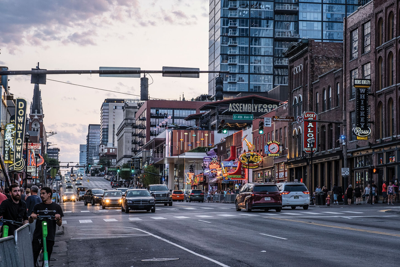

The Metro Council has once again delayed its vote on a plan to prohibit vehicles from turning right at red lights at certain intersections in Davidson County.
The council voted Tuesday to defer an ordinance (sponsored by Councilmember Sandra Sepulveda) to prohibit turning right on red lights at 59 designated intersections, many of which are located downtown.
Also as a part of the legislation, the Nashville Department of Transportation and Multimodal Infrastructure would continue studying more than 700 areas in which the policy could be implemented in the future. The ordinance would not apply to emergency vehicles.
The deferral comes after Councilmember Jacob Kupin — whose district includes many of the designated crossings — proposed an amendment to reduce the number of initial intersections from 59 to 18. The 18 intersections would be those at which multiple crashes between a pedestrian or cyclist and a motor vehicle have occurred, or a single crash between a pedestrian and a motor vehicle occurred, during a right turn since 2021, according to the amendment’s text.
“I think reducing that scope is something that's going to be important for the actual usage of this if we want this bill to be successful,” Kupin said during Tuesday's meeting.
Councilmembers widely opposed Kupin’s amendment as it had not been discussed or reviewed by any of the 40-member body's various committees beforehand.
“This went from a data-centered approach to looking solely at the crashes,” said Councilmember At-Large Delishia Porterfield. “I don't want to be reactive and solely look at where we've seen crashes. I would prefer that we are actually proactive to help save lives.”
After a motion from Councilmember Jason Spain, the council voted to defer the vote until the body’s Oct. 20 meeting, during which the ordinance will be considered on its second of three readings. In the meantime, it will be discussed within council committees.

Meanwhile, residents show up to protest Donelson ICE call center, and mayor’s small business incentives advance
The current version of the bill comes as a stripped-down version of the original legislation, which would have banned turning right on red throughout Nashville’s entire Urban Services District — an area that includes large swaths of Nashville’s pre-World War II-constructed core.
The bill follows concerns surrounding roadway safety, with advocates noting numerous pedestrian deaths that have occurred in the past year, including a fatal vehicle crash on Broadway Aug. 1.
“Something has to be done," Sepulveda said Tuesday. "This is very much low-hanging fruit."
Other residents have cited worries that restricting right turns at red lights could lead to increased traffic congestion.
In other business:
On its final of three readings, a set of incentives for small and longstanding businesses — proposed by Mayor Freddie O’Connell — was also approved by the council. These include the creation of a Legacy Business Program, available to businesses that have operated in the city for more than 15 years. The legislation also establishes a Workforce Advancement Incentive Program to provide grants of up to $10,000 to help small businesses recruit and retain employees and expands Metro’s Property Investment Incentive Program. The latter would update Metro’s current property investment initiative to include commercial buildings valued at up to $2 million, doubling the previous threshold. The expansion would also add interior building improvements to the program. Businesses would receive matching grants that reimburse 50 percent of construction or rehabilitation costs up to $50,000. This follows concerns raised by both the state and local businesses due to increasing property taxes in Nashville.
The council approved a purchasing agreement with Motorola Solutions for public safety software to be used by the Metro Department of Emergency Communications. The agreement passed 26-7 with one abstention following hefty debate from some councilmembers concerned the agreement would act as a form of unauthorized surveillance. Others also raised worries surrounding Motorola’s ties to U.S. Immigration and Customs Enforcement. Councilmembers also expressed frustration that the agreement did not come before the council until after it expired.
Nashville’s first infrastructure development district was also approved. The district will fund public infrastructure on the 57 acres that make up former Rivergate Mall property. The Industrial Development Board will issue bonds to pay for a portion of the infrastructure and be reimbursed through a special assessment on property owners within the district. The site is planned to be redeveloped into affordable and multifamily housing, restaurants, retail and office spaces, senior housing units, sports and entertainment facilities, as well as retail and office space.



Post a comment as anonymous
Report
Watch this discussion.
(0) comments
Welcome to the discussion.
Log In
Welcome to the discussion.
Keep it clean. Please avoid obscene, vulgar, lewd, racist or otherwise abusive language. Comments featuring hate speech or threatening or violent content will not be tolerated.
PLEASE TURN OFF YOUR CAPS LOCK.
Be truthful. Don't knowingly lie or mislead.
Be proactive. Use the “report” link on any comment that violates our comment policy.
Share with us. We'd love to hear your feedback.