
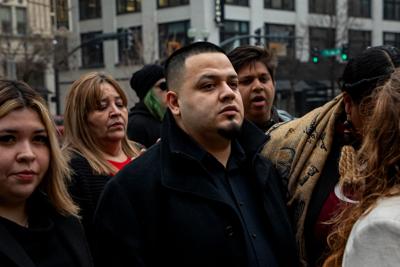

Almost a year after the Trump administration illegally deported him to El Salvador, Maryland man Kilmar Armando Abrego García returned to court in Nashville on Thursday, facing charges related to human smuggling.
The court held an evidentiary hearing Thursday morning that saw two key government witnesses — Homeland Security Investigations Special Agent Rana Saoud and former acting U.S. Attorney Rob McGuire — explain how the government reopened and internally elevated a case against Abrego related to a 2022 traffic stop outside Cookeville. Defense attorneys have asked the court to dismiss the case. They maintain that the charges, filed two-and-a-half years after the traffic stop, are retribution meant to justify missteps by the White House. The case has drawn significant national attention and many consider Abrego a political prisoner.

Federal prosecutors offer no direct evidence for charges against Kilmar Armando Abrego García
McGuire’s office previously charged Abrego, who is 29, with "conspiracy to unlawfully transport illegal aliens for financial gain" and "unlawful transportation of illegal aliens for financial gain" in May of last year, six weeks after he drew national attention when the Trump administration erroneously sent him to a maximum-security prison in El Salvador. Together the charges could amount to 20 years in jail and $500,000 in fines. A judge ruled last week that Abrego cannot be immediately redetained by ICE.
Abrego's defense, led Thursday on cross-examination by local attorney Rascoe Dean, pointed out that McGuire and Saoud both abruptly reopened a case against Abrego, which had never before been presented to the U.S. Attorney’s office, and treated the case with elevated significance, speed and importance. Neither government official recalled receiving a direct order from the White House or the U.S. Department of Justice, but both explained that the case’s media significance led them to fast-track — or even violate — typical protocols.
Saoud said she reopened the case in late April after receiving an article from conservative news publication The Tennessee Star about Abrego's traffic stop by the Tennessee Highway Patrol. Judge Waverly Crenshaw pushed Saoud to specify whether she received this from a friend or a co-worker, as the latter could be seen as influence exerted within the DHS.
“I would think it’s a co-worker, either a colleague or a friend,” Saoud told the judge. “Somebody I had worked with.”
Saoud immediately elevated the issue to national leadership against protocol in the Middle District of Tennessee, which advises agents to present immigration-related matters first to the district’s U.S. Attorney. Saoud testified that she was not aware of this protocol. She later called McGuire at his home on Sunday, April 27, about reopening the Abrego investigation. Saoud, routinely briefed on open cases as HSI’s special-agent-in-charge throughout Kentucky and Tennessee, had not previously seen Abrego’s case and learned about him through the media attention around his March deportation.
“We both agreed we needed to look into what this traffic stop was all about,” McGuire testified to prosecutors. “That we needed to look into this case and see what we’ve got.”
Aakash Singh, an associate deputy attorney general, emailed McGuire that evening. The two exchanged messages around 9:30 p.m., during which Singh sent McGuire a potential witness from another district. McGuire assured the deputy attorney general that he was “hammering as hard as we can on this effort.” The two met the following morning to discuss how to proceed with Abrego’s case.
McGuire also called Tennessee Highway Patrol Col. Matthew Perry to fast-track getting troopers’ body-cam footage from the 2022 stop. McGuire began drafting an indictment on April 29. By Wednesday, April 30, McGuire had the body-cam footage, a development he relayed to Singh in D.C. On Friday, May 2, Saoud formally reopened HSI's investigation into Abrego — though he was in custody at the time, Saoud felt that he qualified as a “public safety threat.”
McGuire continued discussing the case within the Department of Justice and filed charges on May 21. McGuire clarified that he made the decision to indict, not the White House. Abrego pleaded not guilty to all charges.
“I knew once we charged the case, it would be a big story,” McGuire said. “I wanted to make sure everyone in senior leadership had a heads-up.”
![Kilmar Abrego Garcia Released From Putnam County Jail [Updated]](https://bloximages.newyork1.vip.townnews.com/nashvillescene.com/content/tncms/assets/v3/editorial/a/5c/a5c98d5b-24b8-4424-b7bf-d3a1c14e790b/68a8cad48e252.image.jpg)
The Maryland man at the center of national media attention is heading to his home state
For the defense, Dean pointed out that another attorney in McGuire’s office, Ben Schrader, wrote a memo criticizing the government’s case against Abrego for human smuggling and advising against an indictment. Schrader resigned the day McGuire filed charges.
During McGuire’s cross-examination, defense attorneys emphasized the politicized climate within the Department of Justice. Several other abrupt firings related to political cases involving Trump and his allies occurred within the Department of Justice that spring. A DOJ memo issued by Attorney General Pam Bondi referred to the department as Trump’s lawyers.
“The way I understood the memorandum when I read it was that the elected leadership of the country sets the policy for the justice department and we are to follow the policy," McGuire testified. "That’s pretty consistent with the administrations I've served with before. At the end of the day, I got that the president and the AG set the policy for the department and we need to follow them.”
Aakash Singh, the associate deputy attorney general who collaborated with McGuire on this case, repeated this sentiment in January on an internal DOJ call.
Saoud spoke for about an hour while McGuire's testimony continued past noon. Abrego maintains his innocence.



Post a comment as anonymous
Report
Watch this discussion.
(0) comments
Welcome to the discussion.
Log In
Welcome to the discussion.
Keep it clean. Please avoid obscene, vulgar, lewd, racist or otherwise abusive language. Comments featuring hate speech or threatening or violent content will not be tolerated.
PLEASE TURN OFF YOUR CAPS LOCK.
Be truthful. Don't knowingly lie or mislead.
Be proactive. Use the “report” link on any comment that violates our comment policy.
Share with us. We'd love to hear your feedback.