

This story is a partnership between the Nashville Banner and the Nashville Scene. The Nashville Banner is a nonprofit, nonpartisan news organization focused on civic news. Visit nashvillebanner.com for more information.
A Nashville reporter who faced death threats in her home country could now be sent back by Immigration and Customs Enforcement.
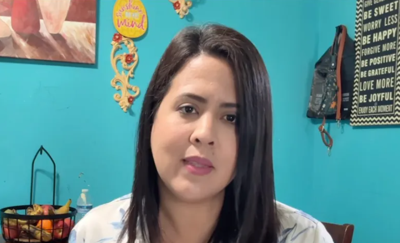
Nashville Noticias staffer Estefany Rodríguez was detained by ICE in South Nashville Wednesday morning. There was no warrant for her arrest. Her attorneys have filed an emergency petition in federal court seeking a writ of habeas corpus, or an immediate review of whether her detention is legal.
Rodríguez, who was in her car with her husband — a U.S. citizen — has been following all the legal steps to citizenship. In her job, Rodríguez has reported several stories holding ICE accountable, and it’s unclear whether her detention was retaliation. As of Thursday afternoon, she was in Alabama en route to an ICE processing center in Louisiana.
A citizen of Colombia, Rodríguez originally entered the country lawfully on a tourist visa in March 2021, then applied for political asylum. According to Joel Coxander, her immigration attorney, Rodríguez was forced to flee Colombia and seek asylum because of her work as a journalist. She covered armed and militant groups and had received threats, which Coxander has seen in the form of a text message. She also filed at least one police report before coming to the U.S. For the journalists’ safety, Coxander said, a lot of the publication’s articles have been scrubbed from existence.
The first time Rodríguez had any contact with ICE was Jan. 8, when she received a G-56 letter requesting that she come to the office for “processing and additional information” on Jan. 26. The letter also stated that she would be issued a Notice to Appear (NTA), an official charging document initiating an immigration court case. “Come in so you can help ensure the best outcome for your case,” the letter read. Coxander says this language is common across these types of letters.
“So ICE sends out these letters to citizens who’ve never had any contact with [them],” he says. “The letters just say, like, ‘Hey, please come by the ICE office.’”
“They’re invitations,” he emphasizes. “They don’t say they’re required. They say, ‘Come in so we can help ensure the best outcome for your case.’ They cite no legal requirement to come. And that’s because, for a lot of people, they have no connection to ICE, this isn’t connected with an application with USCIS — or at least it doesn’t say anything like that.”
“If you don’t want to delay the processing of your case and to help ensure the best outcome,” read the bottom of the letter, “IT IS VERY IMPORTANT that you make every effort to keep this appointment.”
Before Jan. 26, Rodríguez, her husband and Coxander compiled folders full of documents and prepared to attend the appointment. They planned to lay out arguments as to why ICE shouldn’t begin removal proceedings through the NTA or take her into custody. Then, on the agreed-upon date, Winter Storm Fern hit Nashville. ICE’s ERO office was closed.
On Feb. 10, Rodríguez received a letter with a makeup date for the appointment: Feb. 25.

Government witnesses say case was internally elevated at Thursday morning evidentiary hearing in downtown Nashville
Two days before the appointment, her husband and Caleb Mundy, an agent of Coxander’s, visited the ERO office. They were confirming, Coxander says, that Rodríguez actually had to show up. They wanted ICE to send the NTA directly to the attorneys.
“She’s not in the system,” the duty officer told them after running her Alien Registration Number. “This appointment’s not in the system.”
Mundy double-checked if Rodríguez needed to show up, and the duty officer said no. Another agent took a look at the case. Then they took her letter and gave her a check-in sheet stating that Rodríguez should return on March 17, when everything would be resolved.
'Trying to Follow the Rules'
On March 4, when she was stopped in her car, Rodríguez said she was shown an NTA rather than an arrest warrant.
Mundy showed up to the ICE office around 8:15 a.m. on March 4. He says the Supervisory Detention and Deportation Officer (SDDO) told him Rodríguez’s arrest was justified because she was considered a flight risk for missing two meetings.
The SDDO also said that Rodríguez hadn’t shown up in the system because she hadn’t had a previous interaction with ICE.
“She’s being told, ‘We’re holding it against you that you didn’t do this thing we told you you didn’t have to do,” says Coxander, emphasizing that Rodríguez didn’t show up to the first date because the ice storm closed the office and didn’t show up to the second because ICE told her not to. “They’re saying, ‘Hey, you didn’t show up to this invitation letter, so you’re a full flight risk.’”
“Joel had prepared a mountain of evidence” for the first hearing, Mundy says, in favor of Rodríguez being released on her own recognizance. “And we didn’t get to present it until she was already arrested.”
Because of myriad national statutes, regulations, subregulations and unpublished norms and operations at local field offices, best practices in immigration law are a moving target. Mundy says the Middle Tennessee Immigration Bar hadn’t seen G-56 letters until the past two or three months, but the SDDO told him they’d been more common in California when she worked there.
“We’re trying to sort out what all these things mean,” says Mundy, “and what advice to give our clients.”
Attorneys involved say immigration law is like an incredibly high-stakes form of the scientific method — because of a lack of guidance, a lawyer either screws up a case or guesses correctly. When something works — a document format or proceeding — the immigration bar shares with each other. When something goes horribly wrong, they do the same.
People who know her describe Rodríguez as smart, tough, brave and positive, even in the face of something like this.
“She’s not falling apart,” Coxander says.
“I think [positivity’s] a real skill as a reporter,” he adds, “given all the things you see.”
He says he’s always admired Rodríguez’s courage in continuing to report on ICE for Noticias, up close and personal, when she knew she was putting herself at serious risk.
“That’s pretty brave,” Coxander says, “because she understood the whole time that she could be at risk of getting picked up — not even as a reporter, just by physically being present.”
Coxander found it ridiculous that Rodríguez would be considered a flight risk and likely criminal.
“Her husband and attorney literally went to the ICE office two days before the appointment. Like, we’re not blowing it off. ... She is somebody that has been trying to follow the rules the whole time.”
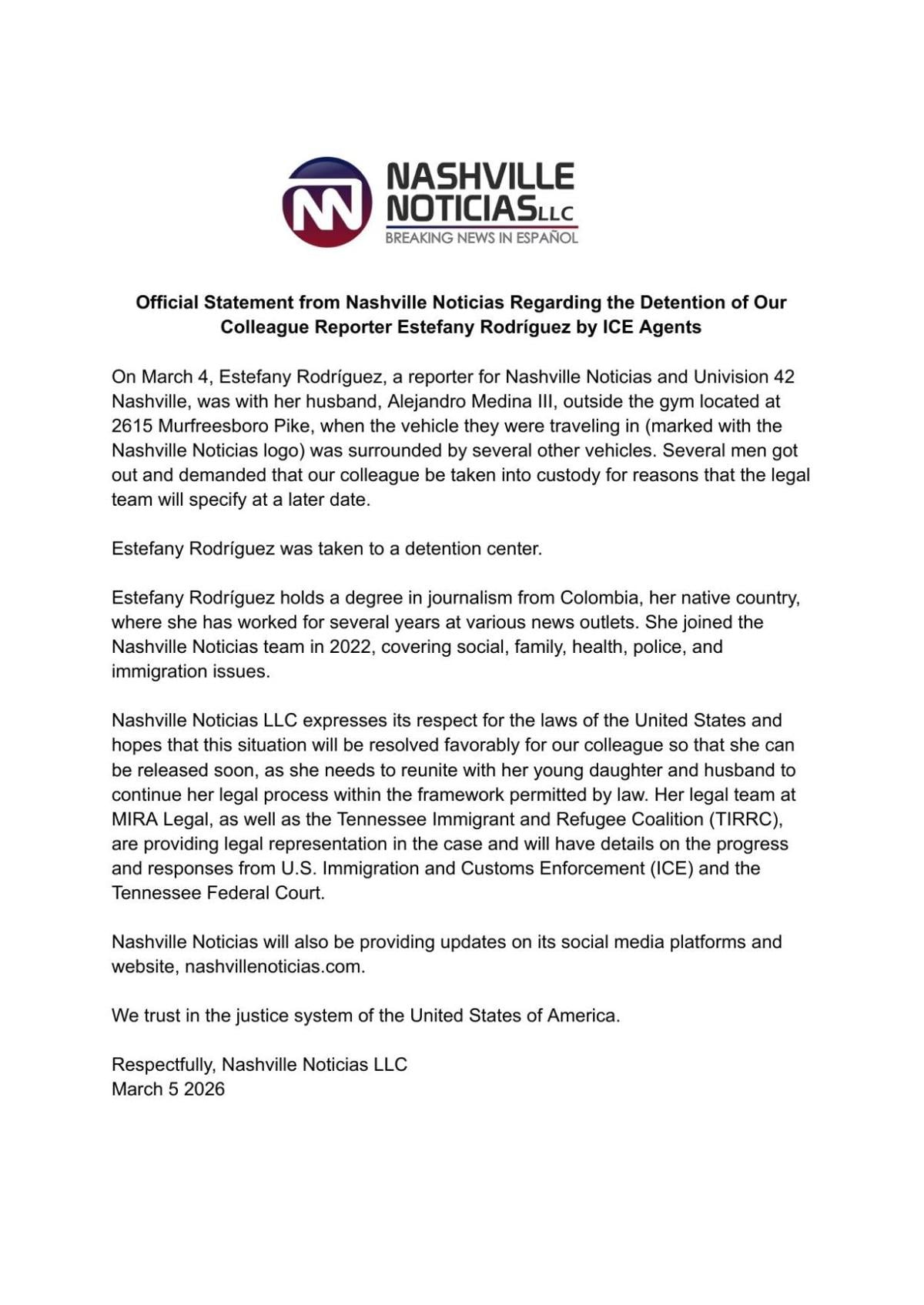
Nashville Noticias has offered the below statement on Rodríguez's detention:
This article first appeared on Nashville Banner and is republished here under a Creative Commons Attribution-NoDerivatives 4.0 International License.



Post a comment as anonymous
Report
Watch this discussion.
(0) comments
Welcome to the discussion.
Log In
Welcome to the discussion.
Keep it clean. Please avoid obscene, vulgar, lewd, racist or otherwise abusive language. Comments featuring hate speech or threatening or violent content will not be tolerated.
PLEASE TURN OFF YOUR CAPS LOCK.
Be truthful. Don't knowingly lie or mislead.
Be proactive. Use the “report” link on any comment that violates our comment policy.
Share with us. We'd love to hear your feedback.