
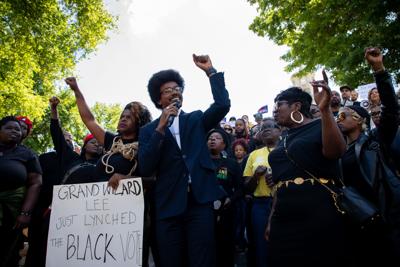

When Justin J. Pearson talks about his 6-month-old congressional campaign, convincing voters sounds like the easy part. It’s the other demands — constant travel, daily fundraising, missing his wife and dogs — that grind the 31-year-old state representative from Memphis.
“ I do six to eight hours of call time a day, hence why my voice is not as strong as you’re used to,” explains Pearson, speaking to the Scene in a conference room at the Cordell Hull State Office Building in downtown Nashville on July 23. “ The most important thing I remember is to put family first. No matter what happens with the campaign, my family will be there. The reason I'm fighting so hard, campaigning so hard, working so hard, raising money so hard, losing my voice so much is because I want the world that my family lives in, and hopefully my future kids live in, to be better than what I'm currently dealing with.”

Five U.S. House seats include or border Davidson County after state Republicans drew out Memphis’ majority-Black district in May
Pearson, making the most of a Midstate road trip from his West Tennessee home, has two events lined up after his interview with the Scene and more scheduled for the weekend. Minutes after we part, a campaign text arrives — it leads with a half-smiling Pearson in front of Memphis’ Hernando de Soto Bridge. He’ll be back in Nashville to headline voting access nonprofit Organize Tennessee’s summit on Aug. 29.
Pearson’s plan to win an upset in Tennessee’s 9th Congressional District, newly gerrymandered from a majority-Black safe Democratic seat, is simple and difficult: Be everywhere, do everything, talk to everybody, and appeal to every Tennessean with economic populism. After initially declaring against incumbent Democratic U.S. Rep. Steve Cohen in the old 9th, Pearson reoriented his campaign after a May special legislative session redrew the seat to favor Republicans and set up state Sen. Brent Taylor, a Republican who represents suburban Memphis. Cohen ultimately announced that he would not run for reelection. Taylor faces his own party challenge from affable state Rep. Todd Warner, a Republican who represents Chapel Hill and has gained ground in recent months. Pearson faces a primary challenge of his own from state Sen. London Lamar, a fellow Memphis legislator.
Pearson believes Democrats across the district — but especially around Memphis, Murfreesboro and Williamson County — will carry him in the primary and make his general election bid competitive. Trump’s unpopularity and Republicans’ MAGA core have alienated enough voters to suppress GOP turnout, he reckons, and Democrats are energized like never before. If Pearson wins — or even gets close — in the district, which connects the Memphis suburbs to Brentwood and voted for Trump by 21 points, Pearson might remake state politics in the process.
“ If you work for a check, you are a working-class person,” says Pearson, unspooling the core pillars of his political message. “I don't care how big you think that check is — you're one of us. We have to create a big tent, we have to mobilize, and we have to have working-class people realize the value of their labor, their personhood, and what they contribute to this world.”
A focus on nation-leading medical debt, soaring gas prices, grocery bills and a rigged economy helps Pearson connect with rural Republicans just as easily as the Memphians in his state House district.
“ We've been baited nationally and in our statehouse into culture wars — voters don't care about that,” says Pearson, citing interactions on the campaign trail. “Culture wars work when people aren't struggling every single day to make ends meet. We care about what people care about: costs being too high and the amount of money in their pocket being too low.”
His campaign leads with arguments favorable among Democrats, Republicans and the large group of voters who switch parties or don’t vote at all: fight resource-intense data centers, a fixture of Tennessee’s future; stop sitting lawmakers from enriching themselves in office, specifically by trading stocks on privileged information; and kick corporations and billionaire money from steering the political process via functionally unlimited election dollars. Finally, provide healthcare. The last point resonates strongly in his now-rural district, home to aging voters suffering under hospital closures and poor medical infrastructure.
“I don’t meet people who disagree with it,” Pearson says about guaranteed healthcare. “ We can have questions about how to pay for it — obviously by taxing billionaires and corporations and penalizing them if they offshore our jobs or if they replace our jobs with AI — but this is a broad-based movement that most people agree on.”

Longtime Memphis congressman no longer campaigning after GOP passes new map
Along with fellow state Reps. Justin Jones (D-Nashville) and Gloria Johnson (D-Knoxville), Pearson became a national figure three years ago when Republicans expelled him from the chamber following a floor protest against gun violence. That’s become an asset too, Pearson says, bolstering his reputation as a principled advocate for Democrats’ patchwork resistance in the Trump era.
“ The Republicans expelling us from the statehouse created a lot of exposure,” he says, moving quickly between campaign talking points, personal anecdotes and the high-level strategy guiding his campaign and his own political path. “The racist redistricting created a lot of exposure. It's going to be probably one of the closest elections in the country for a Democrat and a Republican. My age is absolutely a big advantage — I think people want new energy and new ideas for this moment, and I think most people are exhausted by the 80-year-olds who have run our country into the ground.”
Pearson points to the U.S. House and Senate — where the average lawmaker is 58 and 64, respectively — as physical examples of the country’s outdated and out-of-touch political elite. At the time of our interview, media speculated about Kentucky’s 84-year-old U.S. Sen. Mitch McConnell disappearing from the public eye in June following successive medical crises. “ Most people think he's dead, and I think he is dead, plugged in on a ventilator somewhere,” says Pearson, citing a source in D.C. politics.
Pearson has linked his campaign with the opposition party’s energetic left wing, scoring endorsements from U.S. Sen. Bernie Sanders and Rep. Alexandria Ocasio-Cortez en route to more than $2 million in fundraising without any corporate PAC money. He leads Democratic fundraising in Tennessee along with Chaz Molder — the staid Columbia mayor and 5th Congressional District candidate — who reported a campaign total of $2.5 million this month, about 10 times the money raised by gubernatorial candidate Jerri Green.
While infighting roils the state’s Democratic Party, Molder and Pearson are running strategic, professional operations spanning urban and rural Tennessee with distinctly different politics. Should both favorites prevail in their primaries, voters’ response in November could light Tennessee Democrats’ path.



Post a comment as anonymous
Report
Watch this discussion.
(0) comments
Welcome to the discussion.
Log In
Welcome to the discussion.
Keep it clean. Please avoid obscene, vulgar, lewd, racist or otherwise abusive language. Comments featuring hate speech or threatening or violent content will not be tolerated.
PLEASE TURN OFF YOUR CAPS LOCK.
Be truthful. Don't knowingly lie or mislead.
Be proactive. Use the “report” link on any comment that violates our comment policy.
Share with us. We'd love to hear your feedback.