
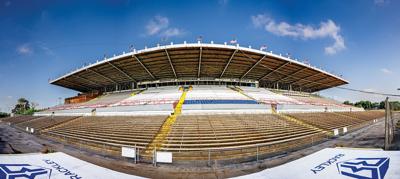

A coalition trying to reorient The Fairgrounds Nashville away from auto racing has 17 days to turn in about 41,000 signatures. Canvassers have inked “tens of thousands” so far, according to multiple people involved, while also provoking a public backlash and “Decline to Sign” countercampaign driven by racing supporters and consultants. The grueling back-and-forth has also produced multiple police reports, two court orders of protection, an ethics complaint against a Metro Nashville Public Schools board member and online vitriol across social media. Associated consultant fees, hourly canvasser rates and other campaign costs have also made this a pricey political indulgence.
Racetrack leasing negotiations have frozen under Mayor Freddie O’Connell, leaving wealthy interests to jockey on both sides of the issue. Many anti-racing consultants are tied to John Ingram and Nashville SC, which operates Geodis Park next door to the current racetrack, while NASCAR track operator Speedway Motorsports has long aimed to lease the Nashville Fairgrounds Speedway from the city.
After the pro-racing crowd amended the Metro Charter in 2011 to require auto racing there, the anti-racing crowd now hopes to eliminate that provision and add “affordable housing” requirements to the site’s mandated uses.
“We’ve had conversations with tens of thousands of Nashvillians who agree that we — not out-of-state racing interests — should decide the future of the fairgrounds,” reads a statement provided by attorney John Spragens, president of Citizens Against Racetrack Expansion (CARE). “Specifically whether it should be another pro sports deal or a community space for affordable housing, the restoration of Brown’s Creek, and other public amenities. We look forward to a public conversation and a vote so Nashvillians can make their voices heard next year.”

Neighbors, lobbyists, politicians and corporate interests duke it out over racing at the fairgrounds
So far this summer, CARE canvassers have been caught confusing or misrepresenting the campaign while gathering signatures, often casting the petition solely as a push for affordable housing. Personal interactions have escalated such that at least two canvassers secured legal protections from a judicial magistrate against an opposing activist, Kevin Wisniewski, who works for pro-NASCAR firm Calvert Street Group. In a statement on social media, Wisniewski called the lawfare a “desperate PR Stunt by PR hacks” relying on allegations that “will easily be proven false.” (Update: On Wednesday, a court dissolved both orders of protection against Wisniewski.)
Longtime racing opponent Heidi Basgall Favorite, representing Neighbors Against Track Expansion (NOTE), separately filed an ethics complaint against noted racing supporter and MNPS board member Zach Young on Aug. 13 alleging that his opposition amounts to bullying and harassment of recent MNPS graduates.
"The complaint speaks for itself for how outrageous it is,” Young tells the Scene. “People can disagree on the future of the fairgrounds — we can have a debate about that — but pulling in the school board is unnecessary, and this verges on being homophobic, as there is already an unhealthy narrative about gay men and students in this country. To then make an ethics complaint alleging I’m bullying or mistreating students is a disgusting way to go about achieving policy goals.”
Activist Drew Small, who became a leading social media voice against the proposed DC BLOX data center slated near the Nashville Zoo, has also apparently been drafted into the petition effort. Small has become the online face of anti-racing group Restore Our Fairgrounds, where he vamps for signatures and targets congressional candidate Darden Copeland and Calvert Street Group, both familiar targets of his ire for their past work promoting data centers.
“I’ve been pulled in as a social consultant, but I’m working on it because I care about it,” Small tells the Scene. “I can hear the racing at my house. It’s close enough that we’re within earshot. For me, I feel like there are a lot of things happening in Davidson County our tax dollars should be doing. Funding racing is not one of them.”
City money currently subsidizes the fairgrounds. Recently floated renovation contracts between the city and Speedway Motorsports rely on significant public spending to help fund renovations that would make the site NASCAR-ready.
While Councilmember Terry Vo, whose district includes the fairgrounds, supports the charter amendment to stop auto racing, state lawmakers have spoken out against overhauling Nashville’s auto racing facilities, including Democratic state Reps. Aftyn Behn and Bob Freeman. Behn equated the track's historic local significance to that of the Ryman Auditorium; Freeman, whose state House district also includes the fairgrounds, recently sent out texts slamming the petition effort as a “shameful” attempt to exploit voters’ support for affordable housing. (Disclosure: Freeman's family owns FW Publishing, which publishes the Nashville Scene, the Nashville Post, the Williamson Scene and Nfocus.)
Supporters say the petition will make way for a modernized fairgrounds that will clear a dilapidated facility in favor of updated park amenities and additional housing developments.
The summer-long effort to capture a requisite 10 percent of registered Davidson County voters will come due on Sept. 18, when the coalition of volunteers, canvassers-for-hire, attorneys and paid consultants owes its petition to the Davidson County Election Commission. If the group clears all necessary requirements, voters will see the charter amendment on the 2027 mayoral ballot. After months of legal arguments, the referendum’s official title reads longer than the accompanying summary.
Paid workers are still scouring local haunts like Shelby Bottoms and Centennial Park with sign-on clipboards asking registered voters to support:
Updating the Functions and Duties of the Metropolitan Board of Fair Commissioners ("Fair Board") by removing the term "Auto Racing" as an activity required to be conducted at the fairgrounds located in Davidson County and owned by the metropolitan government ("Fairgrounds") and replacing it with the term "Affordable housing and/or Workforce housing;" and requiring the Fair Board to implement plans to discontinue auto racing at the Fairgrounds.
This long sentence, cluttered with jargon and punctuation, is the certified language legally approved for voters and signees. Consultants, petitions, billionaires and promises aside, the saga has only just gotten started.



Post a comment as anonymous
Report
Watch this discussion.
(0) comments
Welcome to the discussion.
Log In
Welcome to the discussion.
Keep it clean. Please avoid obscene, vulgar, lewd, racist or otherwise abusive language. Comments featuring hate speech or threatening or violent content will not be tolerated.
PLEASE TURN OFF YOUR CAPS LOCK.
Be truthful. Don't knowingly lie or mislead.
Be proactive. Use the “report” link on any comment that violates our comment policy.
Share with us. We'd love to hear your feedback.