
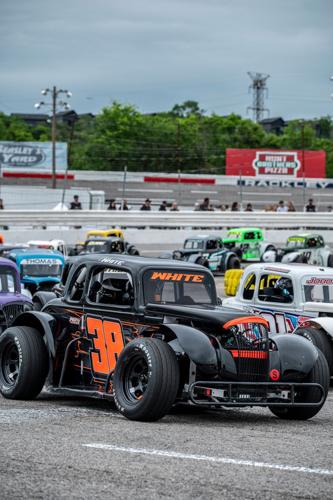

Tire stacks reflect in Tinsley Myers’ mirrored aviator sunglasses on a Thursday in April as she stands next to her pearl race car. Like Tinsley, the car is small but tough.
“We took a hard hit on the wall at Highland Rim yesterday,” says 10-year-old Tinsley, putting on a huge smile and pointing to some exterior damage. “It scratched the windshield up, took the whole door off, the brake line was pinched — my dad stayed up till 5 in the morning to get it ready to race here.”
She walked away with a jammed thumb.
The Myers family traveled up from Zephyrhills, Fla., 20 miles north of Tampa, for back-to-back races at Greenbrier’s Highland Rim Speedway and the Nashville Fairgrounds Speedway. Tinsley currently holds a top 10 ranking in the Bandit division — one of the younger racing age groups, along with Outlaws, Young Lions, Masters, Chargers, Semi-Pro and, finally, Pro. (Yes, some of the divisions are entirely reserved for racers not even old enough for a driver’s license.) On this particular weekend, the Fairgrounds Nashville is hosting the INEX Spring Nationals series.
“I’ve been racing since I was 2,” Tinsley tells the Scene. “I like the speed, I like everything about it.”
Though Tinsley has never raced in Nashville, her family knows the Nashville track by reputation.
“Back in the day, if you couldn’t win here, you weren’t gonna get anywhere,” adds Travis, her dad and mechanic. “This was the track to win to get recognized by owners and sponsors. Anyone who has ever been in the NASCAR Hall of Fame has raced here.”
The racing pit is packed with canvas tents, trailers, tool chests and prized cars. Each team assembles a mobile garage for last-minute tweaks and preparation. Earplugs litter the ground, and — everywhere — there are tires.
“ I like to watch Joey Logano and Kyle Busch, of course,” says Jagger Stone, 12, a mulleted stock car driver up from Texas for the race weekend. “ I’m trying to go to NASCAR one day.”
Racing has steadily declined in popularity since superstar drivers like Richard Petty, Jeff Gordon, Jimmie Johnson and Dale Earnhardt Jr. helped mainstream NASCAR in the 1990s and 2000s. Viewership is down and teams are losing money. Marcus Smith took Speedway Motorsports Inc. — the national track operator founded by his late father Bruton Smith — private in 2019 at $19 dollars a share, less than half of its highs from the late 1990s and mid-2000s. Once estimated at $1.5 billion, the Smith family fortune is directly tied to NASCAR’s financial viability.
Public tax disclosures just before Marcus took Speedway Motorsports private show an entertainment corporation trying to avoid a NASCAR tailspin by embracing profitable growth sectors like corporate events and track rentals, repurposing seating at existing facilities to squeeze the market’s higher end with luxury experiences for shrinking crowds.
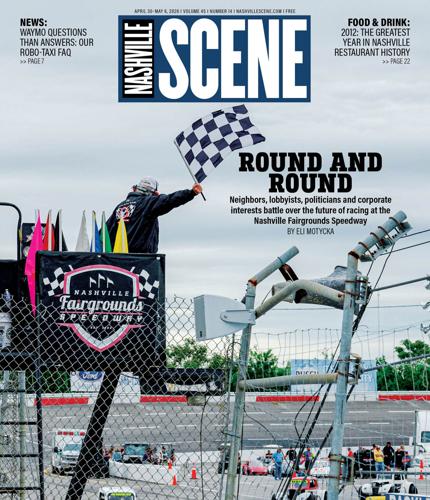
The Nashville Fairgrounds Speedway is a part of this NASCAR future. After NASCAR pulled Nashville’s Cup Series race in 1984, Speedway Motorsports — acting through wholly owned Tennessee subsidiary Bristol Motor Speedway — arrived almost 40 years later to broker a new deal. Since 2021, SMI has run the Cup Series’ Cracker Barrel 400 at the Nashville Superspeedway in rural Wilson County, but eyes Nashville as a crown-jewel site. A terms sheet presented to Metro Nashville’s Fair Commissioners Board in 2022 offered the most recent public glimpse at the plan, negotiated under former Mayor John Cooper in close coordination with Butch Spyridon at the Nashville Convention & Visitors Corp. The deal emphasized the site’s century-long history of spectacle racing (horses, then cars) and gave SMI about 80 race days a year, including one Cup Series race every other year. As with the city’s deal with the Tennessee Titans for a new stadium, Metro would issue revenue bonds to revamp the neglected grandstand and track with help from city and NCVC grants, combining for a sticker price north of $100 million.
The proposal stalled with fair commissioners for months, bogged down by public backlash and financial scrutiny. The staggering $2.1 billion shelled out for a new Titans stadium weighed heavily on the city’s psyche. Neighbors raised concerns about noise, parking and air pollution. Supporters tried, with some success, to revive the successful “Save Our Fairgrounds” coalition that enshrined fairgrounds auto racing in the Metro Charter 11 years earlier. Scheduling by the district’s term-limited Councilmember Colby Sledge punted the deal far enough into 2023 that it became a problem for the next council, forcing NASCAR to woo a new administration.
Billionaire resentment helped vault wonky downtown Councilmember Freddie O’Connell into the mayor’s office in September 2023. A new track deal has not formally surfaced since then, though at one point a Fox 17 article briefly linked to an outline provided by embattled Fair Board Commissioner Jasper Hendricks, who told media in August 2025 that the city could expect updated terms imminently. The outline, which soon disappeared from the public eye, shifted more financial obligations onto SMI, reduced bond liability for the city and better accommodated Nashville SC’s home of Geodis Park, the track’s formidable neighbor, owned by billionaire John Ingram. Each side points to different polling that alternately shows support for, and against, a NASCAR future. Labor union LiUNA supports renovations, which promise more and better paying jobs for another high-end tourist draw.
A carefully orchestrated response from NASCAR opponents — a broad umbrella of wary neighbors, environmentalists, citizen activists and paid consultants who enjoy backing from Ingram and Nashville SC — have since orchestrated a series of legal obstacles that threaten to kill a new lease before it materializes. An ethics complaint filed in September took aim at Hendricks’ close relationship with NASCAR and impeached his credibility as a key decision-maker for taxpayers. At the recommendation of Sledge’s successor, Councilmember Terry Vo, a new racing skeptic has joined the Fair Commissioners Board after an extended vacancy under O’Connell. The mayor’s office is mostly mum about the topic, saying recently that conversations with SMI are ongoing but not yet conclusive.

Former race car driver Neil Chaffin’s partial legal victory delays a looming charter referendum to ban fairgrounds auto racing
After a partially successful court challenge from retired race car driver Neil Chaffin, a new proposed referendum might soon ban auto racing altogether at the fairgrounds, functionally undoing the 2011 campaign. This existential threat has essentially frozen the NASCAR conversation until, pending signature collection, the issue goes to Davidson County voters, possibly as soon as Nov. 3. Chancellor Patricia Head Moskal dismissed several of Chaffin’s issues with the proposed amendment, but ruled on Friday that NASCAR opponents must change the proposal’s title — “Updating the Functions and Duties of the Metropolitan Board of Fair Commissioners (Fair Board)” — to more specifically describe the amendment as a racing ban on the ballot. Kopp and Solomon introduced a new title for the proposed amendment on Monday.
More than language will be on the ballot. Nashville has reliably embraced entertainment in all its forms, from the NFL Draft to the CMA Fest. With an audience skewing more conservative, whiter and male, NASCAR also presents questions about what kind of leisure the city hosts, for who, when, at what cost to taxpayers and — most critically — where. Classism can be heard from opponents who, at times, have referred to NASCAR fans as hillbillies and rednecks. Racing supporters often paint NASCAR’s diverse opposition simply as “soccer people” trying to elbow them out. Every race day, cars put on a thrilling and deafening show, while also spitting fumes into a densely populated neighborhood. Deferred maintenance has piled up, and dwindling crowds struggle to fill the fairgrounds’ poured-concrete grandstand. Humble residents and billionaire money sit on both sides. Though he might prefer that the whole situation just disappear, O’Connell — like Cooper and Karl Dean before him — must soon decide whether NASCAR fits into the city’s view of itself.
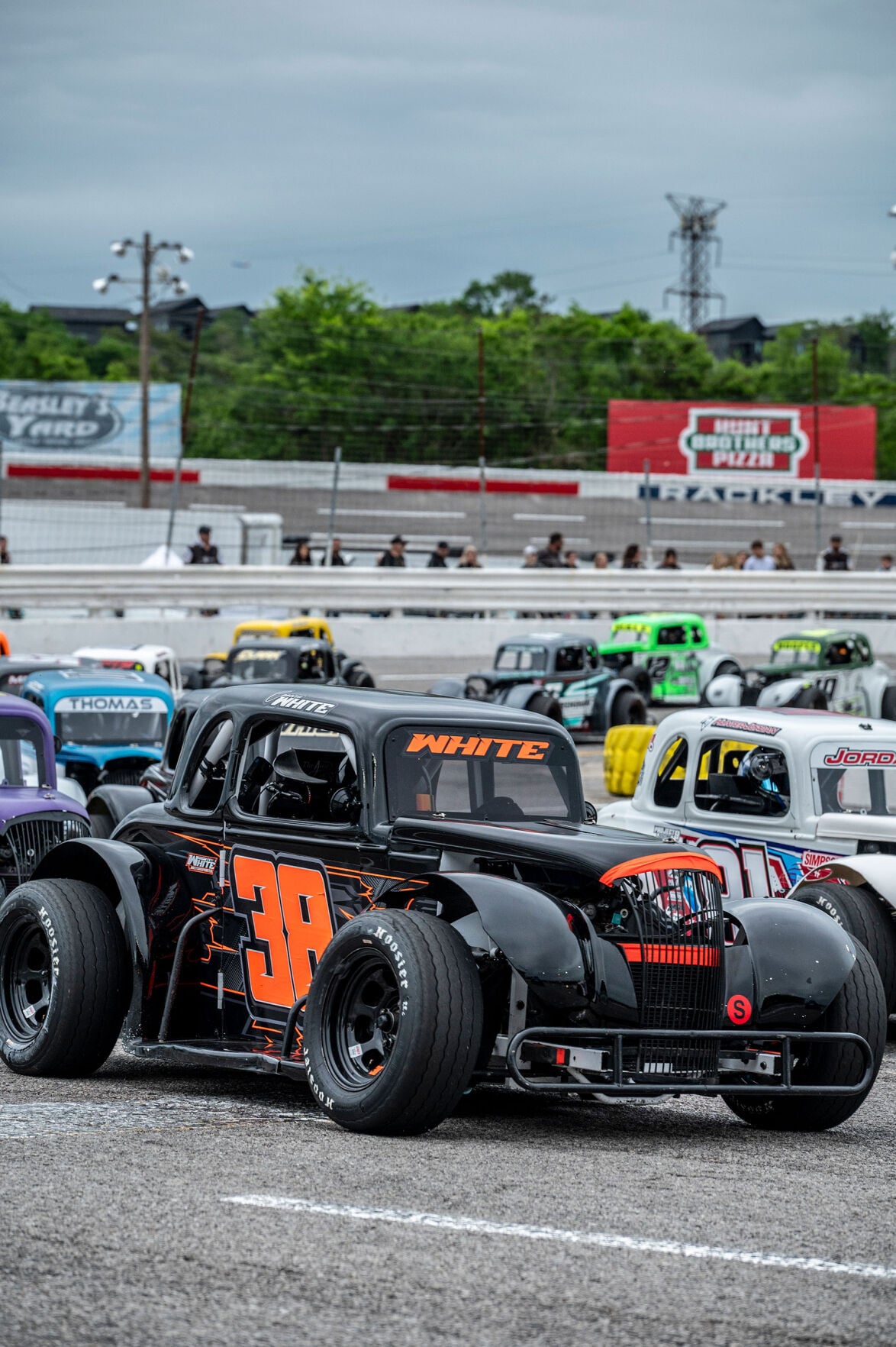
2026 INEX Spring Nationals at the Nashville Fairgrounds Speedway
Suddenly things began moving fast for Brittany Tabor. Returning from her honeymoon, Tabor saw texts from Councilmember Terry Vo and missed calls from the mayor’s office. Months after she submitted her application materials at Vo’s recommendation, the office wanted to know if Tabor was still interested in the vacant Fair Commissioners Board seat previously held by NASCAR critic Jason Bergeron before his resignation in 2022, when he cited strong-arm interference from Cooper. Sheri Weiner briefly filled the seat (and chaired the board) until she moved to the Metro Council in September 2023.
The board’s fifth spot remained empty for O’Connell’s first two years in office, during which time multiple candidates passed on the opportunity, according to the mayor’s office. Tabor quickly learned why. She was stepping into a drama several layers deep involving powerful people with a lot to gain.
“As soon as I stepped out of my subcommittee confirmation hearing, they were waiting in the hallway,” Tabor remembers. “Two guys immediately introduced themselves without any clarifying information. I thought they were fairgrounds employees who came to support me.”
The successful April 7 interview set up her formal confirmation at the next Metro Council meeting. The two men, Matthew Kuhn and Joseph Woodson, turned out to be NASCAR lobbyists; shortly following the hallway run-in, Tabor got a long voicemail from Kuhn, who said he had built a good relationship with the board’s other four members and fully expected her to sail through official confirmation.
“ I would love to get you up to speed,” Kuhn told Tabor on April 16.
Councilmembers confirmed her a few days later, finally restoring the board’s five-person roster. In many ways, Tabor is a model of the civic-minded resident required to staff the city’s hundred-plus volunteer boards and commissions. During her initial hearing, the pro-racing crowd flagged Tabor’s history as part of Stand Up Nashville’s “Sunshine Squad,” a coordinating group for people willing to give public comments about city issues. The economic justice nonprofit brokered a community benefits agreement with Nashville SC in 2018 and has been vocally anti-NASCAR for years.
“ I’ve volunteered maybe three times in the last 18 months,” Tabor explains. “It’s not paid, it’s just people who care about what’s going on in local government.”
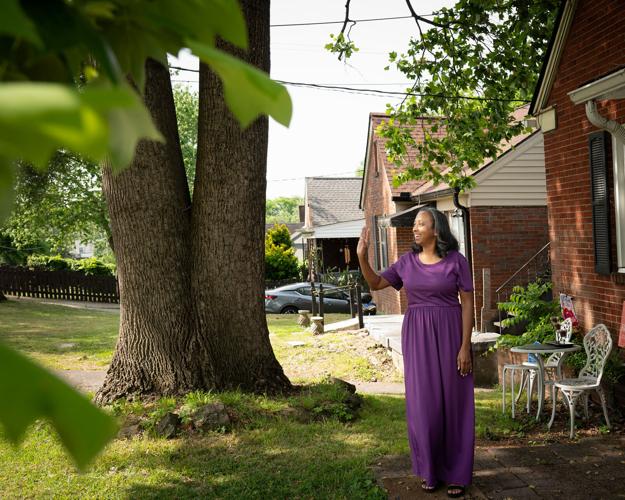
Tabor’s new Woodland-in-Waverly home sits about a mile from the track. After Tabor’s appointment, her neighbors began sharing their thoughts too. One woman across the street sent peer-reviewed studies about the harmful inhalation effects of brake dust. They brought up noise pollution, exhaust fumes, traffic worries and burned rubber particles pluming through the neighborhood. She says, for her vote, any proposal would have to seriously mitigate sound pollution and racing’s adverse environmental effects, and eliminate financial liability for taxpayers if NASCAR suddenly walks away.
“The wrong project could be this neighborhood’s problem and this district’s problem, but it could also be a Nashville problem,” Tabor says. “ The fairgrounds racetrack is super old, it’s falling apart, it needs repairs — something has to happen with it. What that will be depends on what kind of proposals we get and what happens with the charter amendment. As it stands right now, auto racing specifically has to happen at the fairgrounds.”
When a journalist needs information about this topic, most calls get answered by the third ring. Matthew Kuhn and Joseph Woodson are foot soldiers in the army of strategists, lobbyists and consultants billing hours on both sides of the issue. Kuhn works at Hall Strategies — one of Bristol Motor Speedway’s primary local firms, led by longtime media and government relations whiz and former Ingram Group partner Joe Hall. The track operator — owned wholly by Speedway Motorsports Inc. — also counts Woodson (a one-man show at Woodson Results), Nadira Freeman, Jerry Maynard, Maxwell Johnson and veteran lobbyist James Weaver as its registered representatives this year. While Weaver was chair of the Fair Commissioners Board in 2010 — before a NASCAR deal was a publicly discussed prospect — he supported shuttering the neglected track in a Tennessean op-ed. The public countered with the successful “Save Our Fairgrounds” referendum a year later.
Weaver is also registered for Bristol at the state legislature, alongside lobbyists Dustin Goforth and Nicole Osborne Watson. Bristol-friendly East Tennessee lawmakers have angled for a NASCAR deal in Nashville, and the legislature briefly pushed a law that would have lowered the required Metro Council voting threshold to pass a racing deal in 2023. (Courts later struck down the law, calling it a direct violation of Nashville’s home rule protections.)
Pro-racing conversations frequently spring from the 2011 referendum that put auto racing into the Metro Charter. They also helped launch Darden Copeland’s career in paid campaigns. Back then, Copeland, along with bulldog attorney Jamie Hollin, helped convert a true local groundswell of pro-racing support into a successful grassroots electoral effort that briefly redirected city politics under two-term Mayor Karl Dean. Copeland is still a passionate racing proponent working on a self-described “tiny retainer” toward a NASCAR deal. Copeland plainly points to Ingram — who hired Copeland in 2017 to help with soccer stadium negotiations — when referring to today’s multipronged anti-racing efforts, and places the next move squarely with Mayor O’Connell.
“It’s up to the mayor to move this deal along,” says Copeland. “You have to make a decision because you got elected, or you have to put John Ingram and Marcus Smith in a room together to work it out. If you can’t do either of those you should reconsider your upcoming reelection announcement.”
Hollin remains publicly supportive of a NASCAR deal but did not respond to the Scene’s requests for comment.

Board issues warning to Jasper Hendricks, recommends training and disclosure in racetrack case
While the racing camp doesn’t hesitate to name their out-of-state corporate client, racing opponents clam up when it’s time to follow the money. Conversations tend to lead back to Nashville SC and, by extension, controlling owner Ingram — not to mention U.S. Sen. Bill Hagerty, a minority investor in the team and the state’s junior senator since 2021. Some also name real estate magnate Joe Barker and MarketStreet Enterprises, which developed stadium-adjacent properties and is pursuing a major mixed-use play on Bransford Avenue. (Barker did not return the Scene’s request for comment.) Truly community-based opposition is important to campaigners, because the immediate neighbors around Wedgewood-Houston, Berry Hill, Chestnut Hill and Eighth Avenue would most directly feel the effects of a more active track.
“ I respect the people who do attend, and I’m glad they find entertainment in that, but these races are no longer heavily populated,” says Erica Lanier, an active race track critic who lives next to her elderly mother on Neal Terrace. “I always ask them, ‘Would you want this in your neighborhood?’ We want the same respect as wealthy neighborhoods. It’s a quality-of-life issue and a property value issue, especially for my two daughters, when we talk about preserving generational wealth.”
Lanier co-signed the ethics complaint filed last fall against Fair Commissioner Jasper Hendricks. Metro’s Board of Ethical Conduct forced Hendricks to detail his personal affinity for NASCAR and relationship with Michael Jordan’s 23XI Racing and Speedway Motorsports, including attending the NASCAR awards gala. Lanier identifies only as a concerned neighbor.

Erica Lanier outside her house
On a sunny Wednesday afternoon in mid-April, a galoshed Tucker Karnes directs volunteers around Browns Creek some 50 yards from the Fairgrounds Speedway walls. The waterway cleanup is one of several community events hosted by Citizens Against Racetrack Expansion (CARE), the legal entity that’s led organized opposition to a NASCAR deal since the Cooper push in 2023.
Beyond Karnes’ name, email and phone number, CARE’s only identifiable information leads to a P.O. box at the West End UPS Store. Karnes works for powerhouse PR firm Cooley Public Strategies, whose principal Dave Cooley set up shop after a career in city and state politics under Phil Bredesen. When the Scene asks about Cooley’s client, Karnes demurs, directing comments to Zach Hunt — another anti-racing consultant who is frequently tied to Ingram interests. Hunt’s firm, The Strategy Group, did confirm that Nashville SC is a client and offered the Scene a statement that reads, in part:
“We believe, and most Nashvillians concur, that the aging speedway site would be better utilized for affordable housing, green space, and cleaning up Brown’s Creek. Meanwhile, like many Nashvillians, we’ve been alarmed to see millions upon millions of dollars being spent by out-of-state special interests who seem intent on denying voters the opportunity to decide the future of the fairgrounds while creating an unbearable experience for neighbors. Our position is simple: We stand with neighbors and Nashvillians. Let the voters decide this matter.”
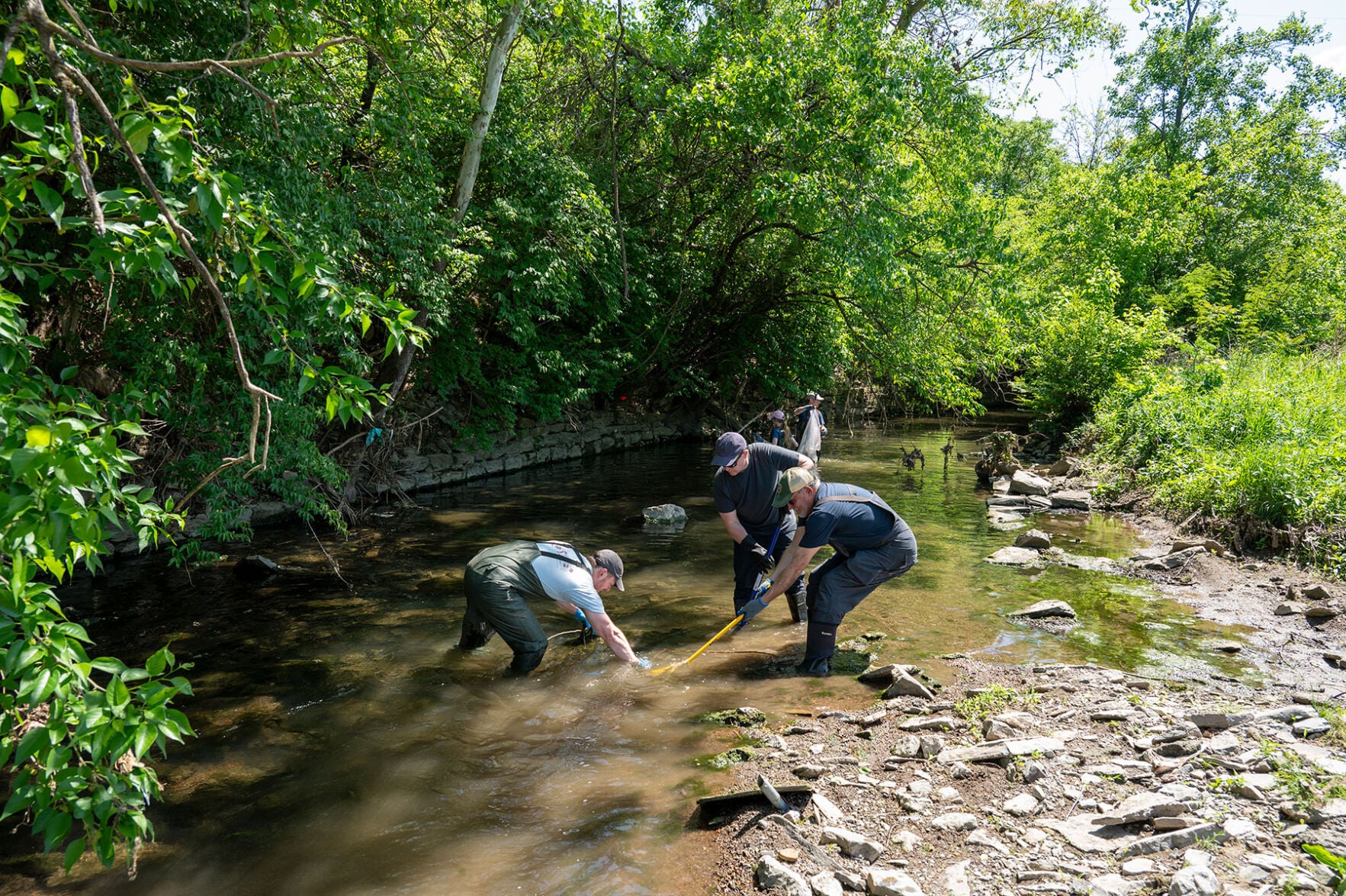
Browns Creek cleanup
Attorney (and former Scene writer) John Spragens helped guide the ethics complaint against Jasper Hendricks through Metro’s protracted bureaucratic process, and lived blocks from the fairgrounds for about a decade. When asked about his own compensation, he also declines to answer. Formal anti-racing paperwork includes other names like Music Row strategist Mike Kopp and Saul Solomon, a former Metro finance director. At the creek cleanup, former school board member and public affairs consultant Will Pinkston finds shade near a pickup truck full of trash.
“ I represented this part of town on the school board, and the fairgrounds has always been close to my heart — not because of auto racing, but because of what it has the potential to be,” Pinkston tells the Scene. “ The speedway outlived its useful life in 1984 when NASCAR abandoned the city. The fairgrounds used to be on the outskirts of town, and it’s now in the center of the city. Any rational person is gonna look at the racetrack and say, ‘Hmm, is it possible there’s a better use of 25 acres in the center of the city than NASCAR?’ And conclude, ‘Yes, a regional park, a transit hub, affordable housing.’ Something that makes sense.”
Pinkston says he’s doing the work purely as a concerned neighbor, uncompensated in any way. He encourages people to see past the billionaires on both sides; fundamentally it’s a question of public resources and public space.
Both teams use sports language to describe the ongoing power struggle over a few acres off Craighead Street. This consultant is “quarterback,” another is “point guard” — the NASCAR deal has already flooded the lobbyist and strategist world with enough money to sort the city’s top fixers, already a competitive bunch, into teams, pitting them against each other with pride (and bonuses) on the line. The winning side would be able to claim the ultimate victory: They know how to work corporate interests, public sentiment and two levels of government, and truly have a finger on the pulse of a rapidly changing city.
Opponents will score a major victory soon by shifting their campaign from negative to positive. Rather than blocking a NASCAR deal, they will soon have the opportunity to rally residents for something — a different vision for key central green space that has flourished with activity in recent years. A street grid upgrade and renovated convention center make the fairgrounds unrecognizably different from just 15 years ago. The towering Geodis Park regularly attracts thousands to bustling game days to watch a winning soccer team currently at the top of the MLS table. On a typical afternoon, residents walk dogs through the abutting greenway and meet for kickball at the park.
The paused charter amendment — still caught in procedural steps, likely headed back to the Charter Revision Commission for approval soon — has allowed O’Connell to sit on the sidelines and wait. A direct campaign also takes the racetrack decision from the Fair Board commissioners and Metro Council, giving it to voters. Intersecting elements of culture, sport, entertainment and demographics make the NASCAR question more than just a business deal: It’s a referendum on what is future and what is past.
Correction: A previous version of this article stated that SEIU supports speedway renovations, but the union has not yet voted on the matter. We apologize for the error.


Post a comment as anonymous
Report
Watch this discussion.
(0) comments
Welcome to the discussion.
Log In
Welcome to the discussion.
Keep it clean. Please avoid obscene, vulgar, lewd, racist or otherwise abusive language. Comments featuring hate speech or threatening or violent content will not be tolerated.
PLEASE TURN OFF YOUR CAPS LOCK.
Be truthful. Don't knowingly lie or mislead.
Be proactive. Use the “report” link on any comment that violates our comment policy.
Share with us. We'd love to hear your feedback.