
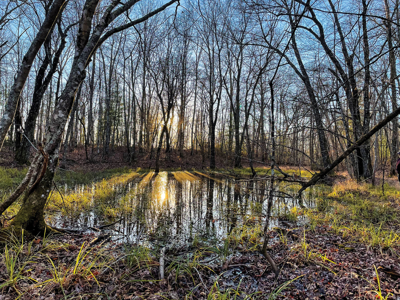


Soak Creek Farm
One of Nashville’s greatest assets is that open space is never too far away. It doesn’t take long to get from the evermore bustling center of the city to the by-God countryside. Drive five minutes west on River Road, say, or Whites Creek Pike, and it’s like being in the middle of nowhere.
And it’s not just on the fringes of the county. There are pockets of undeveloped land — sometimes even wild land — tucked close to the core. It’s why the geckering of foxes is a not-uncommon sound within sight of downtown, and why deer control much of East Nashville. It also goes a long way in explaining the persistent endemic sinus pressure.
It’s not easy to protect these wild places. As the old phrase goes, they’re not making any more land, and so developers lust after the shrinking inventory of open space, and money talks louder than overwhelming public sentiment — as has become apparent time and again in the decade of Nashville’s latest boom.
But money can also serve as an expression of sentiment, and that’s the space where conservation land trusts do their work.
Groups like TennGreen Land Conservancy and the Land Trust for Tennessee team with landowners to permanently protect environmentally significant or historically important sites — or sometimes, just nice natural places. Often this is done with conservation easements, an agreement between the owner and the trust that limits how the property can be used or subdivided. But sometimes, it takes more than that. Sometimes the trust buys the property outright, usually then transferring ownership to another entity — state or local governments, typically — for long-term management.
Facing long odds and deep pockets, land trusts have managed to save some prominent properties. The Land Trust for Tennessee helped acquire land along the boundary of Radnor Lake State Natural Area, for example, expanding the popular urban wilderness. It holds a conservation easement for Hill Forest in Bellevue, one of the largest urban forests in the country. TennGreen purchased the West Meade Waterfall, the headwaters of Richland Creek, and transferred ownership to Metro in 2013. In 2019, the Branstetter family donated the forested hillside near Bellevue Valley Shopping Center to TennGreen to preserve it (presumably) in perpetuity.
But it’s not always the largesse of the fabulously wealthy — and the Branstetter heirs are certainly that — that helps save these spaces. In Hendersonville, a 73-acre farm was in the developers’ sights. The Batey Farm is the last undeveloped space of any size on the eastern peninsula in the lakeside suburb, and supply and demand being what they are, it carried a price of more than $4 million. The City of Hendersonville was able to muster up enough to buy the lower 35 acres, but a local group — Friends of Indian Lake Peninsula — was left to raise the last $1 million for the adjacent 38-acre forested hillside. With TennGreen’s help, the group hit the mark in less than four months. More than 850 households — including from 11 other states — donated. More than 40 percent of the donations were $200 or less. Charmingly, more than $1,000 came from lemonade stands. Batey Farm is slated to become a city park.
Land saved by the trusts has a variety of uses. The Land Trust for Tennessee often simply preserves farmland, protecting it from subdivision. There are numerous parks and historic sites that have benefited from the trusts’ work. Hiking trails and land alongside the Natchez Trace Parkway are part of the bailiwick. The Park at Harlinsdale Farm in Franklin, which hosts the Pilgrimage Festival, is protected by the Land Trust’s work.
In March, TennGreen scored a massive coup for conservation and, at the same time, opened a new avenue in the land-trust game. Philanthropist George Lindemann, who in 2017 donated more than 1,000 acres to the state to establish the Soak Creek section of the Cumberland Trail in Rhea and Bledsoe counties, donated Soak Creek Farm — a tract of nearly 2,000 acres — to TennGreen.
Crisscrossed with more than 16 miles of streams, the tract is a mosaic habitat, including forested streams, grassland and open space and upland wooded areas. The trust and Lindemann announced that the long-term goal is to bar the area from development, except for a research station, partnering with colleges and universities for management.
Part of the work at the research station will be devoted to identifying medicinal plants in the area, providing another benefit to the public. The acquisition being so new, TennGreen isn’t even aware of what might be out there.
“We’re looking into a variety of beneficial plants for medicinal and conservation purposes,” says Carolyn Rehm, the group’s communications manager. “We’re still working through plans for what those specific species and management activities might be, while we learn more about what is present and suitable habitat on the property.”
Either way, it’s 2,000 more acres of largely untouched wilderness that can just be, all within a short drive of an ever-changing city.



