
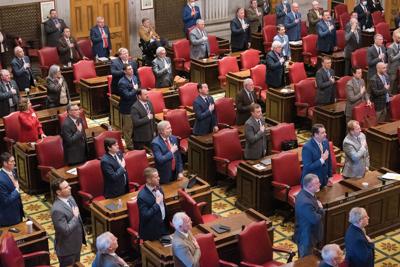

Evidence of the COVID-19 pandemic that has killed thousands of Tennesseans is scant at the state Capitol. The plastic barriers and rules limiting public access have gone. So too has most of the toxic debate over the disease and its effects on society that consumed the legislature for nearly two years.
Zombie hand sanitizer stations forgotten in stairwells, a few rogue mask wearers and Rep. David Byrd’s electric scooter — a remnant of the embattled Waynesboro Republican’s monthslong battle with the illness — are left to remind visitors. But with a new year comes new battles, and this year, the Tennessee General Assembly seems poised to pivot.
The biggest debate of the next few months will almost certainly center on Republican Gov. Bill Lee’s effort to rewrite the formula by which the state funds public education. (More on that here.) It’s an enormous undertaking, and one with a relatively short turnaround time, as lawmakers hurry to finish the legislative session and turn to their reelection campaigns. Given the challenges Lee and Republican leaders faced whipping even Republican votes on their Education Savings Account bill in 2019 — representing a tiny fraction of the money being considered as part of the wider formula rewrite — the governor and his allies could be setting out in choppy waters. But so far, all that’s been released is a high-level draft light on specifics, and even legislative leaders profess to have seen no more of the plan than that. Lee is scheduled to deliver his State of the State address, traditionally an opportunity for the executive to lay out his legislative plans in more detail, on Jan. 31.
“This is going to be a difficult journey, but it’s one where if everyone will pull together and genuinely grab a seat at the table, I think we can have a better way to do it than we have now,” says House Majority Leader William Lamberth (R-Portland). “There’s going to be differing opinions, and I’m not going to say that everybody’s going to be happy at the end of the day, because there’s very few bills that pass the legislature that everybody says, ‘Yes that’s perfect.’ But we hope to have a better solution to how we fund schools.”
Also on the agenda is, as always, criminal justice reform, however one chooses to define it. (More here.) Lamberth wants to establish “truth in sentencing” — a policy under which criminal sentences are standardized and not so subject to variability in the court and parole system. Tori Venable, state director for Americans for Prosperity, wants to end civil asset forfeiture in Tennessee.
It’s “highway robbery,” she says. Her group is planning to launch a “fund the police” campaign to counteract law enforcement complaints that ending civil asset forfeiture would hurt their bottom lines.
“I’m all for tools in the toolkit, except when it violates someone’s constitutional rights,” Venable says. “If the property they would take is evidence of a crime, they can still seize it as evidence. Where people really have heartburn about it is when someone has their property taken and they’re not charged with a crime.”
Democrats in the superminority will be on board for many of the reform efforts that make their way to the floor, according to Senate Democratic Caucus Chair Raumesh Akbari of Memphis.
“We’re trying to see if there’s low-hanging fruit that we can get some consensus with our Republican colleagues, and usually that has to do with fines and fees,” she says. “[Criminal justice reform] was a bipartisan issue, and the last couple of years it’s seemed to narrow a bit and become less of a bipartisan issue. Donald Trump leaned into criminal justice reform; that was the one thing he did that I agreed with him on. It’s very evident: Incarcerating people more does not produce less of a crime rate.”
Outside of education funding and criminal justice reform, lawmakers will continue working on Ford Motor Co.’s new campus in West Tennessee, where the state has promised hundreds of millions of dollars in infrastructure spending, among other incentives. They will also, as they have for several years running, take up a number of medical marijuana and other cannabis bills, including a likely doomed effort at full legalization.
Conservative group Beacon Impact is pushing an end to a so-called innovation tax, which came about as part of Trump’s tax bill, that forces companies to write off research and development costs over a five-year period instead of in the year the costs were incurred. Venable and AFP are pushing an end to the professional privilege tax and the enactment of a new requirement that local governments send postcards to constituents before they raise taxes — an effort triggered by Metro Nashville’s 2020 property tax increase that AFP unsuccessfully sought to overturn.
She isn’t confident that her Republican allies will take up the postcard legislation, though, because they may consider it an unfunded mandate on local governments.
“We don’t have high hopes for that one this year,” she says.
Lamberth says the bulk of lawmakers’ work will be focused on the budget, the education funding debate, criminal justice reform and lingering COVID-19 questions. (One proposal would codify rules allowing family members to visit patients in hospitals; another would penalize schools that close down due to COVID.)
Akbari is one of the leaders of the tiny Democratic caucus at the Capitol, and repeatedly losing is taking its toll, she says. The Memphis Democrat has a warmer outward relationship with Republican colleagues than many Democrats, but the drastic politicization of COVID-19 has hurt that relationship.
“I have always been able to find something that we can compromise on,” she says. “The pandemic is something that pushed me to think, ‘What am I really doing here?’ because it was so scary. I knew people — relatives, very close family friends — that passed away from it, and then you see this rhetoric that has politicized it, and that to me was really discouraging.
“Even though it’s hard, even though you lace up your shoes for fights you’re going to lose almost every day,” she continues, “sometimes you win, sometimes you lean into the third branch of government, the judicial branch, which kind of saves the day a lot of times. … They don’t need our votes, but at least we’ve been given some sort of seat at the table, and I’m hoping it will actually translate into policy that passes.”

With the legislative session underway, we look at where state lawmakers are taking redistricting, education, criminal justice reform and more



