
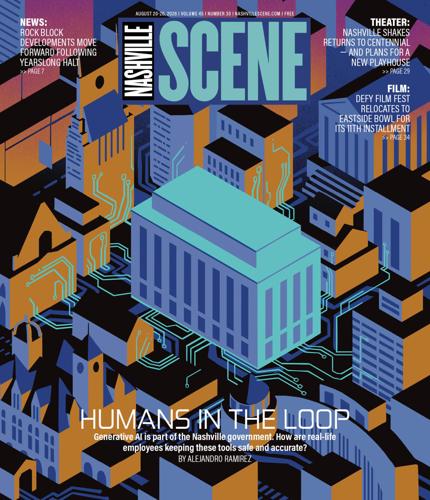





The mayor seemed hesitant to publish an artificial intelligence policy in 2024. Emails obtained by the Scene via public records request show staffers relaying Mayor Freddie O’Connell’s questions and concerns to Metro Information Technology Services (ITS). O’Connell, who has a background in software and IT, asked via a staffer how the city would respond if a chatbot started spewing “garbage” misinformation, which had just occurred in New York City. And could the city better explain the reason such a policy exists?
“Why do we think [it’s] ok to use AI?” reads the email from Kristin Wilson, the mayor’s chief of operations and performance. “Utility? And why do we think we need a policy — not just accepted use, intended use.”

John Griffey, chief information security officer of ITS, responded, emphasizing plans for ongoing reviews of AI platforms, pointing to similar policies established by cities like San Jose, Calif., and stressing the importance that a human remains part of the process.
Keith Durbin, the chief information officer, was blunter, calling the draft an “absolutely industry standard policy that was constructed alongside many other organizations as a starting point.” The policy could evolve later; another round of review would delay it by months. “We are covered only by guidelines with no real force at this point and this field is evolving incredibly rapidly.”
Per emails obtained by the Scene, Griffey established an AI working group in the fall of 2023. During the process, ITS amassed copies of studies and policies from other cities and private organizations, compiling a broad reading list on risks and best practices. Drafts of Metro’s policy were sent to an engineering professor at Vanderbilt and run by tech research firm Gartner. It seems ITS hoped to release the policy in March 2024, but Griffey and Durbin found themselves pleading with the mayor’s office on April 11 of that year to put something official in place.
It worked — the mayor’s office gave the green light, pending a few updates. Metro’s AI policy was posted online days later on April 15, 2024.
There have been some changes since the policy went live. Durbin retired in 2025. The AI policy was also updated and expanded on July 3, 2026, from a four-page document with five sections to an eight-page document with 10 sections. New sections include guidance on data classification, human reviews, assessment and public records retention.
One of the biggest examples of transparency was the release of a registry of AI tools used by Metro, which Griffey noted in past emails would be important for accountability. The list of tools contains 24 items as of July 1, 2026.
Generative AI — which IBM defines as a form of artificial intelligence that can create original content like text or images — has changed a lot in the past two years. Anthropic’s Claude Code threatens to upheave software engineering. AI chatbots and virtual assistants are being integrated into many software platforms. Chinese GenAI tools disrupted the market by offering cheaper alternatives, and AI companies’ demand for powerful memory chips has caused consumer electronics prices to skyrocket. (Gamers call it “RAMageddon.”)

Mayor O’Connell’s proposal to seize control of South Nashville property for Metro use advances, though condemnation is not final
Overall, generative AI — think advanced chatbots like ChatGPT or Claude — isn’t popular with the public. A March NBC poll found most people have an unfavorable view of the tech and don’t believe its risks are worth the benefits. And citizens of all demographics hate data centers, which are used to train AI. Reuters/Ipsos found Democrats and Republicans alike don’t support their construction.
Here in Nashville, citizens rallied around the Nashville Zoo in its fight against plans to build a data center next door, with the Metro Council approving bills regulating the development of these facilities. Even the mayor got in on the action, filing condemnation legislation to acquire the property by eminent domain, which would stop the center entirely. (The council has advanced that legislation as well.)
Data centers built for AI usage are especially taxing on local resources, with the worst offenders consuming as much electricity as 100,000 homes and millions of gallons of water, sometimes raising bills for neighbors. Elon Musk’s xAI facility in Memphis has polluted the air with unpermitted gas turbines, and data centers have been blamed for constant noise and increasing heat levels.
Despite all this, AI slop has taken over Nashville. Posters and logos made with image generators abound on social media and on business signs. The uncanny aesthetics, betrayed by cluttered imagery and fonts, bold outlines and strange “melted” appearance are ubiquitous. Less obvious to the public, though, is how much the Metro government uses AI.

View from the Nashville Zoo of a proposed data center site
“Generally, there is always risk in outsourcing human work to a tool that’s imperfect,” says Cat Moon, a professor at the Vanderbilt AI Law Lab (VAILL), which researches how AI could affect or benefit law schools and legal practices. “Humans are imperfect. AI is imperfect.”
Moon commends Metro for listing its inventory of AI tools, but she still has questions about how folks are being trained and how the quality of that training is evaluated. “What’s being done to assure that folks are actually using the tools within policy,” she asks, “and how’s that being measured?”

Cat Moon, Vanderbilt AI Law Lab
Moon says competent and safe AI usage relies on three “layers.” First is knowing and understanding how the tool works; second is knowing how to use the tools effectively and appropriately; and third is discernment.
Moon says the third point reflects the concept of what’s known as “human in the loop” accountability — making sure an actual person considers whether an AI tool is needed and reviews its output before making any decisions based on the result.
Moon notes that generative AI is a “prediction machine,” not a “fact-creating” or “fact-checking machine.” These tools operate by predicting outcomes based on patterns, not any deep well of knowledge. That’s also why these tools are prone to so-called “hallucinations” — mistakes and misinformation delivered in a confident voice.
And these mistakes can occur in high-stakes situations: Moon notes there are at least 1,500 documented cases of a lawyer or other party submitting a document to court that contains a hallucination. “If you just put the tool in the hands of someone who doesn’t get the benefit of any of the teaching and training, then that’s where things can go sideways.”
While AI raises unique concerns about data protection, Moon notes that laws and policies about private information existed before the proliferation of GenAI and should apply to any tool used by the government.
In a statement issued to the Scene, Metro ITS states the city is seeing “real productivity gains” thanks to automations created using Copilot, Microsoft’s AI assistant, though it doesn’t specify how much time was saved.
ITS also stresses that there’s a lot of upfront evaluation of tools. “Before adoption, every tool goes through our security and risk assessment process,” reads the statement. “That assessment asks specific questions in the area of utility — what does the project aim to achieve, how will it improve service delivery or make operations more efficient, how will the department check to see if the AI solution is making a positive difference, etc.”
The Scene obtained a copy of the assessment survey, which contains 31 questions that touch on topics like a tool’s access to data and how to identify mistakes.
The registry of AI tools is a set of rows that expand when you click on them, and close when you select another one, allowing you to see just one description at a time. Many of Metro’s 24 listed tools relate to image recognition and voice-to-text recording software. The public defender’s office uses JusticeText, for example, which creates transcriptions of body cam footage and provides tools to clip video and take notes. There’s even a platform called Angie, developed by Vanderbilt to train 911 dispatchers. Each item has a status, like “in use” or “pilot” or “under evaluation,” but sometimes they have multiple tags.

Talking with silkscreen printers and a tattoo artist about maintaining customers despite the rise of generative AI art
Some of the listed tools may be part of other products as well. The city has an enterprise agreement with Microsoft for a suite of tools — not just Copilot — for example.
The city doesn’t seem to be racing toward more powerful platforms just yet. According to Metro ITS, the entities that provide oversight of these tools and the ones that approve adoption are separate. “The team setting the guardrails isn’t the same team pushing for faster deployment,” reads the statement. “Those need to be independent of each other and they are.”
The Scene also received a trove of training materials and guidelines from 2024 — scattered across various PDFs and presentations — aimed at employees and vendors. One 10-page document lists examples of do’s and don’ts of prompting AI — like to avoid entering sensitive data into a third-party chatbot — and includes plenty of nuts-and-bolts descriptions of how the tech works and what the risks of its usage is.
The advice is consistent: give context, be clear, keep refining the prompt, and always review the output. Keep that “human in the loop.” The questions are whether those lessons are reaching workers, and whether the city is listening to employee feedback.
Meade Forsythe — an executive vice president of SEIU Local 205, the union representing Metro employees — says the current guidelines don’t do enough to protect workers or offer clear guidance on proper usage.
“The more clear and understandable the policy is, the more a worker can follow it in advance of some kind of disciplinary action,” they say. “We need to know the rules to be able to follow them.”
The expansive update in July was a “step in the right direction,” but Forsythe says the two-year gap between release and the update left workers hanging without a clear policy. Forsythe says it would also help for departments to list any specific AI rules they adopt.
Forsythe worries about employees becoming collateral damage when the city partners with tech entities. They point to widespread frustration over a payroll debacle caused by the Oracle platform adopted by the city — while AI reportedly wasn’t involved in the payment process, it was a tack-on feature to the system.
Overall, it sounds like city employees don’t fear these tools, but they’re also not excited. Union members haven’t complained to Forsythe about pressure from bosses to start using AI. They don’t sound worried about workforce replacement either — something that concerned employees in San Jose, considered the leading city in AI adoption. Forsythe says usage may vary not just by department (which range in employee size) but also by individual user.
Metro ITS’ statement says it’s continuing to “grow our AI literacy program,” training staff on appropriate usage, including where “data can and cannot go” and guidance on where the tools are most useful. “And we’ve reinforced a core message throughout,” reads the statement. “AI does not replace human critical thinking.”
The cover of the Metro Nashville Police Departmental Manual features an eagle in a cop’s uniform flexing a feathered, human-like arm. This cop-eagle is set against the backdrop of the Nashville skyline, illuminated by fireworks. The image seems to commemorate the USA’s 250th birthday. It’s also AI slop. And while that’s obvious to anyone who has ever seen a professional illustration or a child’s drawing, nowhere in the manual does it mention the aquiline officer was created using such a tool. This display of patriotism is low-stakes AI usage compared to something like license plate readers (which are powered by machine learning but have not been deployed in Nashville). But the dystopian Zootopia knockoff demonstrates how a government agency could produce something AI-generated in inappropriate places.

An AI image created for an MNPD manual
It’s hard to say how often generative AI tools are used. ITS says in its statement that the department is using AI to help build internal applications that meet Americans With Disabilities Act standards and assist its quality assurance team.
Since one document I received detailed instructions on how to archive GenAI prompts (even though it might not be legally required to retain these records), I decided to request those copies to gain some insight into what Metro’s AI usage looks like. I could have been more strategic, or at least anticipated that Metro ITS uses AI a lot.
While my attempts to obtain these prompts via records requests weren’t successful at first, they offer some insights. My first request, for nine months’ worth of prompts from ITS, returned an unwieldy 23,063 hits that wouldn’t be available until May 13, 2030. I didn’t get those prompts! But I did uncover an email that noted those results reflected Copilot alone. That sounds like a lot of usage from the 175-employee office.
A follow-up request on June 9 hit a snag — a new policy began on June 1 stating that archived prompts would be deleted after 10 days.
I sent yet another request, this time for 10 days’ worth of prompts from the mayor’s office, which has 48 employees according to Nashville’s data portal. I received 340 cumbersome HTML files. Since these were Copilot prompts, I asked that same chatbot to help me migrate them into a spreadsheet for easier navigation. After more troubleshooting than we need to describe, I combed through the prompts.
The results were mundane. No scandalous image generation (not even of the mayor as a buff eagle), no embarrassing personal questions, and no one appeared to be dating their chatbot. Most users asked for emails to be rewritten in a more “professional” tone and for summaries of notes and PDFs. Some used it like a search engine. Another was attempting to get some string of code to work. One user asked Copilot if an email sounded “too sassy.” (The chatbot didn’t think so.)
Some results seem to be individual pieces of longer conversations, and some seem to duplicate passages of longer sessions. Not all had dates, time stamps or information identifying the users. Copilot seemed most helpful for a grant writer, who used it for organizing timelines for applications, summarizing opportunities and, of course, preparing emails. They even asked Copilot for help designing a presentation on how to use AI in grant writing.
But a lot of the churn seemed to involve making Copilot rewrite something a Metro employee produced. Not much of the copy seemed to leave the mayor’s office, despite attempts to find it elsewhere. As with many of my experiences with AI, I spent a lot of time with it and don’t have that much to show.
Nashville’s approach to AI sounds slower than the dramatic upheaval corporate leaders predicted years ago. It’s not alone: Many cities are waiting for the technology to prove itself, per a study from liberal think tank New America.
“Local governments are taking their time to get to know AI, begin the process of incorporating it into daily routines, and start to think about more ambitious, potentially transformative uses,” reads the study. The municipal focus is often on productivity and automation. Which again reflects what Metro ITS shared in its statement.
“We’re not claiming org-wide transformation and we wouldn’t want to overstate what we can demonstrate right now,” says the statement from ITS. “What we can point to are specific areas where AI is producing real improvement under responsible governance.”
But as public and private entities often say, the AI landscape is always changing.




Post a comment as anonymous
Report
Watch this discussion.
(0) comments
Welcome to the discussion.
Log In
Welcome to the discussion.
Keep it clean. Please avoid obscene, vulgar, lewd, racist or otherwise abusive language. Comments featuring hate speech or threatening or violent content will not be tolerated.
PLEASE TURN OFF YOUR CAPS LOCK.
Be truthful. Don't knowingly lie or mislead.
Be proactive. Use the “report” link on any comment that violates our comment policy.
Share with us. We'd love to hear your feedback.