
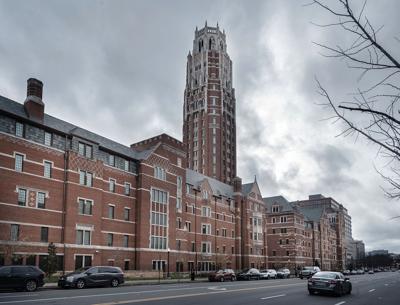

Street View is a monthly column taking a close look at development-related issues affecting different neighborhoods throughout the city.
Five years ago, Vanderbilt University introduced a new transit program, MoveVU. The program is designed to reduce the university’s impact on Nashville road congestion and promote more sustainable lifestyles for students and faculty. According to the MoveVU website, the initiative facilitates “a transformation in how the Vanderbilt community commutes to campus — one with less reliance on single occupancy vehicles and less demand for parking — by offering a ‘daily decision’ of travel mode choice.”
By Vanderbilt’s metrics, the choices worked. Spurred first by the pandemic and later by hybrid working lifestyles, staff and students started to commute differently, more frequently telecommuting, riding the bus, carpooling, riding bikes and walking. Between 2019 and 2023, Vanderbilt surveys report that the number of walking commutes rose from 6 percent to 15 percent. Meanwhile, the number of drivers dropped from 79 percent to 48 percent.
But to some people living in the neighborhoods near the university, things looked a little different.
David Anthony, a resident of the Hillsboro-Belmont neighborhood, has lived on Fairfax Avenue since 2009. “Fairfax has always been a busy street,” he says. But over the past few years, it has become “blanketed with cars.”
Anthony says the cars seem to belong mostly to Vanderbilt University Medical Center workers. He says nearly all of them drive alone, and he sees them walk to campus in their scrubs every morning. There are also some Vanderbilt professors who park on nearby streets.
“Vanderbilt is very proud of [MoveVU], and it sounds great,” says Anthony. “But as a resident of my neighborhood, I think they’re pushing people who are still addicted to car culture just simply to park in my neighborhood.”
While Anthony recognizes that living in “an affluent, high-foot-traffic area in the middle of town” is “a wonderful problem to have,” the parking situation near Vanderbilt does raise important questions. Is the university’s transit strategy working? And as an institution with a roughly $10 billion endowment and an expanding portfolio of Nashville real estate, what is Vanderbilt’s responsibility to its neighbors?
In an email to the Scene, a representative for Vanderbilt University says that if students are parking in nearby neighborhoods, they “should not log a sustainable transportation trip” in Vanderbilt’s system that incentivizes sustainable travel. The representative pointed out some other corrective measures, like oversight methods in their city garages to correct for trips that are logged as sustainable travel but are actually majority driving. They also say the Nashville Department of Transportation “has engaged Vanderbilt on new enforcement strategies to mitigate unpermitted parking in adjacent neighborhoods.” But in neighborhoods like David Anthony’s, many of the streets have free, unpermitted parking — in which case, there isn’t too much the university can do.

The prominent university grows every year — and that’s affecting housing, parking, diversity and more in its neighborhoods
When the Scene last covered Vanderbilt’s campus expansion in 2022, Metro Councilmembers Colby Sledge (District 17) and Burkley Allen (at large) both noted that parking was a persistent community issue. The Metro Council was debating eliminating parking minimums at the time, and Sledge told the Scene that “the impact of Vanderbilt and VUMC’s professors, students and staff parking throughout the surrounding neighborhoods came up time and time again.” Allen said at the time that some employees were “unwilling to pay the relatively high cost of [university] parking when there’s free parking in the neighborhood, in their eyes.”
Vanderbilt’s campus is sizable and rapidly growing. When the Scene reported on the university’s growth in 2022, the campus was 330 acres. Now Vanderbilt’s website lists the campus’s total acreage as 340.7.
Vanderbilt representatives did not respond to the Scene’s question about how much they have spent on property in the past two years. But we do know that in October, the school spent $66.9 million buying West End properties home to Ted’s Montana Grill, Chipotle and other businesses. In 2019, they spent $103 million on other properties. In 2022, they spent $3.8 million on another building in West End. The university has also recently acquired a $46 million property for a satellite business school campus in West Palm Beach, Fla., and leased a new campus in New York.
While Vanderbilt is a significant presence in Nashville, much of its land is tax-exempt. Some advocates have suggested this policy should change nationwide. Anthony says he sometimes jokes that “Vanderbilt is a capital investment firm with a college attached to it.”
A representative for the university tells the Scene they’re taking additional steps to promote sustainable travel, including giving students and staff free passes to the WeGo bus system. They’re also “ensuring incoming students have information on transportation options and how to use the WeGo system, meeting with faculty and staff to discuss commute options, and exploring new technology and parking systems to provide more flexibility for the range of commute needs.”
Mayor Freddie O’Connell’s transit referendum — which passed by a 2-to-1 margin during last month’s election — is set to expand the range of transit options available in Nashville and decrease reliance on cars. Vanderbilt’s representative tells the Scene that West End is set for improvements including increased service frequency, smarter signals, more connected sidewalks and safety improvements. Additionally, a new local transit center “will help riders connect easier between Green Hills and North Nashville.” These changes aim to make it easier to get to campus.
But the MoveVU initiative — and the people potentially exploiting its loopholes — brings up important questions as Nashville starts to implement more connected transit options. If better transit is available, will people use it? And what exactly is keeping people commuting alone in their cars when they have other options?
Anderson supports the transit plan, but he tells the Scene that he’ll probably still see the same VUMC nurse park his large truck outside their house every weekday morning. Anderson’s prediction? He says that as the transit plan improves congestion, “the cars that are parked on my street who aren’t allowed to park on Vanderbilt’s campus will simply get there in a more orderly fashion.”



Post a comment as anonymous
Report
Watch this discussion.
(0) comments
Welcome to the discussion.
Log In
Welcome to the discussion.
Keep it clean. Please avoid obscene, vulgar, lewd, racist or otherwise abusive language. Comments featuring hate speech or threatening or violent content will not be tolerated.
PLEASE TURN OFF YOUR CAPS LOCK.
Be truthful. Don't knowingly lie or mislead.
Be proactive. Use the “report” link on any comment that violates our comment policy.
Share with us. We'd love to hear your feedback.