


Street View is a monthly column in which we’ll take a close look at development-related issues affecting different neighborhoods throughout the city.
Vanderbilt University’s 330-acre campus grows every year. The university has a new tower, a West End Transformation Project, and new offices, dorms and parking lots. The school also owns a number of buildings that host local businesses. And according to Metro Nashville Planning Department data, the university has acquired 58 properties since 2002.
Despite its expansion, Vanderbilt faces many of the same issues as the rest of the city: housing availability, transportation and increased cost of living for its students. The school has also approached these issues in significant ways.
Through the 20th century, Vanderbilt had an often tense relationship with its neighbors. In 1965, the university bought 501 parcels of real estate through eminent domain. The university razed more houses in “urban renewal” areas between the 1960s and 1990s despite vocal opposition from advocates like Fannie Mae Dees, who protested with “large hand-painted signs on her porch and a coffin in her yard,” according to J. Hunter Moore’s account in the historic guidebook I’ll Take You There. Overall, urban renewal disproportionately impacted non-white residents. Moore points out that “while many Black neighborhoods were completely bulldozed during the urban renewal years, the fact that [Hillsboro-West End] was a predominantly white neighborhood likely helped to curtail demolition efforts.”
These days, Vanderbilt’s approach to community engagement has evolved. Scott Troxel, president of neighborhood group Belmont-Hillsboro Neighbors, remembers a “bruised” relationship between the university and its neighbors when he moved to the area in the 1980s. But he says Vanderbilt worked to gain back community trust.
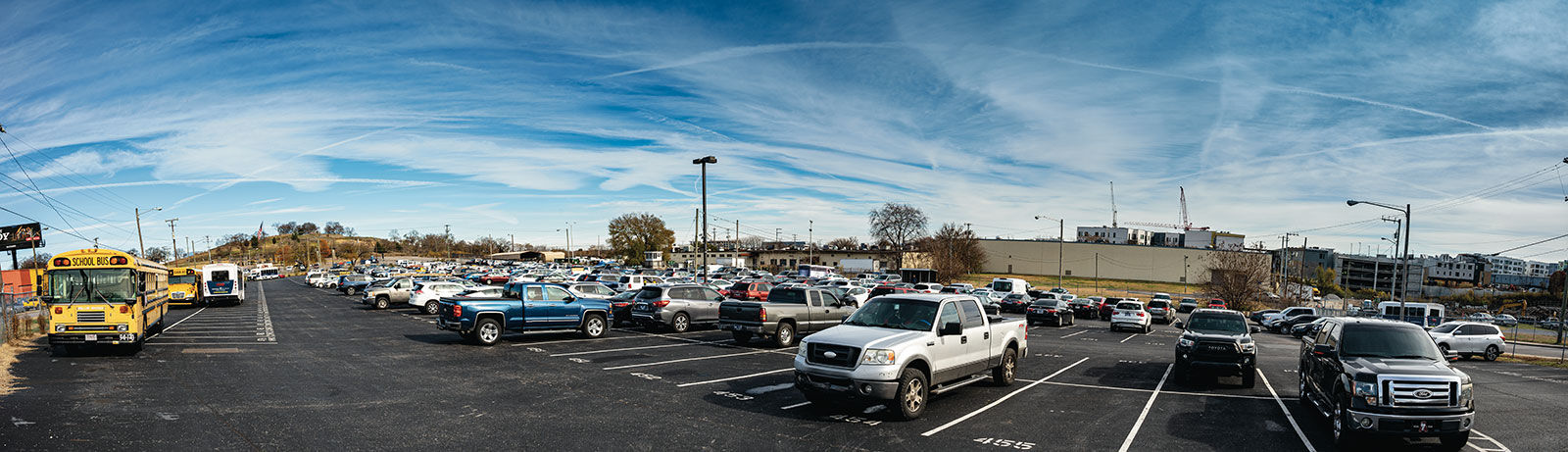
Vanderbilt Parking lot in Wedgewood-Houston
“They’ve done a good job about being proactive, and coming to the neighborhood about things that they were doing, or wanted to do,” says Troxel. “Trying to repair that relationship so that we would see them as partners.”
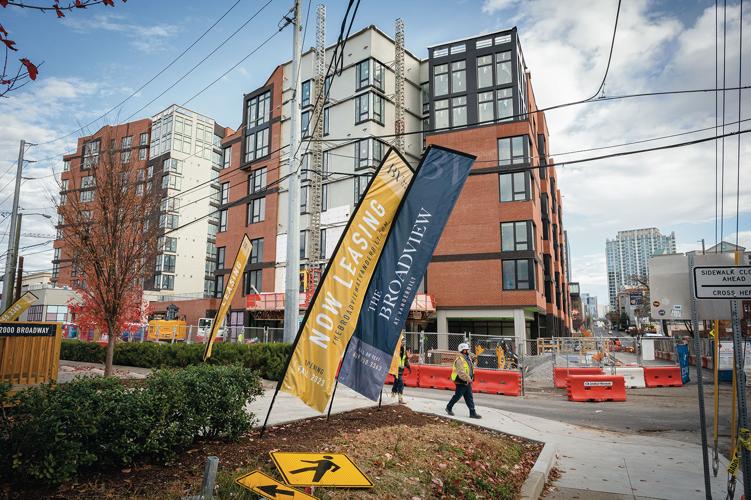
A representative from Vanderbilt University responded to the Scene’s community impact questions by pointing to a number of initiatives, including the school’s investment in Centennial Park conservancy, green infrastructure projects like Vandy’s partnership with a solar farm in Bell Buckle, Tenn., and their new graduate housing The Broadview. University reps say The Broadview “will include a Turnip Truck and 8th and Roast, both local businesses that will add much needed amenities for the entirety of Midtown” and will “enable 616 graduate and professional students to live adjacent to campus, thereby reducing or eliminating their commutes, reducing traffic on roads and alleviating pressure on Nashville housing stock.” Last year, NewsChannel 5 reported that graduate students have raised questions about The Broadview’s affordability; the university responded that its apartments are below market rates.
While initiatives designed to ease housing and traffic pressure can cause positive change, they can’t always keep up with growth. “During council’s recent debate over eliminating parking minimums — which Vanderbilt supported as an institution, and whose support I appreciated — the impact of Vanderbilt and VUMC’s professors, students and staff parking throughout the surrounding neighborhoods came up time and again,” says District 17 Metro Councilmember Colby Sledge.
“I’m sure Vanderbilt intuitively understands that everything they do has a ripple effect around their physical footprint,” Sledge continues. “But I don’t feel like I’ve had an open dialogue with them for several years regarding both the size of those impacts and the ways we can work toward better solutions.”
At-Large Councilmember Burkley Allen echoes the parking concerns while noting that Vanderbilt has “been on the forefront of pushing multimodal transportation, encouraging their employees to ride the bus, and making their campus more pedestrian and bike friendly.” Allen says that while Vanderbilt has been “supportive of residential parking,” some employees are “unwilling to pay the relatively high cost of [university] parking when there’s free parking in the neighborhood, in their eyes.”
Sledge says inefficient land use is an issue — especially, for instance, when it comes to the parking lot adjacent to Vanderbilt’s printing facility in Wedgewood-Houston.
“They pile broken office equipment and furniture onto surface parking lots that are surrounded by new private housing developments,” says Sledge. “They’re sitting on extremely valuable land for our city’s housing needs — and that impacts Vanderbilt’s own staff, who are increasingly being priced out of the areas closest to their jobs. I’d much rather see Vanderbilt and [Vanderbilt University Medical Center] staff live in housing on that parking lot, instead of using it as a park-and-ride they commute to, because they can’t afford to live closer to their Vanderbilt and VUMC jobs.”
Increased housing prices have made it difficult for staff and graduate students to live close to campus. “The area is highly sought-after because it’s a great location, and that tends to limit to a certain socio-economic strata,” says Allen. “Stratosphere, I should say. Which is definitely detrimental to diversity.”
Troxel also notes the decreasing diversity in the area. “When I first moved into Belmont-Hillsboro, it was one of the most racially diverse neighborhoods in the country,” he says. “Belmont-Hillsboro Neighbors prided themselves on really working towards keeping that diversity.”
Troxel says “economic and redevelopment forces” beyond just Vanderbilt have reduced diversity, which has impacted the neighborhood association’s role. “There’s a concern that we shift from being progressive to being NIMBY,” he says. “So much money has been invested into Belmont-Hillsboro by individuals on their own properties. The easiest path is for people to say, ‘We’ve got to protect what we’ve invested.’ Even if that means leaving the progressive ideas and values that existed in the past.”
Sledge believes that as a large property stakeholder, Vanderbilt should pay property taxes or have a PILOT agreement with the Metro government similar to the Music City Center’s.
“We heavily rely on property taxes for our annual operating budget, so when that land does not produce any revenue for the city, we as Nashville residents pay for it,” says Sledge. “Through a lack of transit improvements, less affordable housing and fewer parks and public spaces for all of us to enjoy.”
Either way, the university expansion seems inevitable. Allen has seen the boundary between Vanderbilt and the surrounding neighborhoods move every year.
“It was nice when there was a bright-red line down 31st/Blakemore and we sort of went, ‘They stopped there, and we know they’re not coming,’ ” she says. “Now there’s no obvious stopping point. So I think that makes it all the more important to keep the cards on the table as much as we can.”



Post a comment as anonymous
Report
Watch this discussion.
(0) comments
Welcome to the discussion.
Log In
Welcome to the discussion.
Keep it clean. Please avoid obscene, vulgar, lewd, racist or otherwise abusive language. Comments featuring hate speech or threatening or violent content will not be tolerated.
PLEASE TURN OFF YOUR CAPS LOCK.
Be truthful. Don't knowingly lie or mislead.
Be proactive. Use the “report” link on any comment that violates our comment policy.
Share with us. We'd love to hear your feedback.