
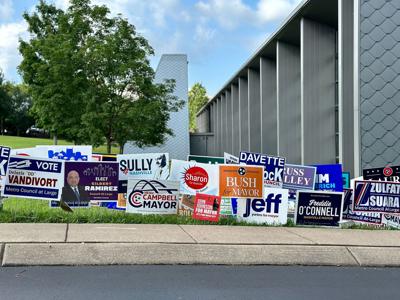

The mayoral runoff has become a tradition in Nashville politics. Fundraising starts again from zero, and candidates get six weeks of extra campaign time. In the general election, candidates don’t have to win a majority or even anything close to it — just a big enough chunk to survive. Then the top two vote-getters from the general make a sprint to the finish. Multiple polls show a huge chunk of undecided voters and no candidate with a clear advantage.
“There will be nothing left in our bank account on Aug. 4,” says Freddie O’Connell, the second-term Metro councilmember who got into the mayor’s race more than a year ago.
A wonky computer engineer, O’Connell seems to enjoy explaining the city’s bureaucratic machinery. He has been saying the same things on the campaign trail since April 2022, when he launched what was then an outsider’s attack against a well-funded incumbent, Mayor John Cooper — who in January of this year announced he wouldn’t seek reelection. O’Connell’s campaign has emphasized support for transit and opposition to big handouts — namely the stadium deal for the Tennessee Titans — a shadow jab at his main competition, former city executive Matt Wiltshire.
Wiltshire has cornered support among the more growth-minded downtown business class, and holds a substantial fundraising advantage. Wiltshire can speak Metro too. Less-defined politics — the left calls him a Republican, Alice Rolli reminds voters that he’s a Democrat — have enabled Wiltshire to cobble together a broad base of support similar to Cooper’s in 2019. While Wiltshire’s bank account remains strong, a recent poll by the Tennessee Laborers’ PAC puts him in fourth place.
Republican Rolli, a former aide to Gov. Bill Haslam, could also have a path to the top two: peel off support from Wiltshire’s right flank and consolidate the city’s conservative minority. AllianceBernstein executive Jim Gingrich dropped out last week after putting up $2 million of his own money. Despite blasting out TV spots emphasizing his executive experience and vowing to soothe Nashville’s growing pains, Gingrich, who moved here with the company in 2018, was branded by opponents as an out-of-touch out-of-towner. Because Gingrich exited the race after early voting had already begun, his name will remain on the ballot through Election Day.
Democratic state Sens. Heidi Campbell and Jeff Yarbro have become second choices. Both rode strong county name ID to favorable spots in early polling. Both had established fundraising networks that could quickly furnish a local campaign. For Campbell, who flipped a state Senate seat by knocking off Nashville RINO Steve Dickerson in 2020 but lost a congressional race to Andy Ogles in 2022, it would be the second major election loss in nine months. For Yarbro, a loss would be a misstep in a political career he has obvious hopes of extending. The electoral math has been confusing — both split support among their colleagues in the state Democratic caucus and split votes in overlapping demographics in Davidson County. Each has struggled to communicate a distinct vision for the city, perhaps hoping that voters will check the box next to a name they’ve seen before. Working long days at the hyper-conservative state Capitol is full of legislative stone walls and pointless floor speeches — both want a win. As numbers look better for O’Connell and Wiltshire, their paths to a runoff look less and less likely, though Yarbro has a fundraising advantage in the campaign’s final stretch.
“It’s a crapshoot at the moment,” says Campbell’s campaign manager, Cyrus Shick. “You have a lot of people undecided, and a lot of people know Heidi. We see races like this change all the time. There have been many more polls done than have been released — connect the dots on why that might be.”
Shick’s point is the undercurrent of the entire race: No one is ahead. No one knows who is ahead. No one thinks they’re ahead, and no one wants to say they’re ahead. Firms out of D.C. have been calling the city constantly, charging $20,000 or so per poll, returning results that no one wants to share. Another recent poll came from Harpeth Strategies, a local outfit run by District 35 Councilmember Dave Rosenberg — an O’Connell supporter — with uneven samples and a shocking 5-point lead for O’Connell at 20 percent. Wiltshire came in second at 15 percent, with Rolli at 13 percent.
After a week, early voting topped 20,000, about a fifth of the total expected turnout. Signs point to a substantial number of undecided voters. Everyone will be surprised on Election Day.



