
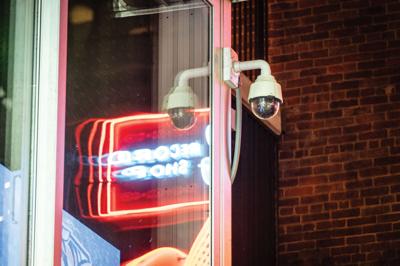


Camera on Broadway
Street View is a monthly column taking a close look at development-related issues affecting different neighborhoods throughout the city.
On Jan. 20, the Metro Council voted on a number of proposed safety enhancements for downtown Nashville. Presented as part of a $15 million state grant, the items included an armored vehicle, a “mobile command post,” a “tactical support post” and upgraded security cameras donated to the Metro Nashville Police Department.
The council ultimately accepted all the items except for the security cameras, with multiple councilmembers noting the potential for cameras to become a tool for U.S. Immigration and Customs Enforcement. But the debate over the grant funding has also raised important underlying questions. Whose safety is being prioritized downtown? And what’s the best way to make it safer?
As a concept, downtown safety is multifaceted. While crime is one piece of the puzzle, there are also ongoing initiatives around pedestrian safety, helping vulnerable unhoused people and responsible drinking.

Also: Resolution condemning The Boring Company deferred; North Nashville zoning matter pushed to March
Better pedestrian safety can’t come soon enough citywide: Nashville had a reported 116 traffic fatalities in 2025, including 24 pedestrians. In the early hours of New Year’s Day this year, a woman was killed in a hit-and-run on Hermitage Avenue, just outside downtown Nashville.
One major concern is safety during larger downtown events, part of the state’s rationale to send Nashville an additional armored vehicle. (The city already has one.) The Nashville Department of Transportation and Multimodal Infrastructure is also installing retractable bollards and an extended pedestrian area on Lower Broadway. An NDOT representative tells the Scene that the bollards — short, vertical, traffic-managing posts — are currently designed, with “construction pending.” The same is true for a number of raised crosswalks with flashing beacons, enhanced striping and pedestrian signage in the downtown area.
Beyond pedestrian safety, there’s also the question of drinking and bar safety. Since 2021, Nashville’s Safe Bar program has offered bystander education to bartenders to help prevent drink spiking and sexual assault.
Cameras, police and security resources can help catch the perpetrators of crimes like drink spiking and hit-and-runs, but some advocates worry these interventions can come at a cost to other vulnerable people.
Last year, the Nashville Downtown Partnership — an entity that manages downtown’s Business Improvement District and is the recipient of the state grant — faced criticism over its use of security company Solaren, which has been met with allegations of harassing unhoused people downtown. In the summer, homeless advocates drew attention to another safety issue, when NDOT replaced a number of benches along Korean Veterans Boulevard with large concrete spheres. When a grassroots effort was made to add wooden benches back to the street, the city removed them.
Homeless advocate India Pungarcher told the Scene in August that unhoused people can feel they’re “constantly being told to move along” downtown. This presents obvious safety issues for people who rely on the downtown core for services including shelter, employment and transportation.
The Downtown Partnership does have homeless outreach programs, including dedicated outreach workers and a program called Homeward Bound. Notably, At-Large Councilmember Zulfat Suara told the Metro Council at its Jan. 20 meeting that funds not accepted as part of the state grant would be reallocated, including to more of these services. Reading from an email sent by the Downtown Partnership, Suara said, “I believe our preference [for funding] would be to spend it on additional ambassadors for homeless outreach.”
A pedestrian was killed and another injured at the same Germantown intersection this summer, raising concerns about response time
However, when contacted by the Scene about this preference, the Downtown Partnership says: “Any requested funds for safety and grant-approved items that Metro does not accept will be discussed with the State of Tennessee. Any possible reallocation would go through the state’s review and approval process to invest funds in improving downtown safety.” An NDP representative provided no further reference to homeless services.
At January’s council meeting, Suara and others raised concerns about the money allocated to camera upgrades. Nashville has a long history with surveillance technologies, including recent debates over video-network technology and license plate readers.
While downtown Nashville already has a network of security cameras, the proposed funding would upgrade them to more effective, modern equipment. District 19 Councilmember Jacob Kupin, who represents downtown Nashville, tells the Scene he was frustrated to see his colleagues vote against the camera upgrades.
“I understand the frustration that people have and the lack of control people feel like they have over their federal and state government right now,” he says. “And there are horrific things happening that shouldn’t be happening. But to take it out on these video cameras, I think was not fair.”
Kupin says that while surveillance can’t prevent crime, it can help prosecute it, pointing to the hit-and-run on New Year’s Day, whose perpetrator still hasn’t been identified. He also mentions Riley Strain, a tourist who drowned in the Cumberland River.
“The mystery of what happened to [Strain] is a blind spot under the bridge,” Kupin says. “If we had one more surveillance camera under that bridge, we would have known exactly what happened to him.”
While not specifically allocated for immigration enforcement, security footage overall can be used as a tool to aid law enforcement in prosecuting immigration cases. As reported by the tech outlet 404Media and the ACLU, one high-profile example of this is data from security footage aggregator Flock, whose data has been used in partnership with law enforcement agencies across the country, including ICE. Notably, Flock also has access to widespread home security footage through Ring cameras, though connections between Ring footage and ICE are currently less clear — even as Ring, with its recent Super Bowl ad, is spinning its AI-powered Search Party feature as wholesome pet-finding technology.
Immigration enforcement was a big part of the discussion about the grant funding. Speaking about the armored vehicle designed for use at large events downtown, District 17 Councilmember Terry Vo worried that once technology was bought, Metro would lose control over its use. “What happens when we lose the local control and those vehicles are used to kidnap our children on the streets, kidnap our neighbors, kidnap people that look like me?” Vo asked.
A recent survey sent out to 1,000 Nashvillians showed the most support for three safety initiatives citywide — 23 percent supported more gun regulations, 18 percent supported better access to mental health services, and 17 percent supported stricter sentencing. Hiring more police officers was close behind at 15 percent — tied with reducing homelessness. Notably, the survey also showed that 8 percent of people also supported police reform.
In an email to the Scene, the Nashville Downtown Partnership said the city’s safety needs call for “thoughtful investment and a coordinated, multi-faceted approach that brings together outreach efforts, infrastructure improvements, technology, and strong partnerships.” They also pointed to figures of nearly 150,000 people downtown on an average weekday, and more than 250,000 people on an average Saturday in 2025.
Kupin says he’d like to see expanded options for unhoused people and other safety enhancements happen downtown, beyond the grant-funded options.
“Most major cities have a physical building that is a place for unhoused neighbors to go to,” he says. He’d like to see a space that provides permanent supportive housing, temporary housing and a resource center beyond the city’s current options. He’d also like to expand funding to programs like Red Frogs, a volunteer group that helps young people stay safe around alcohol and works downtown one night a week.
So while the council did accept some state money for new law enforcement tools, the future of the rest of the funding isn’t currently clear. But for now, there’s plenty of work to do to help make downtown safer. Who benefits — and who could be at risk — all depends on what interventions the city, state and Business Improvement District choose to make going forward.



Post a comment as anonymous
Report
Watch this discussion.
(0) comments
Welcome to the discussion.
Log In
Welcome to the discussion.
Keep it clean. Please avoid obscene, vulgar, lewd, racist or otherwise abusive language. Comments featuring hate speech or threatening or violent content will not be tolerated.
PLEASE TURN OFF YOUR CAPS LOCK.
Be truthful. Don't knowingly lie or mislead.
Be proactive. Use the “report” link on any comment that violates our comment policy.
Share with us. We'd love to hear your feedback.