
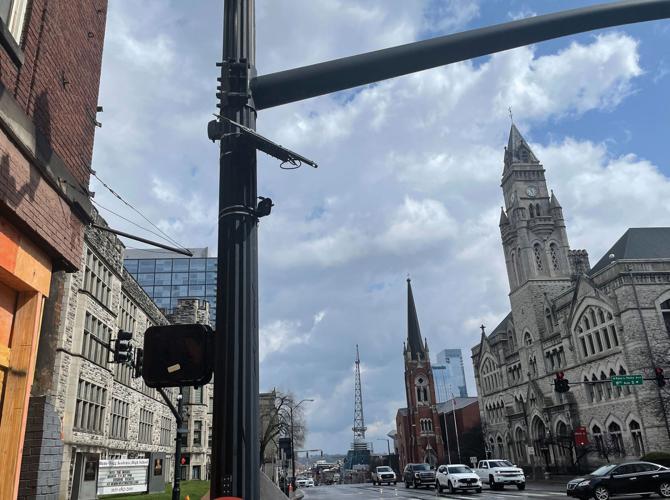
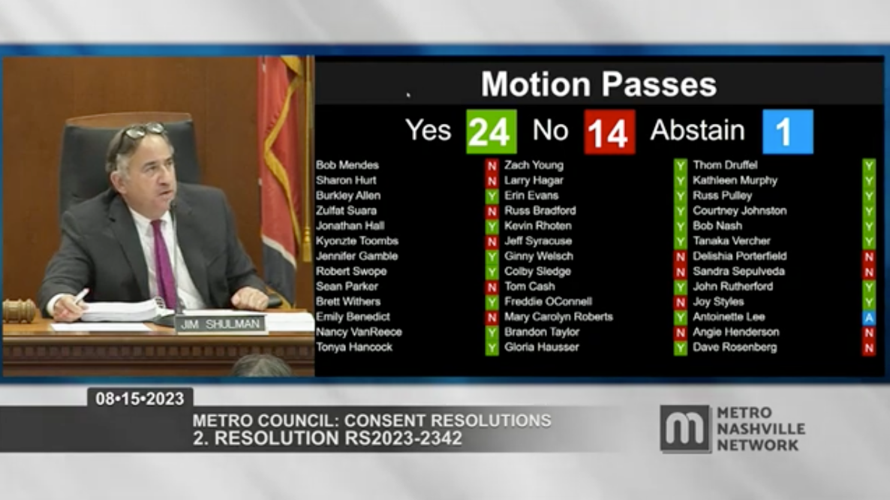

In the final meeting of the Metro Council’s four-year legislative term, the body voted 24-14 to approve full implementation of automated license plate readers across the county. Full implementation follows a six-month LPR trial period mired in controversy over camera placements and police compliance with council safeguards. Metro police will oversee the expanded network of automated cameras, which cross-reference passing cars with state and federal databases.
Outgoing Mayor John Cooper opened the term’s last meeting with an address touting achievements of his administration. While Cooper did not mention LPRs in that address, a Wednesday morning press release from his office celebrated LPR implementation as the first of “five notable pieces of Mayor Cooper’s legislation” passed during a “sprint” to the end of the term. A united coalition of legal and civil rights groups vocally opposed LPR expansion in a letter to the Metro Council dated Aug. 1. The groups include the Metro Community Oversight Board, the NAACP, the Tennessee Immigrant and Refugee Rights Coalition, Chief Public Defender Martesha Johnson, the American Muslim Advisory Council, Conexión Américas, Open Table Nashville, Stand Up Nashville, and SEIU Local 205. The groups resemble the political base that propelled Councilmember Freddie O’Connell into pole position in this year’s mayor’s race. O’Connell initially voted to defer the legislation before voting against full implementation on Tuesday night.
“Our city works best when everyone can feel safe and participate, but massive data gathering and surveillance only serve to erode trust and disproportionately target Black and brown communities,” reads the letter, signed by 19 individuals and groups. It references Community Oversight Board reports about how the LPRs have disproportionately surveilled majority-Black and low-income areas of the city during the trial period, resulting in high rates of officer use-of-force incidents against Black people and unhoused people. Immigrant advocacy groups worry that such widespread data collection could enable crackdowns from immigration authorities, a legal question that remains unanswered, even for policy experts.
“It was correctly stated that ICE does not need a warrant to go and access data,” District 30 Councilmember Sandra Sepulveda told colleagues, referencing HB2315, Tennessee’s 2018 law aimed at so-called sanctuary cities, which forces local governments to comply with federal immigration law.
“We are deciding to move forward on this when we have no protections for immigrants, no protections for minorities,” continued Sepulveda. “I want you to sit with that and think about that. Sit with your privilege and reflect with what that means for some of us. This is the potential separation of families, the potential separation of people who have been here for a very long time who have only known this as home.”
Earlier in the meeting, Sepulveda connected LPR surveillance to Tennessee Attorney General Jonathan Skrmetti’s recent acquisition of health care records from Vanderbilt University Medical Center.
"There is a right way to do things and there's a haphazard, careless way of doing things," said District 35 Councilmember Dave Rosenberg, arguing in favor of Councilmember Delishia Porterfield's motion for a deferral, which later failed 15-24. "Passing this tonight is haphazard and careless."

Results of the Metro Council's vote to implement automated license plate readers, Aug. 15, 2023
A brief public comment period preceded the vote. Christopher Dickerson, a supervisor with MNPD’s homicide unit, spoke in favor of LPR implementation. His argument was based on the conjecture that the 2022 murder of Vishal Patel, an employee at a Kwik Sak convenience store in Hermitage, could have been solved faster with an LPR network. Among others, the Rev. Davie Tucker, a prominent city faith leader and director of the Metro Human Relations Commission, argued against LPRs. The commission has previously expressed disapproval of the plan. Tucker cited the fact that cameras over-surveil Black and low-income areas of Nashville.
“Your intent is not discrimination, but what is your impact?” Tucker said. “It’s your duty to please assuage the public’s concerns.”
By the time his name was called for public comment, Vanderbilt Law School professor Christopher Slobogin had already left the chamber to go home. He helped draft the city’s ordinance along with Councilmember Courtney Johnston.
“I don’t think it should be used for immigration purposes or minor traffic violations — even though those are technically violations of the law," Slobogin tells the Scene. "I think it should be used only for serious crimes like kidnapping and homicides. Technology could be used in what I call a ‘pan-vasive’ way: Watch everybody all the time, because everybody violates the law all the time.”
Even as Slobogin defends LPR legislation as compliant with the current best practices in law enforcement use of technology, he emphasizes that a lot depends on police compliance with the law and unanswered questions about data sharing, particularly with other law enforcement agencies. His 2022 book Virtual Searches: Regulating the Covert World of Technological Policing opens with the hearings that preceded Nashville’s LPR pilot program.

Automatic license plate readers cast huge net for few arrests, push MNPD toward targeted policing
“It’s not entirely clear the city can prevent a state or federal subpoena from being executed, if an agency wants to access the data,” says Slobogin. “In the case of immigration, it’s possible immigration authorities could override any attempt by the city to stop access to the data. I think it’s a live issue. If I were the city, I’d be prepared to resist that, probably through litigation.”
Police can now begin setting up a network of cameras across the county. Their work is still bound by the ordinance, which includes restrictions on who can access LPR data and how it can (and can’t) be used. During its trial period, MNPD engaged surveillance tech vendors like Motorola and Flock Safety, and can now work to procure more cameras. Contracts with these vendors will govern how LPR data is owned and shared.



Post a comment as anonymous
Report
Watch this discussion.
(0) comments
Welcome to the discussion.
Log In
Welcome to the discussion.
Keep it clean. Please avoid obscene, vulgar, lewd, racist or otherwise abusive language. Comments featuring hate speech or threatening or violent content will not be tolerated.
PLEASE TURN OFF YOUR CAPS LOCK.
Be truthful. Don't knowingly lie or mislead.
Be proactive. Use the “report” link on any comment that violates our comment policy.
Share with us. We'd love to hear your feedback.