
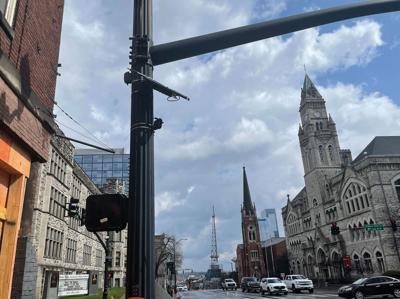

Automated license plate readers are up across Davidson County, while discussion continues about approved uses, data sharing and privacy concerns. The Scene visited six intersections where multiple LPRs are currently in use, none of which were accompanied by signage — despite the fact that Metro law requires “clearly visible and legible” signage where cameras are in use.
Automated cameras, often mounted at busy intersections or on police cars, scan license plates in real time and cross-reference plates with “hot lists” — databases that allow law enforcement to request and share data between agencies. Many embrace the technology as a key expansion of police surveillance capabilities. A citywide network of cameras amasses vast amounts of location and identity information that, agencies argue, is critical for building a database that can help solve more crime. The technology has already been implemented across the state by police from Belle Meade to Goodlettsville, Mt. Juliet and Memphis.
Critics are concerned by the sheer quantity of information that LPRs collect on a daily basis and how that data is stored, bought, sold or shared. They note that the technology is prone to mistakes, fails to reduce crime, violates expectations of privacy and expands police power with insufficient safeguards. Some fear that mistaken “hot list” hits, which occur when a camera misreads a plate or hits on a plate that is improperly categorized, could lead to arbitrary and excessive police interactions. Scrutiny and litigation around privacy, data use, data sharing and government regulation have followed LPRs across the country, largely driven by the ACLU. Critics and advocates use the same phrase to describe a city dotted with LPRs: “It’s like having a police officer on every corner.”
Last year, the Metro Council approved a six-month pilot program for LPR use in Nashville over strong objections from legislators, community members, Metro’s Community Oversight Board and a long list of nonprofit organizations. Some councilmembers worried that such powerful technology could be used to track individuals seeking abortions or immigrants lacking permanent legal status. (The federal government does in fact use LPR data to target immigrants for deportation.)
Councilmembers attempted to bulk up LPR accountability with carefully worded paragraphs and amendments addressing concerns, but they left room for requests from state and federal agencies, which data-share through what are known as fusion centers. Tennessee’s fusion center, housed inside the Tennessee Bureau of Investigation, is central to the state’s Amber Alert program and efforts to identify missing and exploited children, both named and approved uses for Nashville LPRs.
Thirty-nine LPRs are now up across the county, according to the Metro Nashville Police Department. Twenty-four are fixed on major intersections, mostly concentrated in and around downtown. Five are on mobile trailers, and 10 are attached to MNPD vehicles. Cameras started going up in late January and will continue through a five-month “field evaluation trial” in which three private companies are vying for a potential contract with the city. Over the weekend, an LPR hit led to the arrest of a 16-year-old in White’s Creek. He was charged with car theft in juvenile court, according to an MNPD press release. During the five-month evaluation period, these companies retain ownership of “hardware, software and equipment,” a broad allowance leaving a gray area around data ownership. A month into the pilot, councilmembers are still figuring out how they will judge its success.
District 15 Councilmember Jeff Syracuse heads the council’s Public Health and Safety Committee, set to receive regular reports from MNPD about its use of license plate readers.
“I’ve been having conversations with the [police department] about the program, metrics, how we’ll be able to judge it and, when it comes back to us, how to determine if this is a success or not,” Syracuse tells the Scene. “I want to be able to alleviate concerns that data isn’t being permanently stored and not doing anything but looking at a license plate. My goal is to better understand metrics so I can do better decision-making when this comes back to us.”
Syracuse says that, on a recent Zoom call, MNPD promised a public dashboard that will share some information about its use of LPRs. By law, police must share detailed information about traffic stops that result from LPR hits. However, information for 2023 traffic stops is not required until March 1, 2024, more than six months after the Metro Council reviews the current pilot program.
Because the six-month pilot includes a competitive bidding process, Metro is legally protected from sharing its list of potential vendors or legal terms of engagement. All six intersections reviewed by the Scene featured Motorola cameras — Motorola being one of three potential vendors, according to MNPD. Alongside LPRs, MNPD has access to 382 private cameras from retail vendors like Amazon. Through a new program called Connect Nashville, residents voluntarily install a small fūsusCore device that directly shares residential feeds with police, who tout increased community safety and improved response times for users.
A few years ago, then-MNPD Officer David Terrazas was caught querying police databases for information about his wife and his girlfriend, for which he received a four-day suspension. Concerns about abuse of power to surveil and access to privileged information are often dismissed by advocates as unfortunate behavior by a few bad apples. Broader worries focus on the practical policing effects of a new ocean of data. Meanwhile, cameras across the city are already mounted without any signage stating that LPRs are actively scanning and storing driver data. MNPD says the Nashville Department of Transportation is in the process of putting up signs.



Post a comment as anonymous
Report
Watch this discussion.
(0) comments
Welcome to the discussion.
Log In
Welcome to the discussion.
Keep it clean. Please avoid obscene, vulgar, lewd, racist or otherwise abusive language. Comments featuring hate speech or threatening or violent content will not be tolerated.
PLEASE TURN OFF YOUR CAPS LOCK.
Be truthful. Don't knowingly lie or mislead.
Be proactive. Use the “report” link on any comment that violates our comment policy.
Share with us. We'd love to hear your feedback.