
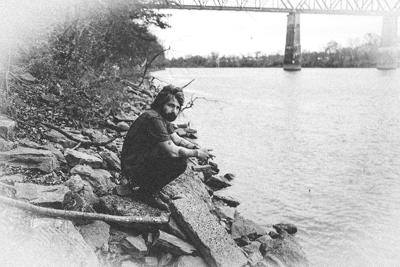

John R. Miller
John R. Miller cuts his work from the same cloth as John Prine. He’s plainspoken, yet he taps into what makes humans tick — for better and worse — with profound nuance. The Washington, D.C., native incisively points his lyrical pen at the for-profit prison industrial complex on one of the most brilliant songs of his career. “Jails get fuller, but they ain’t getting any whiter,” Miller sings in the dusty but venomous “Looking for a Place to Die.” The song stretches the thematic scope of his new record The Great Unknowing, which hits streaming platforms on Friday following its initial physical-only release in June.
“If you incentivize crime, you make it so that crime is profitable, which means you incentivize criminalizing people,” Miller says of the song, which he wrote even before the 2024 presidential election sent Donald Trump back to the White House. “Typically, the people who get criminalized the most are the people who are the most marginalized. In our country, that is basically anyone who isn’t white, straight, and not a cisgender person. It has fallen on minorities. I see it as basically modern-day slavery.”
Miller spent the first 11 years of his life living just outside of D.C. before his family relocated to Hedgesville, in the Eastern Panhandle of West Virginia. While living among the Appalachian hills, he met his longtime collaborator and co-producer Adam Meisterhans (Tyler Childers, Lillie Mae, Kelsey Waldon). Miller recorded his previous two albums Heat Comes Down and Depreciated in Nashville, which he’s called home since the late 2010s. But with The Great Unknowing, he sought a new challenge, so he and Meisterhans headed to Tulsa, Okla., and set up shop in The Church Studio.

A Poem Is a Naked Person is not a rock-doc, at least not in the way that we’ve come to expect in the 21st century. A Poem Is a Naked Person, L…
Restored by current owner Teresa Knox, The Church had housed several different church denominations through the years. Leon Russell bought the building in 1972 and turned it into an office and studio for his Shelter Records. During the time that followed, the space served legendary musicians and songwriters (some Shelter signees and some not) from Willie Nelson, Tom Petty and Dwight Twilley to Stevie Wonder, The Gap Band, Freddie King and beyond.
Miller was naturally very familiar with the studio’s history before recording. In fact, he’d just read Heartbreaker: A Memoir, co-written by famed guitarist-vocalist Mike Campbell of Tom Petty and the Heartbreakers and novelist Ari Surdoval. “There’s a whole part of that where Tom Petty and Mike get to The Church Studio for the first time in the early ’70s,” Miller recalls. “Peter Tosh is there, and they greeted him at the door.”
Stories like that have greatly inspired Miller to craft his best, most emotionally rich record to date. The record brings a heavier, hard-driving sound that nods to the heavy rock music Miller fell in love with as a teenager to support his thoughtful narratives and unfussy drawl.
In June, the Newport Festival Foundation announced Miller as the 2026 recipient of the prestigious John Prine Songwriter Fellowship. Not only will Miller make his debut at the upcoming Newport Folk Festival, set for July 24 through 26, but he was also given a chance to spend a week writing at the Almanack Arts Colony on Nantucket.

The sterling singer-songwriter discusses his new record ahead of the release party at 3rd and Lindsley
“I never got into this to be awarded anything, or get any kind of recognition from anybody,” Miller says. “But it’s obviously a great honor. You never really expect to be doing something like this this long, much less getting to be in the orbit of things that have been very meaningful to you for so long.”
He spent only a few days in Nantucket before he got the call that his father had passed away. When he hops on our Zoom call, he’s just returned from the funeral the night before.
“It’s been a crazy, very strange couple of weeks,” he says. He also notes that he’s carving out time to return to Almanack later this year.
“I got into a groove almost immediately when I got there,” he says, adding that he wrote two or three songs’ worth of material. “I only took my phone, some notebooks, a little Bluetooth speaker and some sundry items. I don’t get to do that very often, just be completely alone in a place and bored out of my mind. That’s the best way to make anything.”




Post a comment as anonymous
Report
Watch this discussion.
(0) comments
Welcome to the discussion.
Log In
Welcome to the discussion.
Keep it clean. Please avoid obscene, vulgar, lewd, racist or otherwise abusive language. Comments featuring hate speech or threatening or violent content will not be tolerated.
PLEASE TURN OFF YOUR CAPS LOCK.
Be truthful. Don't knowingly lie or mislead.
Be proactive. Use the “report” link on any comment that violates our comment policy.
Share with us. We'd love to hear your feedback.