
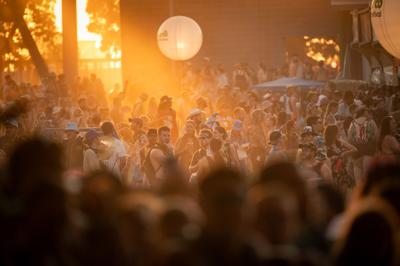


At Bonnaroo 2024
To be completely honest, I did not have a good feeling about the state of music festivals going into this article. Between last summer’s epic weather bummer at Bonnaroo and this winter’s rather high count of events that have been paused, pushed back or canceled outright, it just seemed like maybe music festivals have had their moment. But the more I poked around, the more it seemed like those contractions were natural, the changes a sign of a healthy industry and my worries unfounded. I was confused to say the least.
So I reached out to two folks who could help me sort this out: Gina Arnold, author of Half a Million Strong: Crowds and Power From Woodstock to Coachella, and Sara Minton, a Nashville homie who loves festivals more than anybody I know. What I discovered was that despite over-corporatization, natural disasters and ever-escalting costs for the consumer, the primal human need to listen to music in large groups is still winning.

Family-friendly Franklin fest offers few details, says the move allows ‘the best festival experience’
“If I’m not working, I’m at a show or outside, so I feel like I go back and forth,” says Minton, who is on a walk when we get in touch. In the week before our call, her dance card included shows at Harken Hall, Marathon Music Works and Exit/In, and she has tickets in hand for Bonnaroo next week, as well as two September fests she’ll travel to — Bourbon & Beyond in Louisville and Shaky Knees in Atlanta. She’s also a veteran of erstwhile Gulf Shores fest Hangout (rebranded last year as Morgan Wallen’s Sand in My Boots Festival), Hulaween in Live Oak, Fla., and Franklin’s Pilgrimage (which is set to skip 2026 and return next year). Hell, she’s even got tattoos of the logos for Shaky Knees and ’Roo. “[Festivals are] the best of both worlds, being outside and music — all I need.”
And while Minton’s enthusiasm for the events hasn’t dulled, this year the constraints of the adult world have her scaling back from full-blast, all-weekend music binges. She’s invested in single-day passes and hotel rooms instead of camping in dusty lots where the wooks roam free.
Safety is a bigger concern for Minton since she watched Trainwreck: The Astroworld Tragedy, the Netflix documentary about the crowd crush at Travis Scott’s 2021 festival in Houston that left 10 dead and more than 300 injured. While she’s also bummed out by the admittedly less-serious issue of overzealous security confiscating snacks at the gate, the floods at last year’s Bonnaroo are top of mind, and she’s thinking about evacuation plans and staying connected to her group in the event of an emergency.
“I’m always trying to see as many acts as I can,” says Minton. “But the number one thing that everybody always says [keeps them from going to festivals] is the price is going up.”
The cost of live music for those consuming it and those creating it has skyrocketed over the past few years. Festivals have not escaped the effects of inflation and a buy-the-dip administration hell-bent on the enshittification of everything we know. This shit is expensive, y’all — no matter how you cut it. During the past two decades, festivals were the all-you-can-eat buffet that complemented fans’ daily bread of club and arena shows. But for many, festivals are now the main course.

Verdict upholds findings that the firm and its Ticketmaster subsidiary operate a monopoly
“I think that young people today go to festivals because they see themselves as paying, yes, a giant price like $500, but seeing tons and tons of acts,” explains Arnold, who teaches at the University of San Francisco in addition to writing and editing. “And what they don’t want to do is pay $300 to see one act or $100 to see one act.”
Is the shift from ordering à la carte to a more “Golden Corral or GTFO” model having a deleterious effect on club, theater and arena tours? With the exasperated touring industry scoffing at “blue dot fever” — a term coined to describe concert tours that get canceled because of poor advance sales plainly visible on ticket sites, which some executives deny is an issue with the conviction of Marco Rubio pretending those shoes are the right size — it’s easy to blame festivals. They are the biggest, most obvious boogeyman. But they are also squeezed by the larger economic forces at play, as the recent wave of cancellations and postponements makes clear. (See the aforementioned Hangout and Pilgrimage, or just skim the feed of anonymous festival news channel The Festive Owl.)
“I mean, they’re still standing,” says Arnold. “The big ones are still standing, and it must make economic sense to someone. People are always saying to me, ‘Why are tickets so high?’ Because people pay it. If you didn’t pay it, they wouldn’t do it.”
And while programming at major festivals has entered a very creative phase — Kesha in charge of the Bonnaroo Superjam is inspired booking, y’all — and audiences are still in love with the experience of music festivals, this is an industry built on cheap gas and political stability. How many seasons of forever war can we endure before the fun gets too far out of reach for average music fans?

Diving into the who, what, when, where and why of the two major music festivals that hit Middle Tennessee at the start of summer



Post a comment as anonymous
Report
Watch this discussion.
(0) comments
Welcome to the discussion.
Log In
Welcome to the discussion.
Keep it clean. Please avoid obscene, vulgar, lewd, racist or otherwise abusive language. Comments featuring hate speech or threatening or violent content will not be tolerated.
PLEASE TURN OFF YOUR CAPS LOCK.
Be truthful. Don't knowingly lie or mislead.
Be proactive. Use the “report” link on any comment that violates our comment policy.
Share with us. We'd love to hear your feedback.