
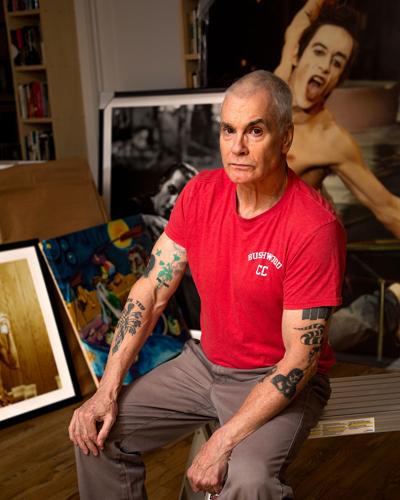
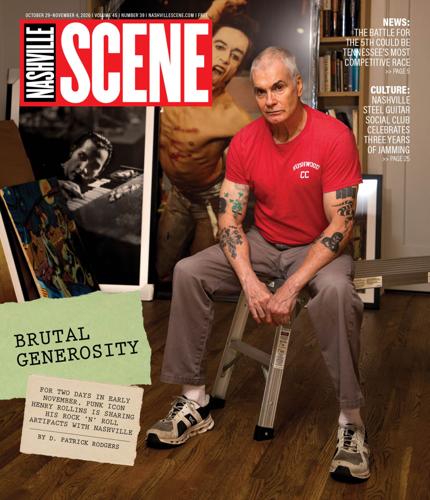
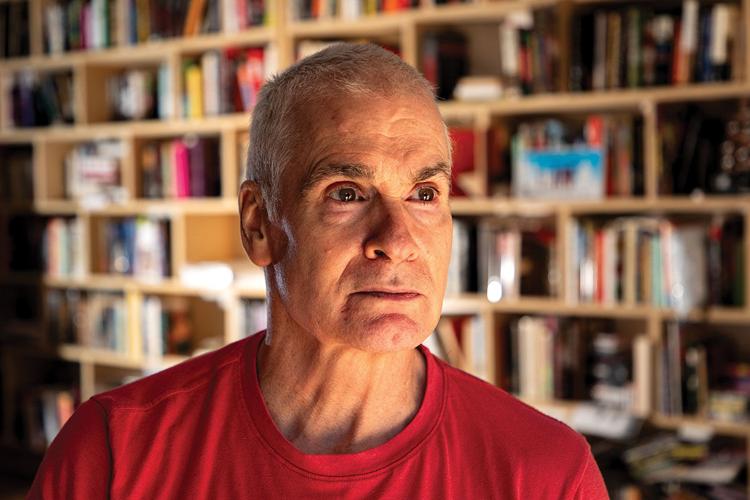


Henry Rollins with his collection at home in Nashville, October 2026
“This is where all my passion and excitement is — in this.”
Punk icon Henry Rollins is seated behind a desk in the office of his Nashville home, gesturing toward the framed photographs, posters and other rock ’n’ roll ephemera that surround him. To many, Rollins is known as the onetime frontman of formative American punk band Black Flag, and of Rollins Band after that. To others, he’s known as a spoken-word artist, author, radio DJ, historian and archivist. To the folks in his neighborhood, he’s just Henry.
“It’s just nice meeting everyone in your neighborhood and going to their houses and saying hello,” says Rollins, who moved to Nashville in October 2021 after decades in Los Angeles. “They give the wave as you drive by. And that’s all kind of a new language for me, and I must say, I quite enjoy it. In Nashville, it seems you can talk to anyone, like at the supermarket. … It’s like a Norman Rockwell painting come to life.”
He’s befriended an elderly couple in the neighborhood, and sometimes goes over to their house for backyard cookouts. The couple’s entry point to understanding who he is: Their son is a big fan of FX biker drama Sons of Anarchy, in which Rollins played a violent white supremacist. Now neighbors will keep an eye on Rollins’ house when he goes out of town, and vice versa.
“I fell in love with Nashville immediately,” he says. “I liked it already because I’ve been touring all my life. I’ve been here a bunch of times. I met all my neighbors, the nicest people. … It’s that Southern thing, and I know the South because I’m a touring guy, and the South gets a bad rap. ‘Oh, they’re all dumb.’ You’re dumb to say that. ‘They’re all racist.’ There’s racists everywhere.”
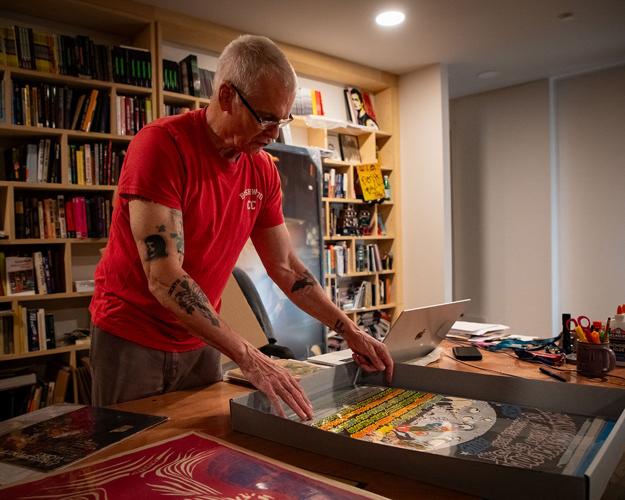
From the outside, Rollins’ home — he asks that the Scene remain vague about its precise location — looks nondescript and suburban, a “snore fest” with “nice little rooms for a breeding family,” as he puts it. Inside, he’s converted what the previous owners used as a two-room TV-watching and gaming area into an archiving and cataloging HQ. It’s bursting with artifacts from legendary American rock ’n’ roll outfits, many of whose members Rollins knows or knew personally and professionally. Some of the “major food groups” of his collection, as he describes them, are The Cramps, Black Flag, The Damned and Iggy Pop’s The Stooges, the latter of whom he calls America’s best band.
For two days in early November, Rollins will share some of his immense collection — not a majority share of it, more like “the tip of the tip of the tip of the iceberg” — with his fellow fanatics. His show Cool Evidence: Captured Moments From the Last Century will take over indie art space RADAR615 on Nov. 6 and 7. The event will be free and open to the public.
Why Nashville?
Now 65 years old, Rollins doesn’t cut quite the hulking figure he did in his ’90s prime, back when he was stalking stages with Rollins Band and getting thrown through a plate-glass window by Al Pacino in Heat. But he’s in good shape — he still works out twice a day, he says — and those unmistakable Misfits and Black Flag tattoos still dot his arms.
“I moved out here because of this,” he says, spinning his laptop around to reveal a photograph of a room packed with framed photos, posters and other materials, all crowded and leaning against the walls of a living room. “Basically, where I was standing taking this photo, that’s my old living room in Los Angeles. And [my manager Heidi May] said, ‘OK, what are you doing with all this stuff?’ I said, ‘I just find rare stuff and frame it. And I ran out of wall space, so it’s now all leaning.’ All three floors of the house looked like that. She said, ‘OK, you’ve now tipped the scale, and now, because no one comes to your house, you need to make this available for people. They should see this. Otherwise, you’re just a weird hoarder. You should do a museum or a pop-up or something.’”

Henry Rollins reviews his archives at home in Nashville, October 2026
Rollins’ initial plan was to open a brick-and-mortar location in Nashville that would function as a sort of rock ’n’ roll museum, as well as an office for himself and May. And so in 2022, he bought a building in the Chestnut Hill neighborhood, not far from downtown. Much speculation from the general public followed.
“I’m old, so my ideas are old, and my aim, and Heidi’s too, was to come out here, buy a building, and move our offices into it, move our mail order into it — 9 to 5, we show up every day,” he says.
As it turns out, in New Nashville, that was going to be an arduous and cost-prohibitive process. So he sold the building last year. Its buyer is now planning an eight-story mixed-use building on the property. Rollins later tried to lease a space. That too was going to be prohibitively pricey. And so the idea became “pop-ups.”
“It would have turned into this money-eating thing that would have killed me,” says Rollins. “I wanted a museum. I wanted my piece of the rock. But as a rootless, faster, more agile cheetah, it moves better than an elephant. It just makes more sense. And so it took me a couple of weeks of my ego, my dream getting crushed, to come up with a new dream. And I’m like, ‘Oh, wait a minute! This is better.’ So it’s a smart idea to do pop-ups. I hate the term, but I get it, and people like Raymond Pettibon do them. Shepard Fairey does them.”
So he’d warmed to the idea of pop-ups. But where?

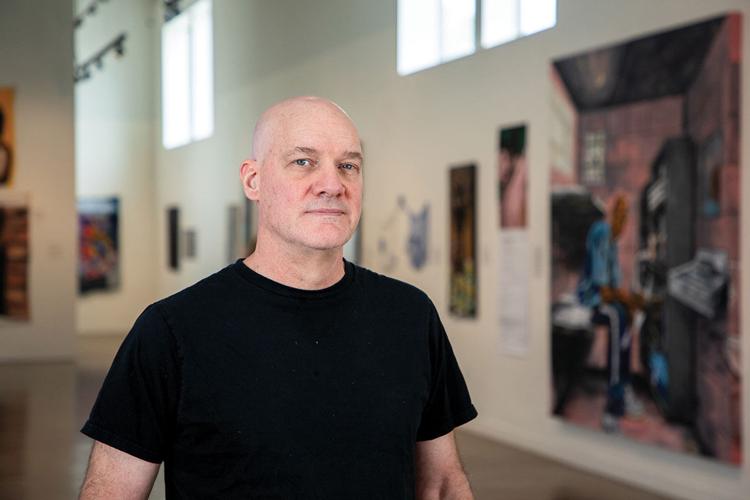
Lain York at RADAR615
RADAR615, and Nashville's Punk Ethos
“My God, just the whole punk ethos, DIY ethos, and my particular generation,” says RADAR615 director and native Nashvillian Lain York when asked about how Rollins’ work in Black Flag and elsewhere has affected him. “I mean, personally speaking, I learned DIY from those examples. … I feel like those [projects], for me, really carried through here with my work with the Untitled group and really in the community.”
Untitled, of which York was a member, was an artists’ group formed in Nashville in the ’90s that became known for hanging DIY pop-up art shows in unlikely spaces. York also worked with Zeitgeist Gallery, where he was the gallery director, for 29 years, forging a strong working relationship with founder Janice Zeitlin. Zeitgeist closed last year, and York now operates art space RADAR615 out of the gallery’s former home on Hagan Street in the rapidly developing Wedgewood-Houston neighborhood. RADAR615 collaborates with MZA Architecture and Interiors to program the space.
Chatting with the Scene from across a conference table in RADAR615’s space — in a gravelly, resonant voice that would sound great narrating audiobooks — York notes that RADAR615 “sailed into” its inaugural year with no planned programming, but shows have developed in the space organically and serendipitously. Throughout most of October, the gallery hosted A Lesson I Learned: A Lesson I Taught, a show co-presented with Tennessee State University and the Educators’ Cooperative and coordinated by TSU students. Later in November — as part of IndigenNash, a festival featuring work by Indigenous artists — the space will host an exhibit by Indigenous chocolatier Sophia Ray and sponsored by The Forge exploring the history of chocolate in the Americas.
As Rollins explains it, he jokingly asked Betsy Littrell — a Nashville real estate agent and architect with whom he regularly works — to recommend “a gallery where the people who own it know me, they’re fans, and they’ll let me do whatever I want.”
“I was kidding,” says Rollins, noting that he didn’t think such a space existed. “You know, ‘I want everything.’” But Littrell immediately recommended York and RADAR615, and when the pair connected in March of this year, they hit it off immediately.
“I’ve found him to be an incredibly warm person,” York says of Rollins. “He’s very organized, which I certainly expected. … I’ve worked with a lot of curators on a lot of different levels, and Henry is every bit the professional and has the vision that any curator that I’ve worked with has.”
In August, Rollins collaborated with York on a showcase of work culled from the archives of Memphis artist and musician Alicja Trout. That helped lay the groundwork for this collaboration.
York speaks with authority on how punk rock, country music, avant-garde visual art and DIY printmaking all intersect in Nashville’s art scene. He references Lipstick Traces, a 1980s treatise by cultural critic and music journalist Greil Marcus, as well as Paul Grushkin’s The Art of Rock: Posters From Presley to Punk and Fucked Up + Photocopied: Instant Art of the Punk Rock Movement by Bryan Ray Turcotte and Christopher T. Miller. He calls these works “amazing documents” showing the connected roots of punk music and American visual art. The Art of Rock, he notes, “opens with Nashville’s Hatch Show Print and closes with ‘the punk years,’ which includes Nashville-based designer/photographer Michael Ray Nott’s designs.”
“Where’s the art scene?” York asks rhetorically. “It’s underground. What that has always been — it’s been fiercely independent. It’s been fiercely spiritual. I’ve always looked at music — rock ’n’ roll in particular, for me — to be that. It is about these fundamental underpinnings of human engagement. It is about art. It is about music. It is about dance. … You know, this is in [Nashville’s] DNA.”
In outlining why Music City is a fitting place to display Rollins’ collection, York also references the ongoing work of Jon Sewell, a Nashville native who catalogs the city’s deeply rooted and far-reaching rock ’n’ roll scene with his project the Nashville Underground Music Archive. “It has so much depth, and it is so serendipitous what’s happening here,” says York of Sewell’s efforts. York notes that Sewell was also instrumental in bringing the archives of longtime punk zine and radio show Maximum Rocknroll to MTSU’s Center for Popular Music.
“The narrative’s here,” says York. “It’s just picking up that narrative.”
So What’s in the Collection?
Rollins describes growing up in his native Washington, D.C., where as a child he’d take the bus to the Smithsonian Institution and other museums.
“I was at the Smithsonian all the time,” he says. “I just became fascinated with like, ‘That’s a dinosaur bone? That’s John Glenn’s helmet? Like, it’s still around?’”
That obsession with historical curation stuck with him, and he describes Cool Evidence as “a 15-year-old’s bedroom walls meets the Smithsonian.”
“This is the idea: rare things to be put on the walls for people,” says Rollins. “The fun idea is anthropomorphizing time. Because it is trying to get away. [Time] is trying to hide. It wants to hide the Civil War. It wants to hide the Roman Empire. It wants you in the moment. ‘Forget about the past.’ Well, I don’t want to forget. … I think you lose a lot when physical objects are eradicated.”
As a teenager, Rollins would attend rock shows with his best friend Ian MacKaye, who later became known as the punk rock icon behind Minor Threat, Fugazi and Dischord Records, among other projects. (Rollins notes that, 52 years after first meeting, the two are still best friends who speak by phone every Sunday.) In the early days, Rollins says, most bands didn’t hang onto things like show posters. “We said, ‘Well, we’re just going to keep one of everything.’”
So Rollins saved and cataloged flyers, posters, tickets, photographs, album art, vinyl records and tapes. Among his collection are early posters given to him by Misfits frontman Glenn Danzig, rough sketches for The Damned’s album art and recordings of his friends’ band practices. When he joined Black Flag in 1981, Rollins began to set aside various artifacts. He’d find “safe people” whose houses he could use to store shoeboxes full of photographs and flyers. In the years since, he’s also built up his collection with pieces he’s won on eBay.
“Who knew that the punk rock stuff would be of value later on?” he says. “Because at first, you couldn’t give the records away. I bought my Misfits records for $2.99. Those are like $10,000 records. It’s ridiculous. It’s just eBay. But that’s just my wheelhouse. And so the older I get, the more I become aware of archiving and [storing recordings and paper in] acid-free environments.”
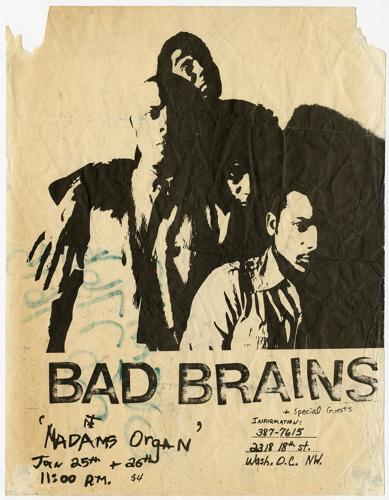
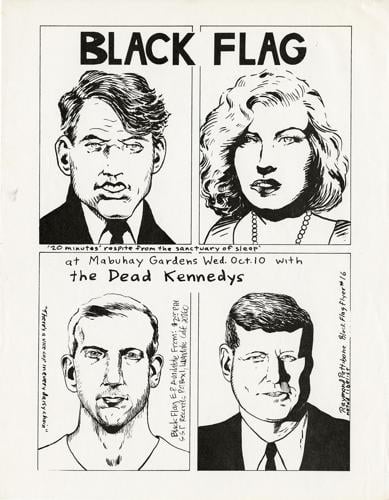
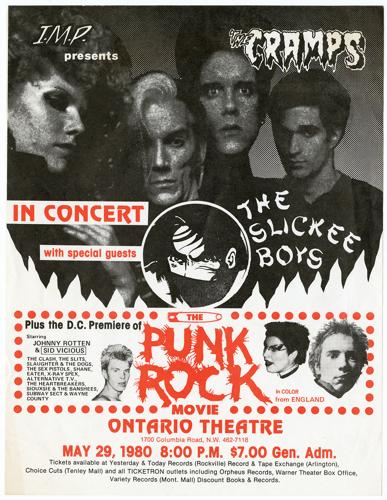
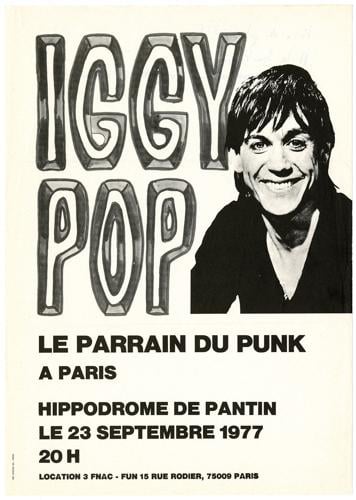
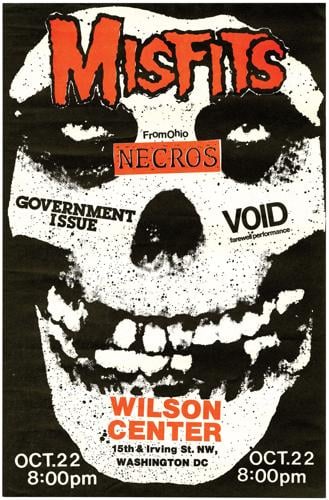
Flyers From Henry Rollins' Collection
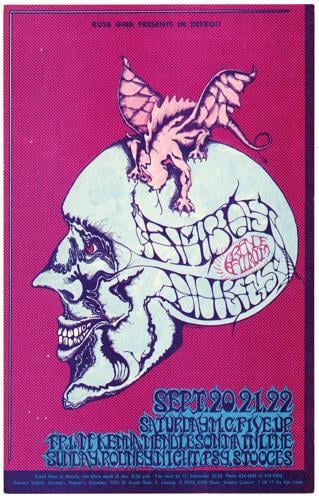
He talks about flying to Tucson, Ariz., to meet up with Kid Congo Powers from The Cramps and The Gun Club. There Rollins picked up much of Powers’ memorabilia, including the Claus Castenskiold painting featured on the cover of The Gun Club’s 1987 album Mother Juno. Rollins also drove to the home of a collector and associate of The Stooges named Michael Tipton in Alabama, where he gathered never-before-seen live photos. From a different collection, Rollins came into possession of a Polaroid of Iggy Pop performing one of his first shows with The Stooges — in April 1968, hair permed and face painted white — that Rollins scanned and blew up to massive proportions.
Rollins also mentions Susie J. (now Susie J. Horgan), a D.C. photographer who shot many of MacKaye’s and Rollins’ early shows, and also photographed the pair when they were her adolescent co-workers at a Häagen-Dazs in D.C.’s Georgetown neighborhood. One shot — a well-known photo of Rollins at age 20, just months before he joined Black Flag, wearing his work T-shirt in the back of the ice cream shop — has been blown up and framed.
Rollins’ various Cramps relics are among his most valued possessions. Just this year, Rollins — along with MacKaye and Larry Hardy of In the Red Records — spearheaded efforts to release Gravest Gravy, a previously unheard collection of the psychobilly trailblazers’ earliest recordings, tracked with Alex Chilton at Memphis’ Ardent Studios in 1977. There are more Cramps releases on the horizon, Rollins promises. But first, Cool Evidence.
Will Rollins Take His Show on the Road?
“I wake up every day, this is what’s on my mind,” says Rollins of his Cool Evidence collection. “The demo tape, the toe in the water, is the weekend in November.”
He says he hopes to gather “field data” at RADAR615 on Nov. 6 and 7, observing attendees to find out what works and what doesn’t. Perhaps rock fans will be more interested in his photographs than his show posters, or vice versa. And that will inform his focus in future exhibitions.
The day after he speaks with the Scene, Rollins is set to start recording the audiobook for his recently completed memoir, Bait Dog Boy, which will be released on March 2 via Random House. Rollins is a prolific writer — he says he’s written four books in this very room in the five years he’s been in Nashville — but Bait Dog Boy is his first for a major publishing house, and his first to be sent through an intensive editing process. In 1994, Rollins published his first book, a collection of Black Flag-era journal entries called Get in the Van. Bait Dog Boy covers Rollins’ life up to about age 20, where Get in the Van picks up. He hopes a mobile version of Cool Evidence can arrive alongside the “shameless” book-promotion process.
“The dream is this thing starts moving,” he says. “We can probably do a thing in L.A. with somebody. New York probably. Chicago, Seattle, Atlanta, San Francisco, and then eventually — and this is me dreaming out loud, me and Heidi — Paris, Tokyo, London, Berlin.”
Rollins compares himself to a retired football player opening a restaurant or a used car lot in his hometown. He doesn’t play anymore, and isn’t interested in putting his body through the rigors of fronting a punk band. This is what he wants to do instead.
“And all of these things have stories,” he says of his collection. “That’s my fourth quarter — museum-curator guy, archivist, researcher.”

Henry Rollins with his collection at home in Nashville, October 2026
A phrase pops up frequently in the Scene’s conversation with Rollins: “brutal generosity.”
“It’s free for the people, and I’m paying for everything else,” Rollins says of Cool Evidence. “I said to Lain, ‘Are [the people hanging the art for us] pricey?’ He went, ‘Oh yeah, but they’re really good. … You’re going to pay.’ I’m like, ‘OK, what do you call that?’ He goes, ‘We call it brutal generosity.’”
“We cannot ticket this event — it has to be free,” Rollins says. “And what a great way to say, ‘I live in Nashville now,’ to do a free event, and I’m going to pay. … I’m going to eat all of it. Brutal generosity.”
Rollins truly cares about being a part of his community. He keeps up with local music, including excellent local art punks Snooper, going so far as to write press releases for them. He also says if he ever decides to charge a cover for an event or exhibit, he’ll ultimately give the proceeds to a good cause — a good cause like, he suggests, nonprofit Nashville punk venue Drkmttr, or a program for queer youth, or the Southern Poverty Law Center.
“I want to be a good neighbor, and an asset to the city.”




Post a comment as anonymous
Report
Watch this discussion.
(0) comments
Welcome to the discussion.
Log In
Welcome to the discussion.
Keep it clean. Please avoid obscene, vulgar, lewd, racist or otherwise abusive language. Comments featuring hate speech or threatening or violent content will not be tolerated.
PLEASE TURN OFF YOUR CAPS LOCK.
Be truthful. Don't knowingly lie or mislead.
Be proactive. Use the “report” link on any comment that violates our comment policy.
Share with us. We'd love to hear your feedback.