
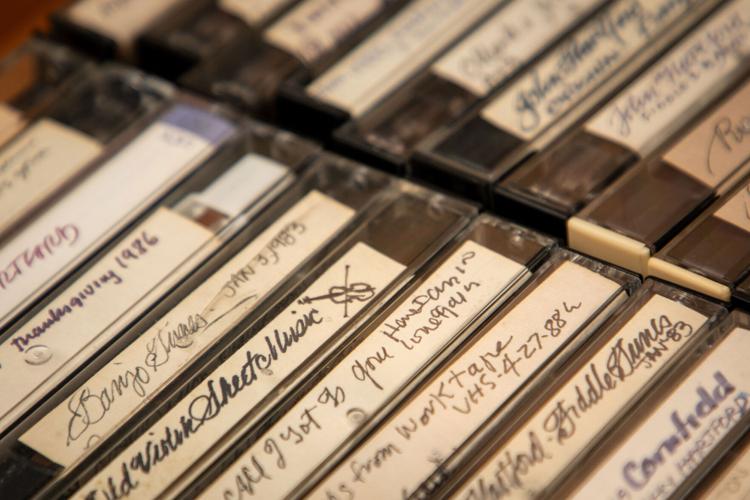


Audio cassettes featuring jam sessions and fiddle tunes recorded by the late John Hartford, collected at the Center for Popular Music
In our hyperconnected, hyper-online world, your first thought might be that the most important step in preserving cultural information for future study — especially information about music, since it’s consumed digitally in such massive quantities — is getting it into a computer. While it’s important to digitize certain things, like rare or totally unique recordings on fragile media, organizing and caring for the tangible objects is a much bigger concern for Olivia Beaudry, the archivist at the Center for Popular Music at Middle Tennessee State University in Murfreesboro.
“It’s not possible to digitize everything, and you wouldn’t want to,” says Beaudry. “There’s nothing like holding a 1700s book in your hand rather than flipping through it on a website.”
The center was established at MTSU in 1985 as a stand-alone program of the state, and officially became a part of the Scott Borchetta College of Media and Entertainment in 2009. It resides on the ground floor of the John Bragg Mass Communication Building. At present, there are more than a million items in the collection, from sheet music to cassette tapes of oral history interviews to periodicals and commercial recordings.
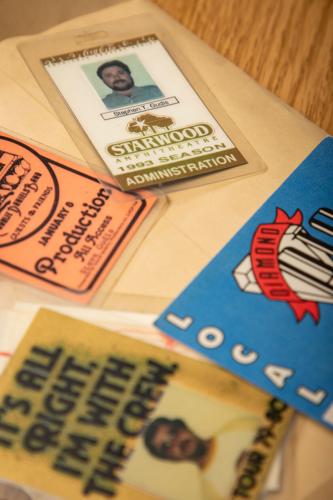
Among a huge array of items of local interest, Beaudry points out tapes of jam sessions at late musician and songwriter John Hartford’s home, as well as a collection of backstage passes and other memorabilia going back to the 1970s donated by live event professional Stephen Gudis. (You can even find an extensive collection of print issues of the Scene.)
Beaudry began working at the center when she came to MTSU as a graduate student studying country music. She has bona fides from the Academy of Certified Archivists, a professional organization that administers an exam she compares to the bar exam for attorneys, except for people who want to make things last for another 500 years. (Also key is making sure things can be found and someone can easily see what they are. Writing what’s known as a finding aid, which includes a short description of the items in a collection, is just as important for Beaudry and her team as keeping items arranged and stored in acid-free containers.)
Having all this stuff in one place is great, but Beaudry points out another vital role for physical archives: context.

Some of Stephen Gudis’ backstage passes, collected at the Center for Popular Music
“If you come in person or look at the items, sometimes you might see connections that you wouldn’t see by just clicking on one item on a website,” she says. “Or even just talking with me, I might say, ‘Hey, I know this related thing to your research topic,’ that you probably wouldn’t have thought of, just because I know the collection.”
Lots of additions to the collection happen because individuals volunteer them. Something like tapes of live-in-studio performances on a radio show are more in line with the center’s mission than, say, a moldy box of Steppenwolf LPs, or even a sheaf of glossy 8-by-10 photos from a 1990s press kit — there’s a decent likelihood they already have those anyway.
One enormous new acquisition is the complete archive of epochal Bay Area international punk zine and radio show Maximum Rocknroll. Because of the extensive process, it will take some time for Beaudry and her crew to prepare the tractor-trailer load of zines, vinyl and more for the public.
“If something was to come in,” says Beaudry, “we have to record it in what we call an accession record. It’s really just saying what came in. Count the material: Say there’s 10 VHS and two LPs and a linear foot of papers. So we have to document all of that. And if the donor wants to take a tax deduction, we have to do another report form, because it’s a donation to the state. [In theory, I will] process it right away — that doesn’t happen very often — and re-folder, re-box, write the finding aid, post the finding aid on the website, catalog the finding aid, and then make it available to the public.”
There is a key distinction between an archive like the Center for Popular Music and a library or a museum: You can’t just browse the collection in person. But even though supporting academic research is an important goal for the center, all of its materials are available to anyone at no cost. Peruse the online catalog to get an idea of what you might be looking for and head on down.
“We supply parking passes if somebody needs it. A heads-up is helpful, but not necessary. You can walk right in and request to see something, and you don’t need to prove that you’re writing a book or a journal article or anything like that. It could just be you want to listen to Pet Sounds on the original vinyl. Well, come in here and listen to it if you want. We’re open.”

Touring Nashville’s zine scene, investigating the resurgence of VHS, considering the influence of AI in graphic design and more





