

On May 7, the second day of the Venice Biennale’s opening preview, artist María Magdalena Campos-Pons slowly circled a path around a gathering crowd, her husband and collaborator Kamaal Malak strumming a bass guitar nearby. She began quietly, but her low whisper grew into a joyful cry as she acknowledged the 61st Biennale’s curator, Koyo Kouoh, who died from cancer in 2025.
“I know that Koyo is walking with us,” she said in a sonorous stream-of-consciousness chant. “As we join in this caravan of love, this caravan of peace, this caravan of hope, this caravan of affirmation of the beauty of the complexity and the many colors, shades, forms of being human, I know that our sister is out there, smiling, laughing, moving, circling in a dance of pure joy!”
A performance from Campos-Pons is a magnetic, magnanimous affair. It’s a perfect fit for the Venice Biennale, long considered to be one of the most important events in the international art world — it is called “The Olympics of Art” as frequently as the Oscars are referred to as “Hollywood’s Biggest Night.” When Kouoh invited Campos-Pons to participate in the Biennale, she put her in league with an elite group of some of the world’s most prominent artists. Visibility on the scale of the Venice Biennale is difficult to replicate.
As she led her caravan of participants through Venice, Campos-Pons wore a ceremonial robe adorned with animals and flowers. A group of purple irises — the state flower of Tennessee — was at the front, directly over the artist’s heart. Since moving to Nashville in 2017 to serve as the Cornelius Vanderbilt Endowed Chair of Fine Arts at Vanderbilt University, Campos-Pons has enthusiastically called the city home. Through Vanderbilt, Campos-Pons founded the Engine for Art, Democracy and Justice (EADJ), and she oversees the West End Avenue art gallery Begonia Labs. She also curated the 2023 Tennessee Triennial, was the subject of a major museum exhibition that traveled from the Brooklyn Museum to the Frist to the Getty Center in L.A., and was awarded a prestigious MacArthur “Genius Grant” Fellowship.

The celebrated Nashville-based artist’s exhibition opens Sept. 27 at the Frist
But perhaps even more impressive than her professional achievements is the rigor with which Campos-Pons cultivates community. Her practice consistently centers artists and curators whose work she believes in, and the Venice Biennale might be her biggest contribution to Nashville’s art ecosystem yet. Only a select few artists are invited to participate in the Biennale. Although Campos-Pons was among the 110 artists handpicked by Koyo Kouoh to represent the theme In Minor Keys, Campos-Pons also invited many Nashville-based artists to participate in a concurrent exhibition. As a result, their work will be seen by the same audiences and enter into the same conversations surrounding one of the art world’s most significant global events.
“I’m forever grateful to Dr. Campos-Pons for inviting me to show work in Venice for EADJ during the 61st Biennale,” photographer LeXander Bryant tells the Scene via email from a plane back to Nashville. Bryant was among the more than 50 artists Campos-Pons and Malak invited to participate in Resonance, a group exhibition that will be on view for the first few months of the Biennale.
“Nothing could have prepared me for the overwhelming amount of art and artist programming on display,” he says. “There’s nowhere else in the world like Venice, and the city’s local culture created a very unique one-of-one experience.”
Bryant’s work includes a selection of cyanotype prints pulled from his series Dirt Road Baby. “I wanted to present work that was a clear representation of me being from the American South,” he says. “All of the cyanotype prints were created using images captured in my hometown of Jackson, Ala. This exhibition connects my experiences of living in the American South to that of the Global South.”
Vadis Turner, who recently shared exhibition space with Campos-Pons in the Frist’s exhibition In Her Place, is another Nashville-based artist whose work is part of Resonance. Her work, “Gold Bow Tondo,” uses gilded satin ribbon to upend the masculinist legacy of the grid in art.
“It feels like an important time to put ourselves in the way of being moved, and to witness how human connection can transcend borders,” Turner tells the Scene. “Magda is bringing so many voices from Nashville to Venice. She doesn’t have to — she chooses to, with a spirit of generosity and ‘radical love.’ Until I can repay her, I intend to pay it forward.“
Jana Harper, another artist whose work was in In Her Place, is showing three works that come from her ongoing research around water systems along North America’s Indigenous Anishinaabe migration route. The central work in this series, “Song for the Water,” features photographs printed on silk panels. Vesna Pavlović will show selections from her series No Ordinary Sunset, and will lead a participatory performance this weekend.
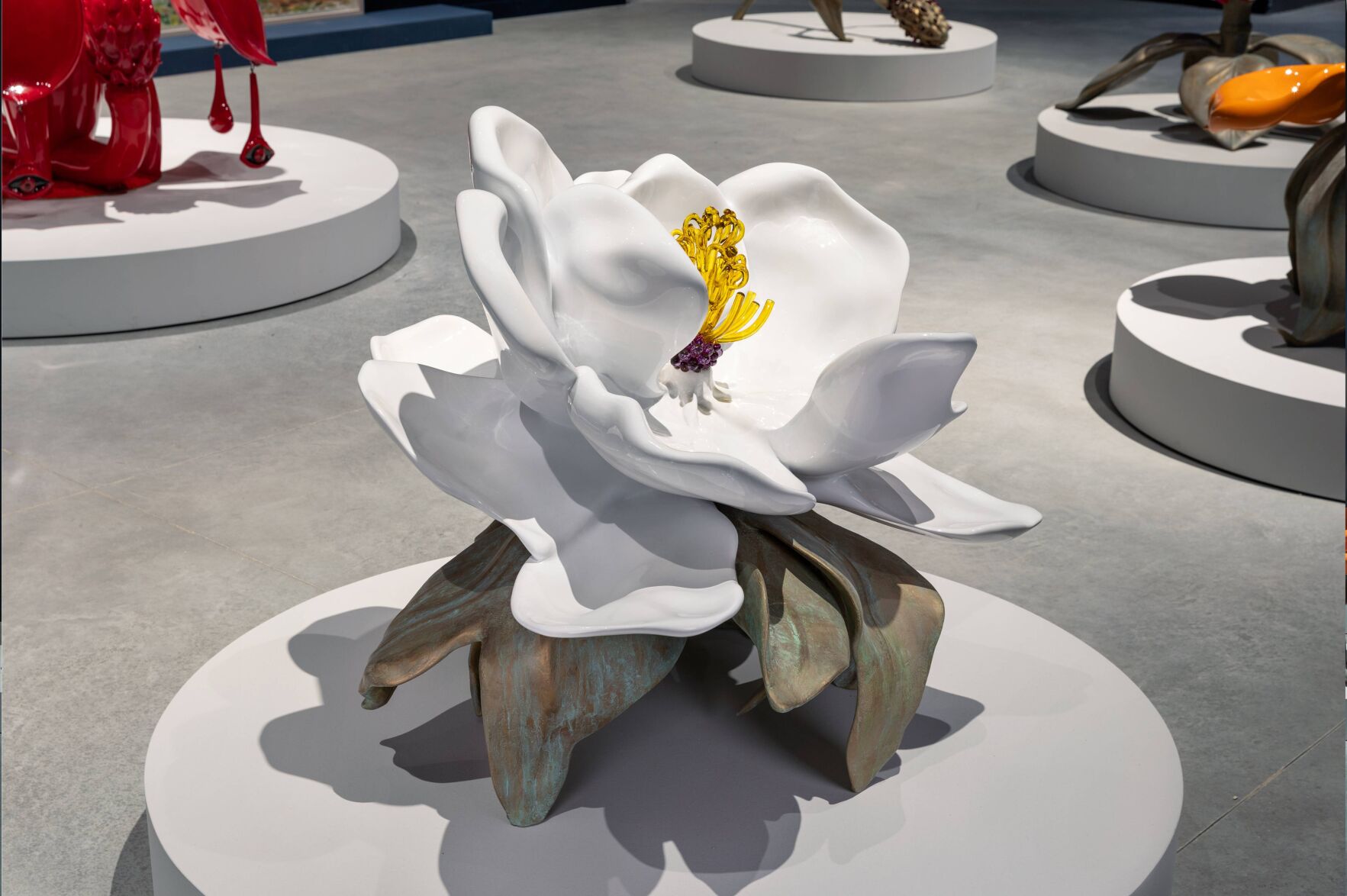
Detail from Anatomy of the Magnolia Tree for Koyo Kouoh and Toni Morrison, by María Magdalena Campos-Pons
Resonance also includes work from artists whose scope extends well beyond Nashville — Campos-Pons positions artists she has developed relationships with locally alongside established, generationally important artists like Carrie Mae Weems and Deborah Willis. Their inclusion produces a compressed version of the exchange that makes the Biennale such a major cultural phenomenon.
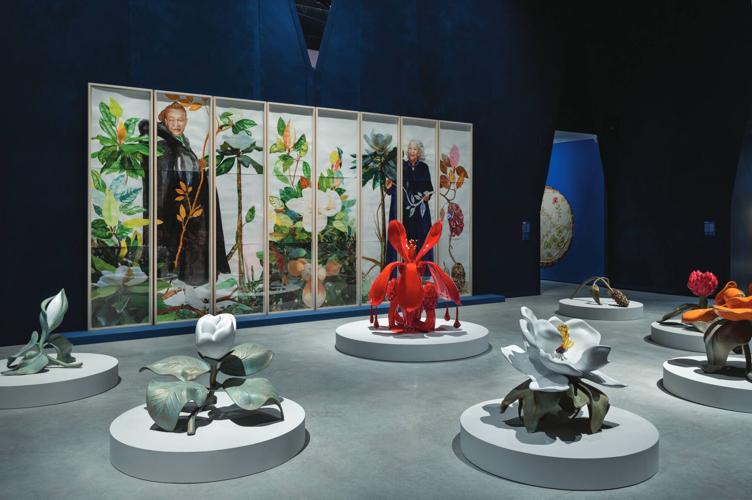
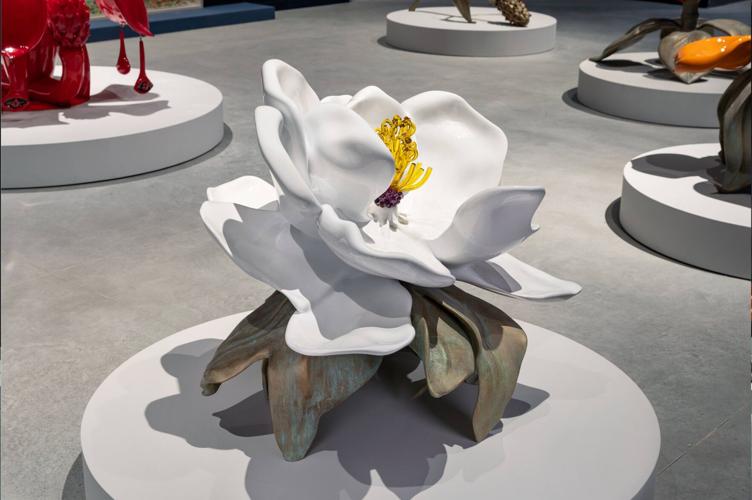
As for her own contribution to the Biennale, Campos-Pons has created Anatomy of the Magnolia Tree for Koyo Kouoh and Toni Morrison, a multipanel painting that honors Kouoh alongside the late Nobel Prize-winning author Toni Morrison, and Malak composed a 47-minute sound piece that plays on a loop at the Biennale’s entrance. A garden of resin, glass and metal magnolia blossoms is assembled around the massive installation in something that curator Grace Aneiza Ali has described as a “monument in floral form.”
“In my lifetime, I have seen a lot of discomfort, a lot of suffering, a lot of necessary ruptures between people,” Campos-Pons tells the Scene from her room in Venice, where she will stay until the exhibition concludes in November. “What I try to model and to live through and with is a proposition in which if we collaborate — if we support each other — life is better for every one of us. I believe that profoundly.
“Our journey is brief,” she continues. “Our present is just a temporary light that passes. We are here for a period of time, and we turn into something else. And in this embodiment of who I am, in this consciousness, I know that it is very important that the work that I do — not only for the betterment of myself, but for the betterment of everyone around me — is valuable. I mean, is that not what Christianity proposed? To help each other, lift each other, bring everyone with you to the place that you know that is better, and say, ‘You have enough, distribute to others.’”



Post a comment as anonymous
Report
Watch this discussion.
(0) comments
Welcome to the discussion.
Log In
Welcome to the discussion.
Keep it clean. Please avoid obscene, vulgar, lewd, racist or otherwise abusive language. Comments featuring hate speech or threatening or violent content will not be tolerated.
PLEASE TURN OFF YOUR CAPS LOCK.
Be truthful. Don't knowingly lie or mislead.
Be proactive. Use the “report” link on any comment that violates our comment policy.
Share with us. We'd love to hear your feedback.