

A photograph is great when it shows you connections you might never see otherwise. Consider William Eggleston’s monumental tricycle, RaMell Ross’ camera shroud, Nan Goldin’s unflinching black eye. LeXander Bryant’s exhibition Dirt Road Baby — on view through Dec. 20 at Red Arrow — is full of great photographs.
A quiet portrait sets the stage. At 60 by 40 inches, “Deacon Berry” is the largest photograph in the exhibition, but most of that space is taken up with darkness, barely perceptible in shades of black. The deacon is shown in profile, and his head is bowed as he reads from what one can only assume is a Bible. The photo’s one instance of color comes from a glowing stained glass window that silhouettes the holy man. And what a color — a sharp, cyan blue centers what looks like a neon sign of praying hands, and is echoed in the gallery’s upper level, where a line of cyanotypes puts a gritty, experimental cap on the show.
Beside “Deacon Berry” — almost in line with where the deacon’s gaze would be if he were to raise his eyes from the text in his hands — is a stack of three Crisco cans. This mixture of reverence and irreverence — of deifying something so banal but so essential — works like a Southern Black version of Andy Warhol’s soup cans.
On the opposite wall, three photographs continue Bryant’s story. The middle piece shows a dirt road in a classic one-point perspective. Like the part of a movie in which a character casually states its title, this photograph’s straightforward simplicity conceals the entire exhibition’s overarching theme. Titled “Hotel Hill (Dirt Road to Heaven),” it lovingly details a path toward Bryant’s family cemetery. The path cuts through a lush treeline that provides just enough shade to emphasize where the sunlight hits it further down the road. The lighting makes the path feel optimistic, like a subliminal message that brighter days are just ahead.
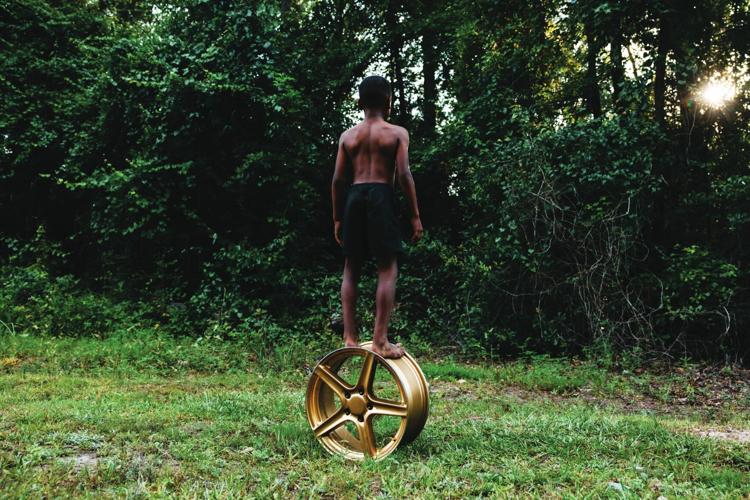
To the left of the dirt road is “Walker Springs Dirt Road Baby,” in which a boy is standing on a gold rim facing an overgrown patch of woods. His back is toward the camera’s lens, but the effect isn’t cold or isolating — instead, it creates a kind of kinship with the boy, underlining that we’re looking in the same direction. The light is hitting the boy’s face, and the sun peeks out through the bramble in the top right corner of the photograph. A tiny rainbow spectrum at the sun’s edge lends the piece a hallowed, almost biblical feeling.
On another wall, a piece called “The Weight of Gold 01” shows the same boy, this time carrying the gold rim in a way that recalls a bass drummer’s stance, and wouldn’t be out of place next to one of Derek Fordjour’s marching band paintings. This is what it is to be a dirt road baby — a son of the South raised on the outskirts, moving along to a country road’s beat.

Dirt Road Baby installation view
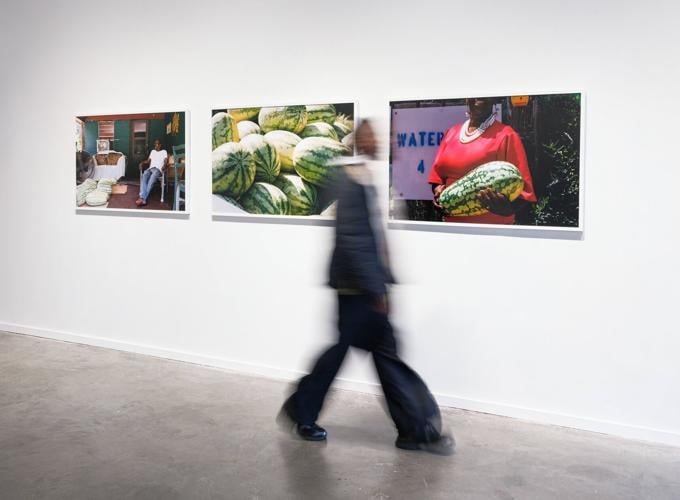
If youth and possibility course through the works on this side of the gallery, the three photographs on the other side deal with elders, lineage and maternity. And watermelons.
“Carry Me Through” is a portrait of a woman holding a watermelon like a swaddled baby. Her stylish red dress and pearls, as well as her direct, full-faced smile, show her pride in having her picture made. The camera crops off the top of the photograph and keeps it firmly outside of family-portrait territory — this mother, with her naturally cradling arms, is as much a mother-with-child as any Renaissance pietà. Again, Bryant has reclaimed art history for Southern Black culture, where it feels right at home.

Speaking with the Nashville artist about Forget Me Nots, now on display at the Frist
Another photograph is a pile of whole watermelons that could be a study in shadows, texture, pattern and repetition. But its central watermelon has a long stem that winds out of it in a way that mimics a newborn’s umbilical cord. Like the optimism of the light at the end of his dirt road, Bryant has made connections by deploying subtle, almost subliminally recognizable details.
Viewers who remember Forget Me Nots, Bryant’s 2022 solo exhibition at the Frist Art Museum, undoubtedly recall the wheatpasted posters that the artist frequently brings into his installations. Dirt Road Baby is no exception. A black-and-white photograph of a trailer from Bryant’s dirt-road hometown is wheatpasted onto the wall underneath the staircase. The to-scale photograph is printed onto four panels and hung almost like wallpaper, aside from the scratchiness of the wheatpaste technique. It’s an ambitious but irreverent addition to the show — it brings the country town into the gallery, contextualizing the work in its natural setting, but also upending the preciousness of an art gallery’s white-box suggestion. The crackles and ridges of the wheatpasted photo echo the weeds and vines that are growing up around the trailer in the same spindly shapes.
Sitting on the floor in front of the wheatpasted photograph is the same gold rim from Bryant’s photographs — bright and polished like a sentinel standing guard, at once a pedestal to stand on and a weight to carry.



Post a comment as anonymous
Report
Watch this discussion.
(0) comments
Welcome to the discussion.
Log In
Welcome to the discussion.
Keep it clean. Please avoid obscene, vulgar, lewd, racist or otherwise abusive language. Comments featuring hate speech or threatening or violent content will not be tolerated.
PLEASE TURN OFF YOUR CAPS LOCK.
Be truthful. Don't knowingly lie or mislead.
Be proactive. Use the “report” link on any comment that violates our comment policy.
Share with us. We'd love to hear your feedback.