
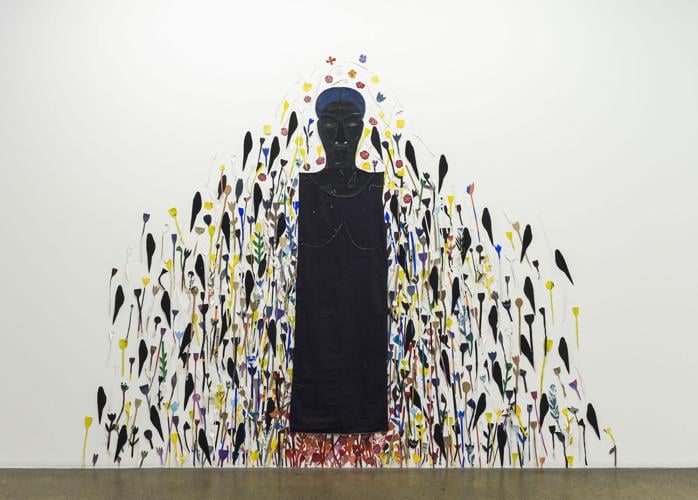
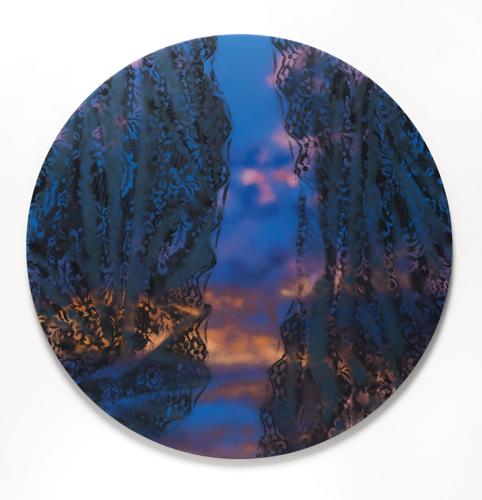
More than 100 artworks from 28 Nashville artists, representing four decades of our city’s art scene, fill up every corner of the Frist Art Museum’s largest gallery for In Her Place: Nashville Artists in the Twenty-First Century.
Co-curated by the Frist’s senior curator Katie Delmez, community engagement director Shaun Giles and independent curator Sai Clayton, the exhibition is one of the headliners of the museum’s 25th anniversary year.
The idea of an all-women Nashville art show first occurred to Delmez nearly a decade ago, and if we go back, we’ll remember that 2016 and 2017 were peak years for all-women group shows. As with all exhibitions dedicated to under-represented populations, such shows come with recurring debate about their merits and issues — one camp claiming that they reinforce stereotypes about the work being unable to stand on its own, the other side just happy for the opportunity. In the foreword to the exhibition catalog, art historian Katy Hessel addresses the obvious question — “Are we not beyond this?” — and answers with a regretful, “No, we’re not.” She reports that between 2008 and 2020, acquisitions by 31 prominent U.S. museums included only “11 percent by female-identifying artists, while only 0.5 percent were by Black American women.”
Fortunately, In Her Place isn’t so simplistic as to make gender a genre. Rather, it’s showcasing something special about Nashville’s art scene — the fact that women had such a major role in building it. In the accompanying audio tour to In Her Place, artist Vadis Turner puts it succinctly: “The female artists are very much the heavy hitters.”

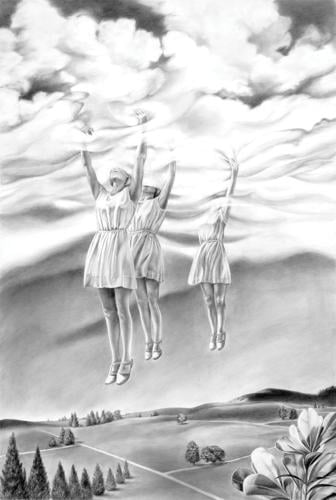
"Air and Dreams," Marilyn Murphy
In order for generations of women to be recognized on a societal scale for their contributions, it can be necessary for an institution like the Frist to make a clear acknowledgment, and that’s what we have with In Her Place. Additionally, if we go ahead and accept the importance of female artists and art professionals in Nashville, we can dispense with a fixation on gender as the show’s primary thematic tie-in. (If it were, there’d be some discussion of queerness, and there is none.) We can abandon any obligation to infer that the works’ traits, subjects and materials are stereotypically associated with femininity, and instead look at these 28 artists as representative of the people who laid the groundwork for Nashville’s contemporary art community. It’s not a comprehensive show, after all. There’s no way it can include everyone who “should” be here. So what are we left with?
Quite a bit. As you move from room to room, In Her Place feels like the best art crawl you’ve ever been to. Most rooms function like smaller themed shows based on malleable connections like “Materiality and Memory” or “Patterns and Abstractions.” You can imagine popping into the former Zeitgeist or David Lusk galleries to see Marilyn Murphy’s surreal pencil drawings of domestic settings in conversation with Ashley Doggett’s expressive portraits of violence and injustice in the history of Black enslavement and the Jim Crow South. The dreamy room with paintings by Emily Weiner, Karen Seapker, Katie Hargrove and LiFran Fort could easily be an afternoon at Red Arrow.
It’s an expansive show, but there are only three artists who have an entire room dedicated to their work — Raheleh Filsoofi, Elisheba Israel Mrozik and Jana Harper. These immersive spaces, devoted to wonderment and sensory overwhelm, have strong COOP Gallery, Elephant Gallery and Neue Welt energy. I spent the most time in Mrozik’s installation, seated on the floor (there are only two benches available for guests of the show) to watch a video of her swimming in Caribbean waters in the direction of Africa. I do wish that Lauren Gregory’s eight-minute short film “Ol’ Splashy” could be viewed in a small theater instead of on a screen with one headset, if only so I could sit and watch it with people more than once.
Something else I cannot get over is the scale of it all. Most of these pieces are huge. From Alicia Henry’s opener to Kelly S. Williams’ finale, the works tower over the viewer, hang from ceilings, reach to the rafters, cascade around corners. Even the sounds of birdsong from Filsoofi’s room spill over lavishly.

“How Do You Spell Your Name?” Kelly S. Williams
This remarkable scale is certainly one of the ways to tell the story of Nashville’s visual art scene. As many of the artists explain in the audio tour, Nashville has been an appealing place to live and make art because it was more affordable than where many of them came from, like New York City or Chicago. Here, they could afford to have larger spaces and literally expand their artwork, although several of them note that affordability is no longer what you can expect here. In this way, In Her Place is a retrospective of the creativity that can be made when supported by affordable housing and workshop space, and how accessibility allows an entire arts industry to flourish.
Along with the scale, there’s significant cohesion through techniques, materials and colors. We encounter genius uses of fabrics and quilting. We meditate on legacy, heritage, the love of the natural world, grief processing, family, motherhood and — of course — place and a sense of belonging.
In co-curator Giles’ essay on artist-educators from the exhibition catalog, he mentions Harper’s commitment to “the Indigenous concept of seven-generations thinking — that is, a responsibility to three generations in the past and three in the future.” This idea of creating backward and forward stayed with me, particularly when passing between Beizar Aradini’s delicate tapestries and Kimia Ferdowsi Kline’s table of salvaged wood objects. I am grateful that the show is not chronological, which could’ve been the case due to its association with the Frist’s anniversary. Instead, they’ve allowed for something far less finite and much more triumphant for these artists — recognition of their work as contribution to a city’s history, but also distinction from it.



Post a comment as anonymous
Report
Watch this discussion.
(0) comments
Welcome to the discussion.
Log In
Welcome to the discussion.
Keep it clean. Please avoid obscene, vulgar, lewd, racist or otherwise abusive language. Comments featuring hate speech or threatening or violent content will not be tolerated.
PLEASE TURN OFF YOUR CAPS LOCK.
Be truthful. Don't knowingly lie or mislead.
Be proactive. Use the “report” link on any comment that violates our comment policy.
Share with us. We'd love to hear your feedback.