

Many film critics say it’s easier — or at least more fun — to write about a film they hate than one they love. The reasons are surely various. As for me, I often love a work of art for its mysteries, which reveal themselves over time as I age. In writing down my first take, I fear I am robbing the experience of magic that will come with time. This is the case with Petite Maman, Céline Sciamma’s tender fifth feature film. But there’s another factor too. It’s a film that should be experienced through the innocent eyes of its protagonist, without prior knowledge of its premise. I’ll do my best not to spoil it for either of us.
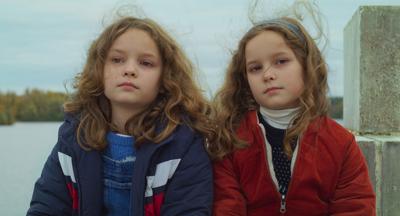
Petite Maman is a story about a girl and her mother. The film opens in a nursing home. Nelly, whose grandmother has just died, is about 8 years old, and she goes from room to room saying goodbye to the residents. Nelly is played by Joséphine Sanz, an endearing young French actor who brings a sense of curiosity and watchfulness to the role — as well as budding talent in spades.
Her relationship with her mother (Nina Meurisse) appears to be one of ease and intimacy. Nelly feeds her mother cheese puffs from the back seat of the car, and reaches forward to gently put the straw of a juice box in her mouth. But Nelly is also shown waiting for the inscrutable woman to reveal herself and be fully present in her life, for herself and for her family.
Nelly and her parents — her father played by a charming Stéphane Varupenne — go to her grandmother’s house to pack up the remainder of her belongings. The furniture is already draped in sheets, and the house holds little evidence of the lives of those who lived there. As Nelly’s mother tucks her in at night, Nelly comments that bedtime is usually the only chance she has to see her mom. We don’t know why, but can guess from mom’s melancholy, faraway looks that her grief precedes her mother’s passing. The following morning, the mother has gone home, leaving Nelly and her father to complete the job. Nelly, always thoughtful, takes the news in stride, finds an old toy and heads out to play.
Through unexplained magic, Nelly has the chance to learn about who her mother was as a child. The story unfolds buoyantly, but the knowledge that Nelly cannot stay in this world for long makes each scene bittersweet. Sciamma is a master of tone. For a casual viewer, it may not be obvious that the same writer-director made 2014’s spirited Girlhood, 2020’s incredible Portrait of a Lady on Fire and Petite Maman. This film has the most in common with her sophomore effort, 2011’s Tomboy, which follows a 10-year-old gender-nonconforming child as they look for a place of belonging. Tomboy is more concerned with the interior than the exterior — Sciamma does not need grotesque acts of violence to show what is at stake for trans kids.
Sciamma also uses a restrained hand in Petite Maman. The film is sincere but not sentimental. Nelly is precocious, but not excessively so. Sciamma trusts her audience to read between the lines, and summons exceptional performances from her cast, including her child actors. As the film unfolded, I wondered how the central relationship would play out as Nelly got older — whether she would be as forgiving, as devoted, or if she would become resentful.
It is perhaps inevitable that before we accept that life itself isn’t fair, we cast blame where we can — often on our parents, and specifically our mothers. I think all mothers have moments when they believe they are failing, and there have been moments when I thought my own mother did fail. But there have also been times I blamed myself for my mother’s suffering. Petite Maman does not side with either mothers or daughters, but rather asks a question I had never considered: For what might we forgive our mothers if we could meet them as children? How much more might we understand if we could live for a few days in their childhoods — walk in their woods, drink from their cups?
Petite Maman is a story about a girl and her mother, but it is also a story about me and my mother. And you might find yourself in it too.



Post a comment as anonymous
Report
Watch this discussion.
(0) comments
Welcome to the discussion.
Log In
Welcome to the discussion.
Keep it clean. Please avoid obscene, vulgar, lewd, racist or otherwise abusive language. Comments featuring hate speech or threatening or violent content will not be tolerated.
PLEASE TURN OFF YOUR CAPS LOCK.
Be truthful. Don't knowingly lie or mislead.
Be proactive. Use the “report” link on any comment that violates our comment policy.
Share with us. We'd love to hear your feedback.