
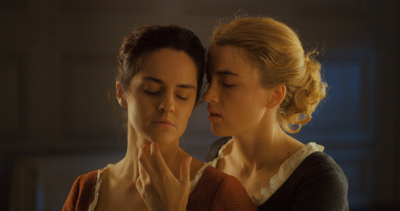


In a time when the debate about gender representation in cinema has been heated, a quiet, powerful film is slipping by without much fanfare. Portrait of a Lady on Fire, the fourth film from French writer-director Céline Sciamma, will likely outlive such conversations — it’s an achingly gorgeous picture that resists conventions and charts new territory in queer cinema.
It’s 1770, and Marianne (Noémie Merlant) has come to an island in Brittany, France, to paint the wedding portrait of a young noblewoman, Héloïse (Adèle Haenel). Héloïse left a convent after her sister took her own life by throwing herself from Brittany’s rocky cliffs, and she must now marry her sister’s fiancé, a Milanese nobleman. But Héloïse doesn’t want to marry the nobleman. She refused to sit for a portrait by the last artist the family employed, as if doing so could delay the inevitable marriage. Her family hires Marianne under the pretense that she’s simply there to take Héloïse for walks — to supervise her so that she does not choose death over marriage to a man she has never met, as her sister did. The painter must observe Héloïse closely by day and go back to her room to paint from memory each night.
What follows is a story of pauses and glances that build toward intimacy. At times it’s restrained, at times it’s ecstatic and otherworldly. Sciamma’s script is spare, and every word carries weight. Less central to the plot but still a potent character is Sophie (Luàna Bajrami), the servant of the house, whose role shows how some women did — and do — subvert gender and class distinctions, to create a small domestic space on their own terms.
Portrait of a Lady on Fire is ceaselessly beautiful. Cinematographer Claire Mathon frames her shots like they’re paintings, hyperconscious of how elements are positioned and how they relate to one another. As Marianne sneaks in a sketch on the beach, Héloïse walks behind her toward a massive stone archway that’s been carved by the sea. Marianne must perceive the most subtle details of her subject’s body, while Héloïse takes in the grand ocean and sky, a view that seems to quake with feeling. The ocean recalls a Renoir seascape; hunks of bread and cheese on a table in the firelight recall a Cézanne still life. In one scene that’s distinctly reminiscent of van Gogh, the three women hunt for herbs in a field of tall grass that undulates in the breeze. Mathon sets her lens on Marianne’s canvas as she paints, and we watch her manipulate paint and charcoal. Despite the gorgeously designed costuming and the film’s desolate but exquisite 18th-century setting, Portrait doesn’t feel like a period piece. The experience of being closeted, of being trapped in a world that denies queer people sexual freedom, is all too contemporary.
Merlant and Haenel are both superb in their roles. As Marianne becomes more conflicted about her secret mission — and more entranced by Héloïse — her professional demeanor softens, yielding to vulnerability. As Héloïse is drawn to the ocean and those jagged cliffs, Haenel expresses the character’s longing for sexual and personal liberation that’s as threatening as it is exhilarating. Best of all, Haenel embraces Héloïse’s anger, communicating it in small ways — a tense jaw line, an upright posture, nostrils that are just slightly flared — that give her a righteous edge.
Prior to the mid-20th century, women mostly fit into the history of painting as subjects — their likeness captured by and for the male gaze. Because of this, male desire is often imposed upon women in painting, as well as in film. But with Portrait of a Lady on Fire, Sciamma removes men from the equation altogether. We are concerned only with how these women look at one another, and how that translates onto a canvas. Héloïse is being seen, but not by the Milanese nobleman who will soon possess her — by a woman close to her own age, who expects nothing of her, and who understands how it feels to long for freedom and self-possession.
This is what makes the queer desire in Portrait so affecting, and Sciamma gets right what so many get wrong. For example, Abdellatif Kechiche’s 2013 scissor-fest Blue Is the Warmest Color was anointed as a masterpiece at Cannes. In that film, lesbian desire is depicted as a fusillade of pussy slaps, gasping mouths and agonized lovemaking interspersed with elaborate nude poses. Kechiche showed us what he wanted to see, focusing on his own desire — not that of his characters. Sciamma — who is a queer woman — puts her characters in full possession of their sexuality and their bodies, and eroticism comes naturally. The result is a revelatory testament of queer desire and resilience.



Post a comment as anonymous
Report
Watch this discussion.
(0) comments
Welcome to the discussion.
Log In
Welcome to the discussion.
Keep it clean. Please avoid obscene, vulgar, lewd, racist or otherwise abusive language. Comments featuring hate speech or threatening or violent content will not be tolerated.
PLEASE TURN OFF YOUR CAPS LOCK.
Be truthful. Don't knowingly lie or mislead.
Be proactive. Use the “report” link on any comment that violates our comment policy.
Share with us. We'd love to hear your feedback.