
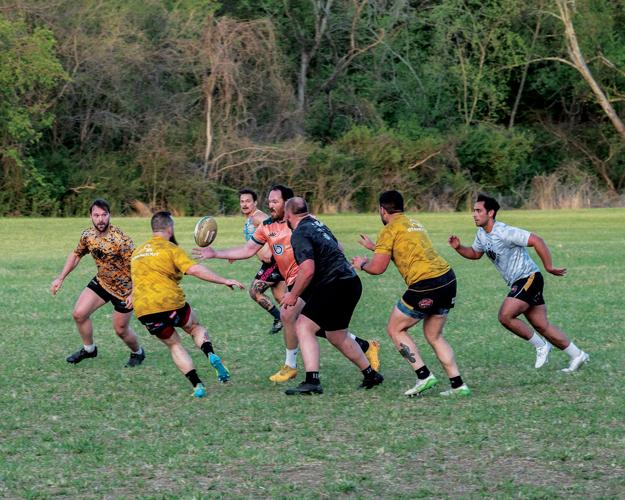


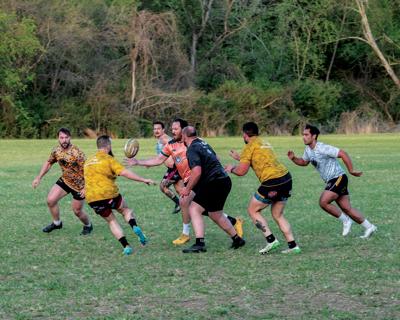
If you’re driving down Lebanon Pike on a Thursday night, right before you reach the “Welcome to Donelson” sign, make a right turn into a gravel parking lot. A couple hundred feet past the tree nursery is an open field, peppered with generator-powered light towers and a lone goalpost.
There you’ll find dozens of men from across the globe — France, South Africa, England, even Brentwood. Some are tall, some are short. Some have a lean build from years of running up and down soccer pitches, while others look like they stepped right out of a boxing ring. Some played high school baseball or football, others wrestled or ran track. A handful never played organized sports. At least one grew up playing Australian rules football in Melbourne. But for two hours on Thursday nights, their differences are nonexistent. Their singular goal is to move an elongated ball up and down a former dairy farm field. Afterward, they make the trek to The Lost Paddy for the weekly family dinner.

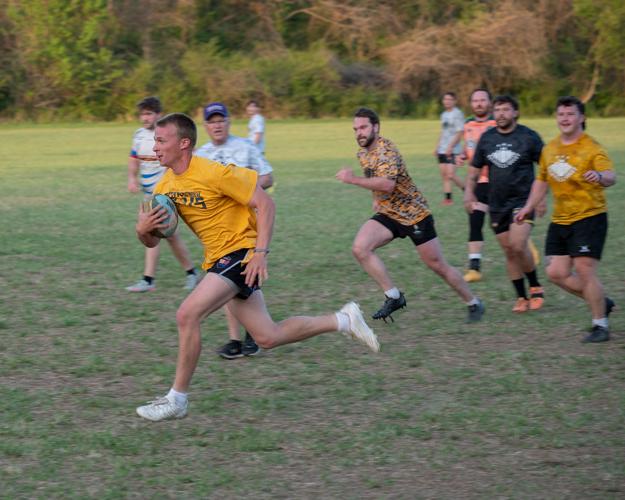
Nashville Rugby Football Club
Nashville Rugby Football Club is one of several organizations in the area that exist in a nebulous world somewhere between a professional sports team and a hobby. This isn’t your local kickball team that gathers at the park once a month to down a few beers and have a few laughs. (Though you can read about some of those elsewhere in this issue.) These athletes pay club dues, travel to other states for competitions, have professional-looking uniforms and practice at least twice a week. They also have full-time day jobs; some have families.
“The core guys … they spend their lives dedicated to this, making sure the club’s afloat, making sure we have nice gear, transportation to games,” says NRFC’s John Sutton. “A lot of these guys put their heart and soul into this.”
Sutton, who suited up for Iowa Central’s rugby program in college, has been playing rugby since he was 6 years old, then living in London. Players like Sutton — those who have a deep familiarity with the game — are integral in a setting where most of the athletes are converts from other sports. He says the most difficult part of teaching someone how to play rugby is breaking habits learned from other sports.
NRFC’s Keenan Kayser, who picked up rugby as an eighth-grader in Murfreesboro, says it’s “an anomaly” that he started playing as a kid in Middle Tennessee.
“The game is growing,” says Kayser, also president of the True South Rugby Union. “There’s a lot of good youth programs around. We’re excited for the influx.”
It's a perfect spring Saturday afternoon in Nashville. The city's skyline reaches into the faultless sky to the west. From the south, the wind…
Rugby is on the rise in Nashville. There are several dedicated clubs, including NRFC, Nashville Women’s Rugby Football Club and the Nashville Grizzlies, a queer-focused men’s club. Major League Rugby recently sent two of its best teams to Geodis Park for the inaugural Music City Rugby Showdown, the venue’s first non-soccer sporting event. Nashville is on the short list to be among the host cities for the 2031 Men’s Rugby World Cup and the 2033 Women’s Rugby World Cup. And the annual Nash Bash tournament features clubs from across the country. But even with a budding scene, there is no rugby-specific pitch in town. In fact, there’s only one rugby-specific field in Middle Tennessee, the nationally recognized Hendersonville Rugby Complex.
Clubs like these are always recruiting new players, whether through meet-and-greets, on social media or by forming relationships with local college programs. Sometimes interest spikes following heightened national exposure of the sport, like when U.S. Women’s Rugby star Ilona Maher became internet-famous during the 2024 Summer Olympics in Paris.
“We’ve definitely seen a huge growth in rugby — I think a lot in part due to the U.S. Women’s success at the past Summer Olympics,” says NWRFC board president Sara Bowman. “We had a lot more players coming out every new season to try it out just because they had seen it on TV.”
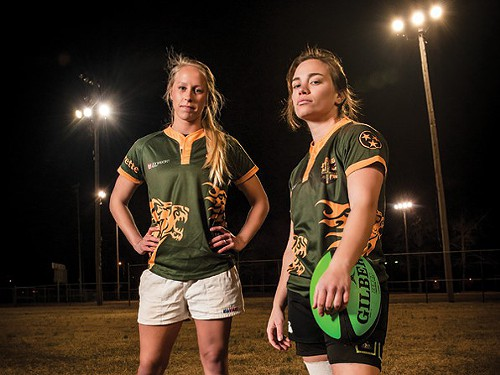
Hey, Nashville, did you know you had a women's rugby team? It's true! And not only do you have a rugby team, you have a CHAMPIONSHIP rugby tea…
Even so, it can be hard to convince people to put in the hours — and the dollars — necessary to fully commit to a club team environment, especially in a leadership role.
“It takes a lot of time, but I think the love of the sport drives us to do that,” says Bowman.
Other sports aren’t as lucky. Without a national wave of excitement to ride, it can be tough to keep the club afloat. The Nashville Kangaroos were among the founding members of the United States Australian Football League, the top level of Australian rules football (or “footy,” as it’s known down under) in America. The club finished as the runner-up in the first men’s Division I USAFL Grand Final.
Despite the on-field success, the Kangaroos often have trouble finding a practice space. Australian rules football fields are gigantic, roughly twice the size of an American football field. They’re also oval-shaped, making it hard to find a surface that accommodates their needs. There are apparently no Australian-rules-football-specific fields in America. In Nashville alone, there are more than 20 Metro-owned soccer fields, plus several “multipurpose fields,” essentially soccer fields where other teams are allowed to practice.
“I remember my first practice — after about an hour, I about fell in love with the sport right then and there,” says Kangaroos captain James Duty. “Even though it was unique and strange, it still oddly felt familiar.”
At the time, Duty — who’d previously been recruited to play college basketball at Lipscomb — was looking to replace the sense of community he lost when his journey with organized sports came to an end.

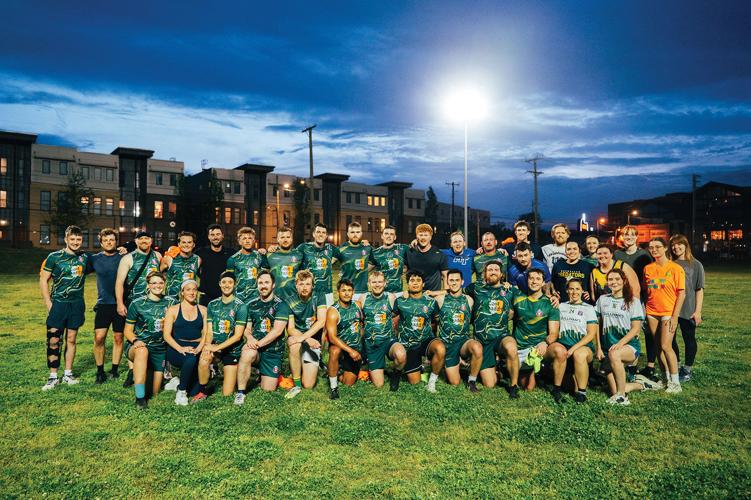
Nashville Gaelic Athletic Club
“There’s not enough options out there, from an American standpoint, for guys to get reintegrated into high-level competition, and for that individual to feel like they belong,” says Duty, who was inducted into the Kangaroos Hall of Fame after more than 100 career matches with the club.
“Sports and athletics are one of the best gifts a community has,” he says. “It’s incredible the type of connections [that form] and the barriers that get broken down when you involve athletics.”
Compared to other countries — think of the infamous Sunday football leagues in England — there is a lack of infrastructure and funding for competitive, community-based adult sports leagues in America.

Hurling sliotar used by Nashville Gaelic Athletic Club
“The benefits aren’t just for the team, it’s individually as well,” says Daryel O’Brien, a member of the Nashville Gaelic Athletic Club, who grew up in Ireland. “You’re running around, you’re being active, you’re socializing. One thing I’ve noticed about America is, after you leave college or high school, there’s very few adult leagues for the amount of people that are here in the country.”
Under the NGAC umbrella are men’s and women’s Gaelic football teams, as well as an integrated hurling team (think lacrosse crossed with field hockey). But the organization also functions as a sort of Irish community ambassador in Nashville. In November, the club hosted the United States Gaelic Athletic Association’s annual convention.
O’Brien is both a player and a manager for the NGAC’s men’s club, which features players from a half-dozen countries and has an unofficial headquarters at The Lost Paddy — apparently a thriving hotspot for Nashville sports clubs.
“We have lads who are from Ireland who have played all their lives,” says O’Brien. “We have lads from Ireland who never played at home. But once you come out here, a GAA club is the closest thing to an Irish community that you’re going to get out here. … Our club is very inclusive. It doesn’t matter about race, religion, gender, sexual preference, we don’t care. We accept everyone; we train everyone.”
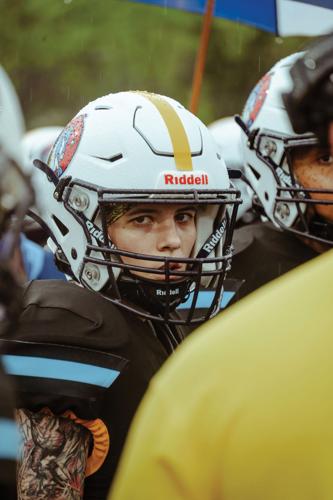
Other than a fight for space and a lack of resources, these clubs all have something else in common: They operate in the enormous shadow of American football, especially in the South. But the Tennessee Trojans have almost the opposite problem. They are a football team in the football-crazed South, playing at the highest level of competition for their sport — the Women’s National Football Conference. But because women’s football has historically been wildly underfunded compared to its male counterpart, these athletes are often paying out of pocket just to compete.

Tennessee Trojans
“When I found women’s tackle football, I had never experienced the teamwork, the sisterhood anywhere else,” says Tessa Ortiz-Marsh, Trojans quarterback and co-owner. And that’s saying a lot — she played college softball and was in the military for nearly 20 years, including two tours as a combat medic.
Women’s football is on the rise thanks to an explosion in popularity for flag football, which is being rapidly added to college athletics departments across the country and has been added to the docket for the 2028 Summer Olympics in Los Angeles. But women’s tackle football is still fighting for its place.
“It’s the first time ever that girls are playing the sport in high school and then knowing that they can go play at a higher level,” says Ortiz-Marsh, whose wife Rachel is also a Trojans co-owner.
“We do have some athletes who have never played a sport in their entire lives,” she continues. “It’s a lot of our linewomen, because women who [have] the body stature of offensive linemen or defensive linemen, growing up, they’ve been told they’re not athletes because of their size. And then they find football, and they’re celebrated for their size.”
At the Trojans’ home opener at Hendersonville’s Beech High School in April, the Scene spoke to the father of three young girls in the stands. They had traveled all the way from Alabama just to watch the game. With a lack of women’s tackle football options, this is the closest professional-level team within driving distance.
“Representation matters,” Ortiz-Marsh tells the Scene after the game. “That’s what we do every single day. We put our cleats on, we put our shoulder pads on, and we give the next generation the representation, so that they can see it and be it.”

A four-part look at recreational leagues and high-level clubs



Post a comment as anonymous
Report
Watch this discussion.
(0) comments
Welcome to the discussion.
Log In
Welcome to the discussion.
Keep it clean. Please avoid obscene, vulgar, lewd, racist or otherwise abusive language. Comments featuring hate speech or threatening or violent content will not be tolerated.
PLEASE TURN OFF YOUR CAPS LOCK.
Be truthful. Don't knowingly lie or mislead.
Be proactive. Use the “report” link on any comment that violates our comment policy.
Share with us. We'd love to hear your feedback.