
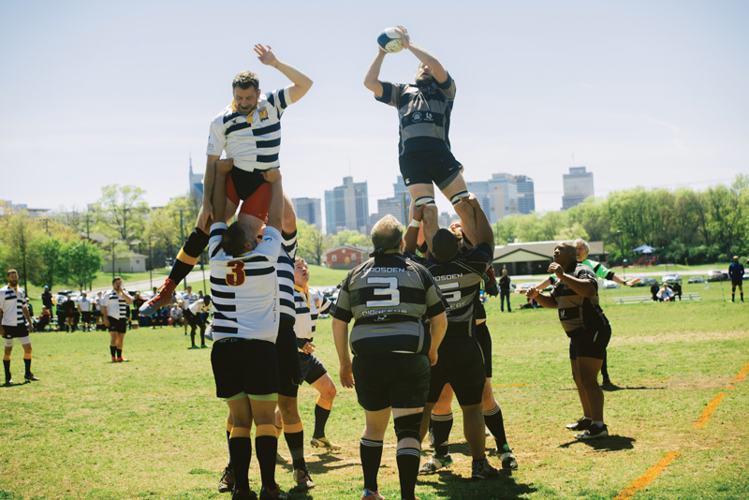
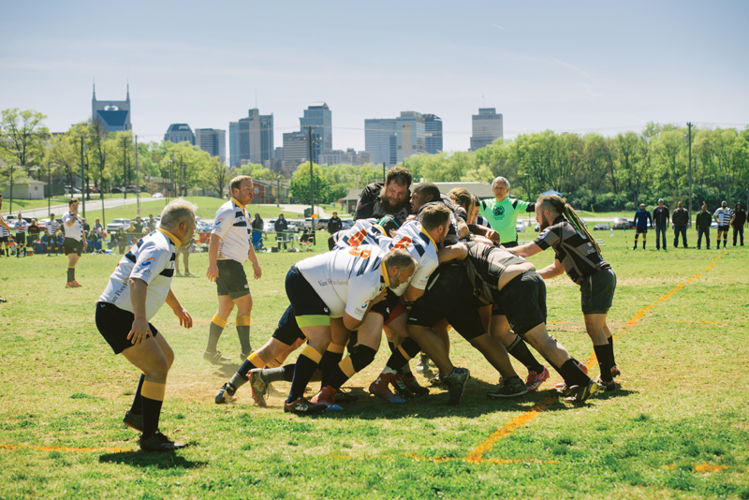
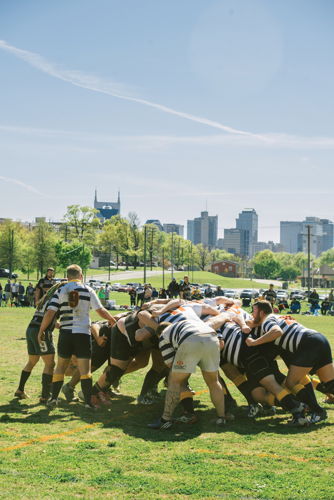

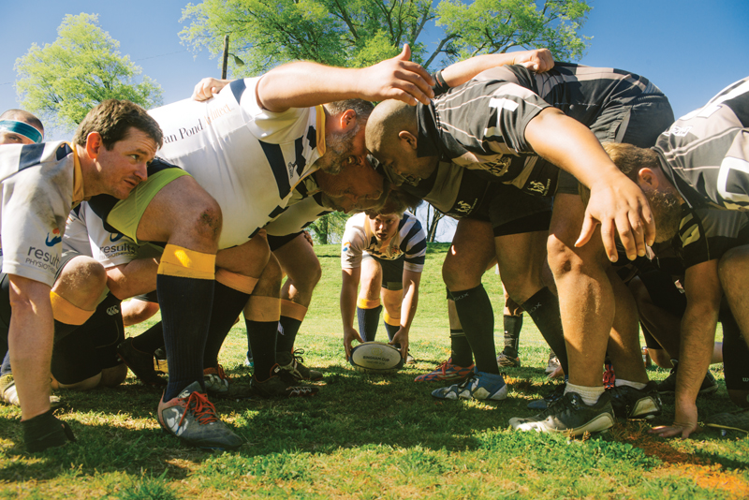


It's a perfect spring Saturday afternoon in Nashville. The city's skyline reaches into the faultless sky to the west. From the south, the wind puts a comfortable bite into the air as it blows in fits and starts.
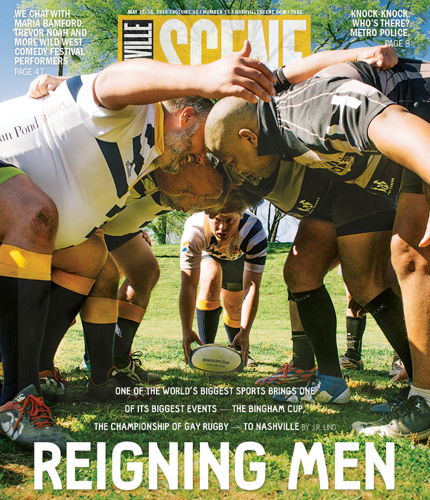
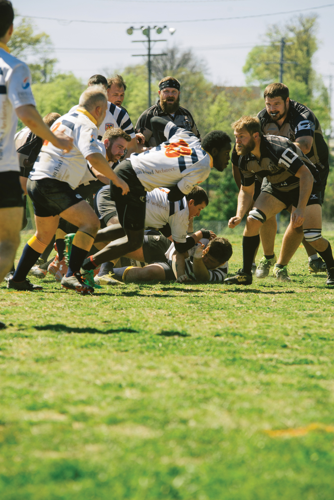
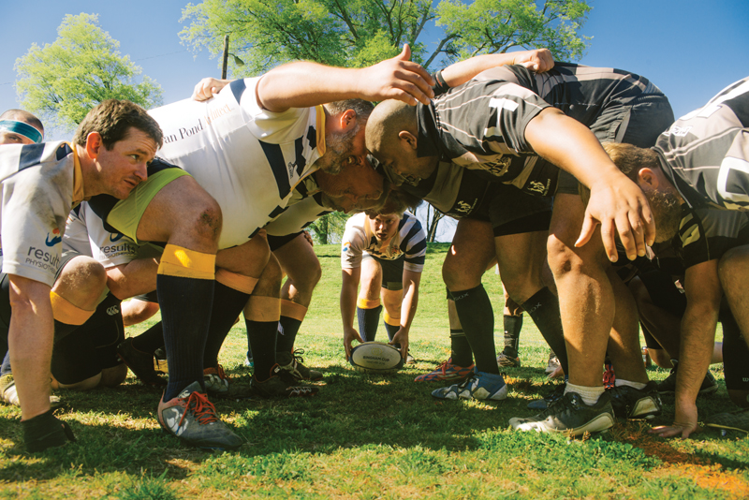
On a scraggly field in Douglas Park, 30 men take their positions — eight from each team in three tight lines facing one another, the other 14 scattered around.
The referee directs traffic and then shouts.
"Crouch!"
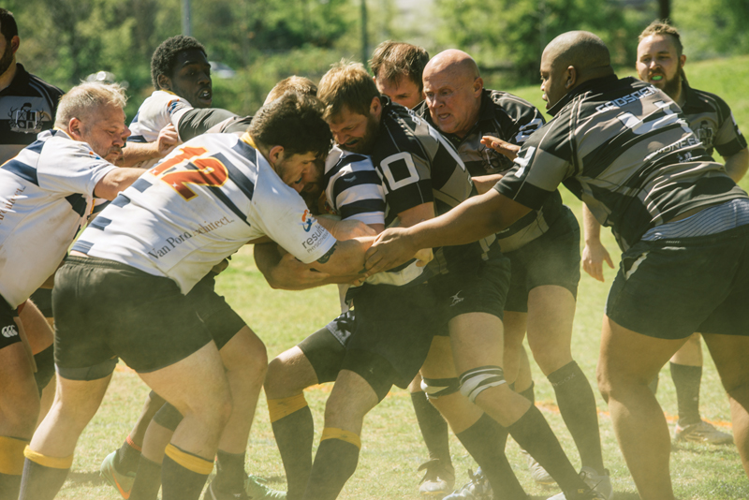
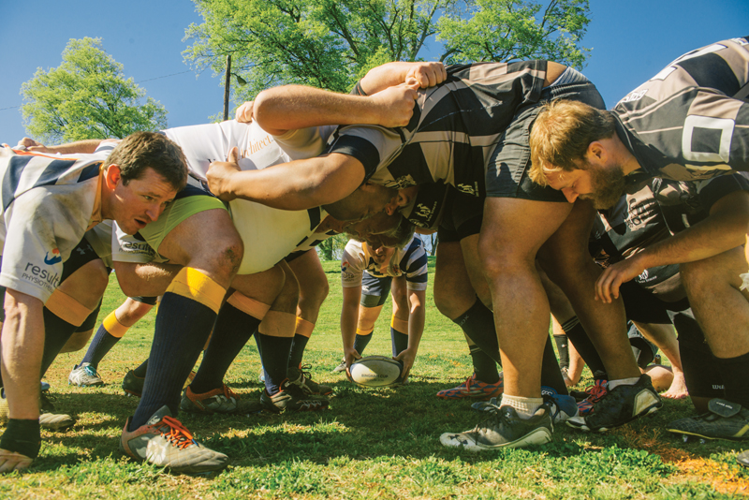
The broad men up front toss their arms — biceps like rolled-up Sunday newspapers, forearms like bridge cables, hands the size of salad plates — on the ample shoulders and expansive backs of their neighbors. Under telephone-pole thighs, knees bend on command.
"Touch!"
The props — the men on the outside of each pack — place their free hands on the shoulders of their opposite number. One more look from the referee and then ...
"Set!"
The packs lean forward and push, with the props and the hooker — the man in the middle of that front row — pressing into the other side. The locks and flankers behind drive forward, the Number Eight — in a sport with such delightful and specific position names, the Number Eight leads in whimsy, as it seems that after expending energy naming the other positions, someone just gave up — providing support from the rear.
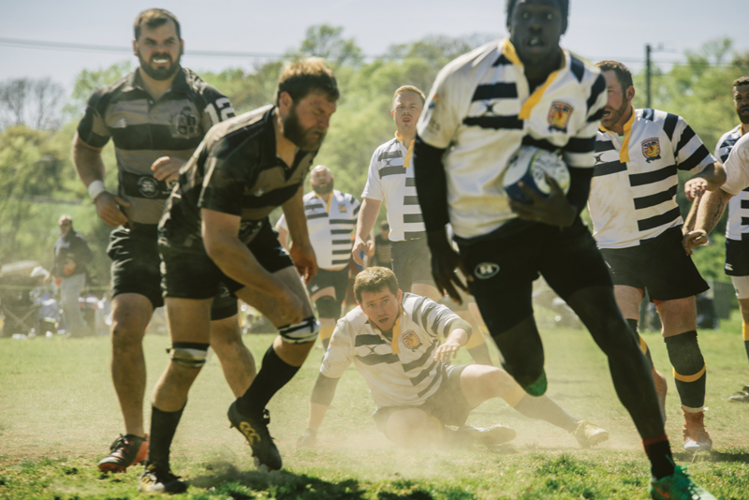
The scrum half feeds in the ball. A mass of feet and brawn fights for possession until the ball rolls out of the back to be picked up by speedier men looking to score.
This is rugby, a sport that perhaps more than any other has a place for players of all shapes, sizes and gifts. That was a scrum, the set piece that exemplifies that quality more than anything.
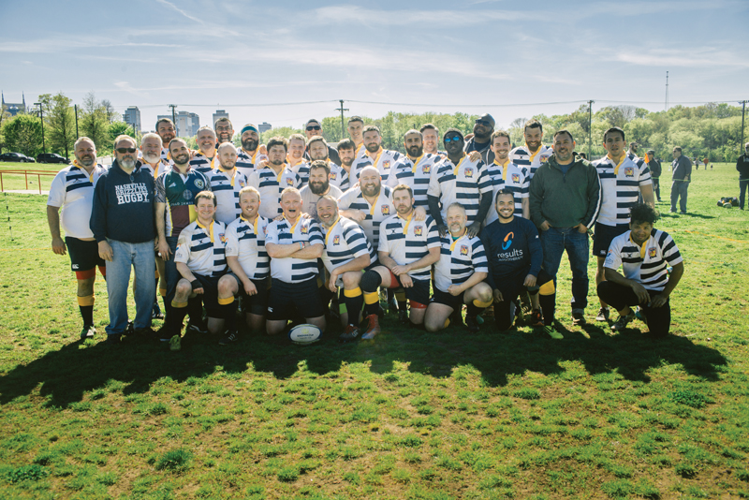
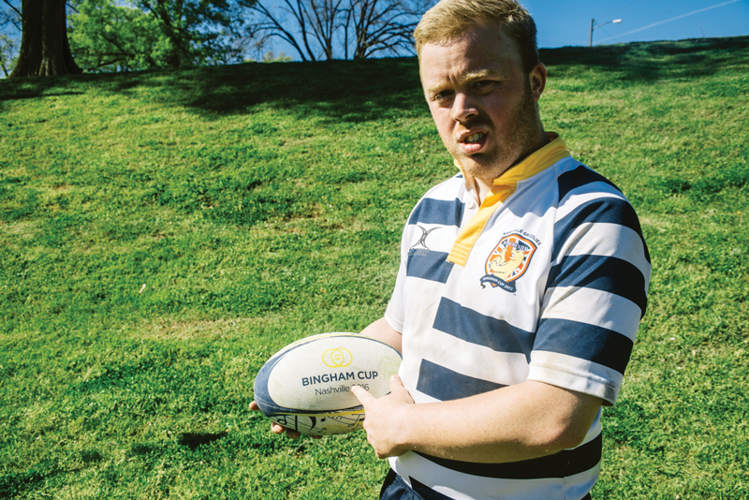
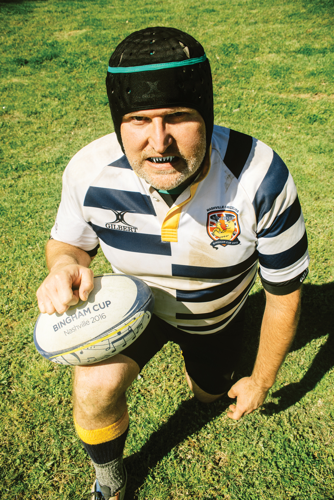
The team is the Nashville Grizzlies, the host of this summer's Bingham Cup, the world championship for gay rugby teams and the second largest event on the planet for one of the world's most popular sports. May 26-29, that event comes to Nashville.
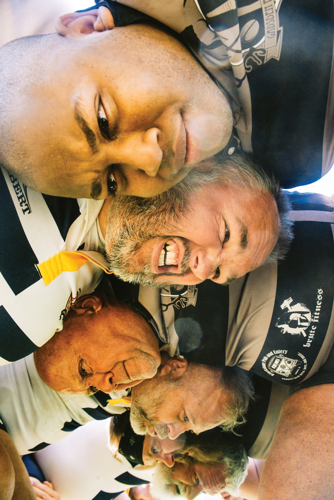
In addition to being illustrative of rugby as a sport for all body types, the scrum also serves as a shining example of the level of trust and respect players must have for one another. The scrum is one ton of humanity pushing against another in a space smaller than a standard office cubicle, fighting over a foot-long ball. It is a sport played with less protective equipment than soccer. Sideline sprints are stopped with stunning form tackles, and yet there are far fewer head injuries than in American football, with its weaponized players.
It is, as a famous English quip explains, a sport for hooligans played by gentlemen.
But for all the respect rugby requires, the coming Bingham Cup, which will bring as many as 40 teams from the United States, Canada, Australia, the United Kingdom, the Netherlands, Portugal and elsewhere, with a total of 800 players and 200 supporters, has received broader attention for a moment of disrespect.
State Rep. John Ray Clemmons, a Nashville Democrat, filed a resolution honoring the tournament, but after a kerfuffle during debate of a similar resolution honoring Nashville Hispanic activist Renata Soto, he pulled the resolution.
"The gist is, [Republicans] were going to fight it, and I don't want to send the signal to the state of Tennessee or the world that we don't support this event taking placing in Nashville, Tenn.," Clemmons said at the time. "I'll find another way to honor them without allowing the supermajority to send the wrong signal."
Republicans argued that the resolution was solely meant to cause them political problems, a charge Clemmons denied.
On one hand, honoring an LGBT-friendly event might cause the more vicious social-conservative element to bristle. On the other, voting against the resolution would mean on-the-record opposition to the namesake of the tournament.
After playing rugby for University of California Berkley, one of the top college programs, Mark Bingham was instrumental in founding two of the pioneering gay rugby teams in the United States: the San Francisco Fog and the Gotham Knights. To put that in perspective: In 2001, there were six gay rugby teams in the world, and Bingham founded two of them.
On Sept. 11, 2001, Bingham was flying on Flight 93 between Newark and San Francisco. Of course, the plane never made it there, as four al-Qaida hijackers took over the flight. But they were overpowered by a group of passengers, widely believed to include Bingham, and the plane crashed in a field near Shanksville, Penn.
The Grizzlies stayed out of the political fray, even after Clemmons pulled the resolution, instead emphasizing the support the tournament has received from Metro Nashville. That makes the debate about the resolution an example of the often fractious relationship between city and state, particularly on LGBT issues.
Jon Glassmeyer is the chairman of the committee organizing the Bingham Cup in Nashville. The process began in 2014, with the winning bid announced a year ago. Glassmeyer and his crew have to wrangle fields, referees, volunteers, housing and transportation — no small undertaking.
Ask Glassmeyer to get into the details of the details, and he can rattle off statistics and times like a train conductor, his face bending into the mixed sort of expression that indicates a sense of accomplishment and a very serious need for some time off.
The Scene met up with Glassmeyer at a fundraising beer bash at Tribe before the start of the Grizzlies' season. Glassmeyer is perhaps a little older than many of his teammates — though not all of them, as the Grizzlies range in age from 20 to mid-50s, demonstrating the appeal of rugby across the age spectrum. Glassmeyer notes that he is drinking something a little more high-end than the thin, golden-colored brew coming out of the beer-bash keg.
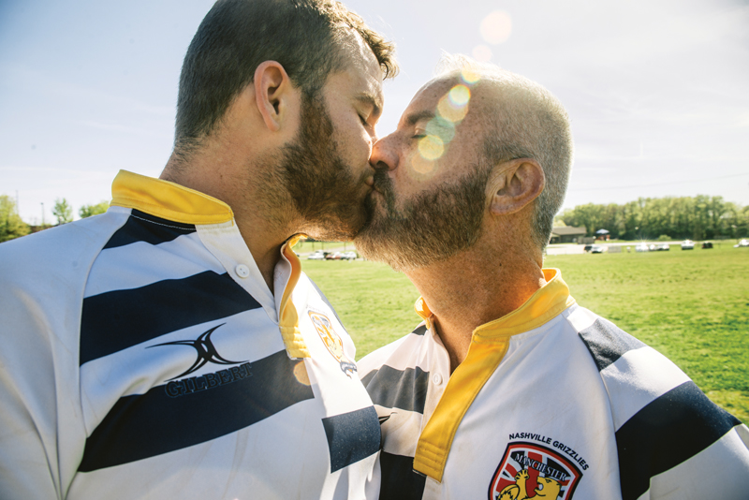
He emphasizes that the Bingham Cup and its parent organization, International Gay Rugby, aren't just for players who are gay. International Gay Rugby is more about clubs that are gay-friendly and inclusive. The Grizzlies, like most IGR teams, have straight players.
Because of the hypermasculinity of the sport, gay men did not always feel comfortable in locker rooms where "sissy," "gay" or "fag" were used as casual insults.
"For a long time, gay men have been excluded," says Grizzlies club secretary Thomas Hornby. "Calling somebody a sissy or gay was an insult suggesting that they weren't athletic. That's what gay rugby is trying to address."
While greater society is certainly moving toward inclusiveness and acceptance, things are far from perfect — there is still a place for sports organizations that emphasize gay-friendliness.
Rugby, Glassmeyer says, is particularly attractive for gay men. As a sport that is not particularly well-known in the U.S., players — gay or straight — already see themselves as being outside the mainstream. The mutual respect that rugby requires from its players engenders a camaraderie between teammates and opponents that isn't always prevalent in other team sports, and the wide range of sizes and skills makes it a naturally inclusive sport.
The Grizzlies' motto is "Tecum Fratres" — "With you, brother."
Captured in two Latin words is a concept that illustrates all that is good about team sport. And as club president Jeremy Dykes notes, it's a comforting message for gay men looking for a community, particularly if they come from places that are not welcoming or if they have struggled with finding a support structure.
And then there are the parties.
In rugby, the tradition of the post-game blowout, known as the "third half," is a very serious proposition.
"You to get to hit people," Dykes says. "And then drink beer."
The Grizzlies, who will celebrate 10 years in October, are now regularly playing quote-unquote "straight teams."
Is there ever any homophobic trash talk or vitriol or slurs from the straight teams? In 2016, that should be a silly question, but this is the year when the Bathroom Bill, the Counseling Bill and the opposition to the Bingham Cup resolution itself was taking place a mile away on Capitol Hill.
Dykes sips his beer and shrugs.
"When you find a rugby bar, it's like being in a giant fraternity or sorority," he says. "And everybody knows gay rugby teams throw the best parties."
Back to that perfect spring afternoon.
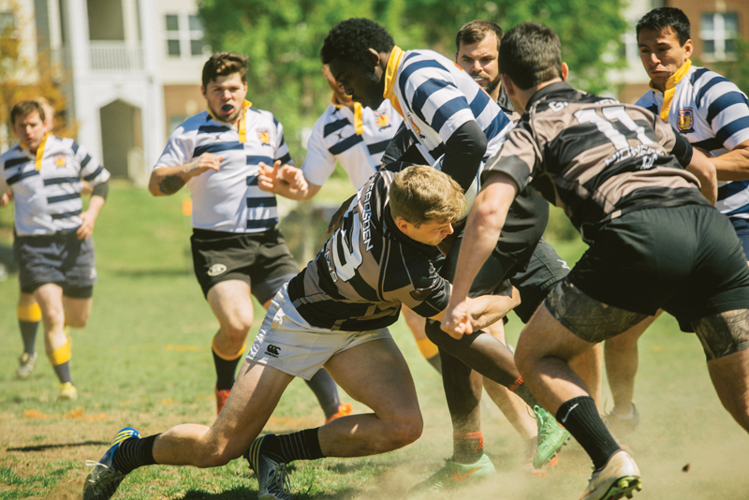
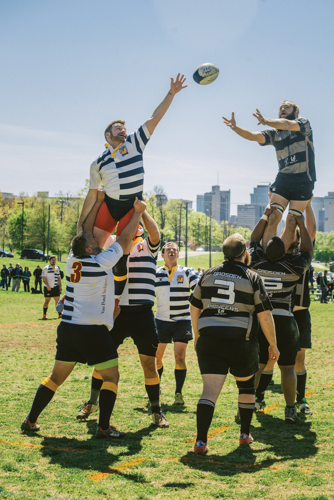
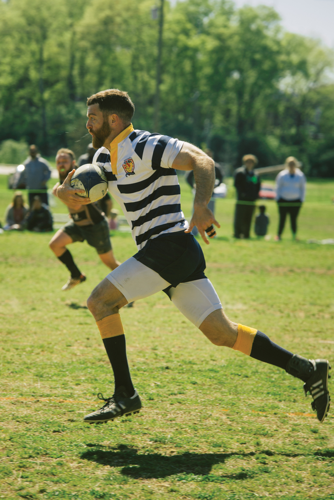
It is the final match of the regular season, the last home match for the Grizzlies before the Bingham Cup. In a competitive and surprisingly high-scoring game — plenty of sideline sprints and tough inside running led to a bevy of tries, the rugby analog to the touchdown — Nashville fell to the visiting Gadsden, Ala., Pioneers, 55-46.
The crowd, which fills the modest bleachers and spans the touch line with folding chairs and blankets, is boisterous, even rowdy, as serious about disputing the referee's decisions as any crowd a few blocks away at Nissan Stadium.
The tight contest produces hot tempers at times, but no extracurricular pushing and shoving, or any of the other shenanigans one sees both at Nissan Stadium and at any local YMCA pickup basketball game. Again, rugby requires a great deal of respect.
The whistle blows, the ball goes into touch, the game ends with the home team on the wrong side of the score line.
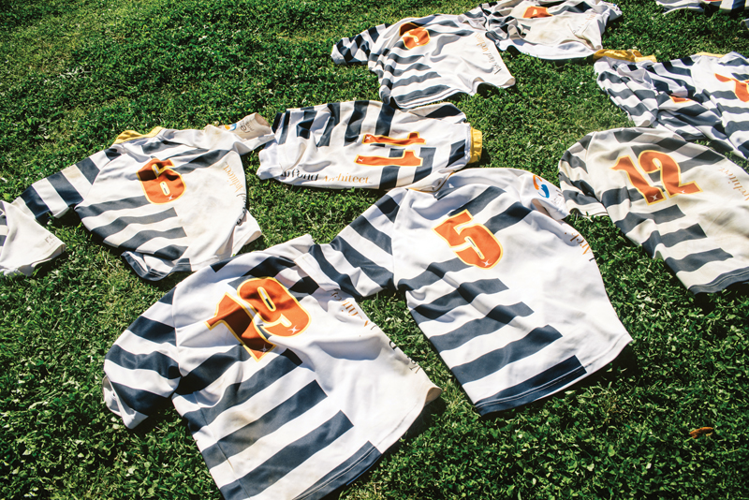
Handshakes are exchanged and uniforms are doffed for postgame attire — including a shocking number of kilts. The goalposts are disassembled.
Then the most important piece of information is relayed with a booming voice.
"THIRD HALF AT THE STIRRUP!"
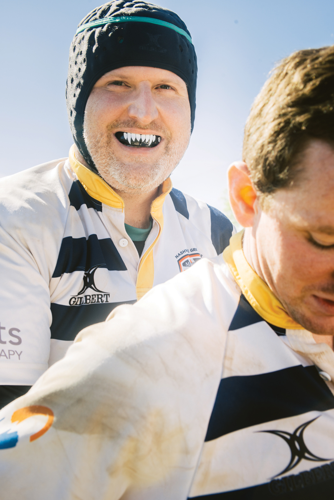
Men who moments before had been in pitched battle throw those Sunday newspaper arms over each other's shoulders, the spirit of competitiveness melting like the setting sun into the spirit of brotherhood. Today it is Nashville and Gadsden.
In a few weeks, it will be the world.



