
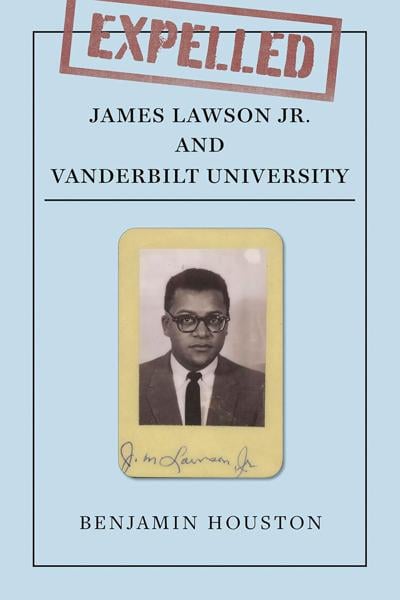

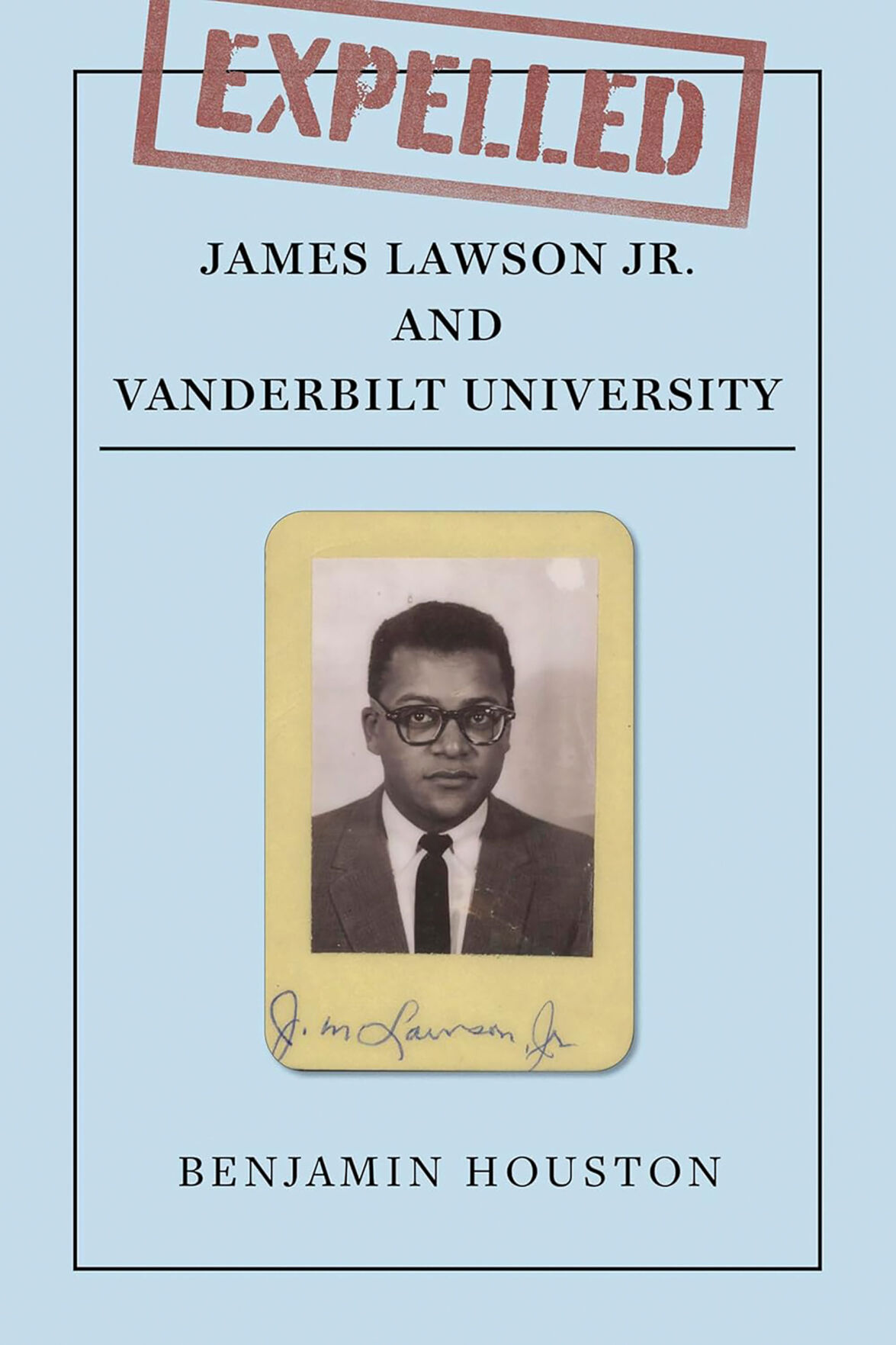
People talked differently then, and more of them read newspapers, but much of Benjamin Houston’s short and laser-sharp Expelled: James Lawson Jr. and Vanderbilt University feels eerily familiar 60 years after Vanderbilt kicked James Lawson out due to his involvement in Nashville’s civil rights movement.
After brief but thorough biographical and historical context, Houston zooms in on February and March 1960, as civil rights organizers escalated a campaign against segregated downtown lunch counters. A big fundraising drive was looming, and on March 3, 1960, the Vanderbilt board of trustees’ executive committee — guided by ever-fuming conservative James Stahlman, publisher of the Nashville Banner, along with influential Nashville attorney Cecil Sims — voted unanimously to expel Lawson. At the time Lawson was a graduate student at Vanderbilt Divinity School, and the board cited his “mass disobedience of law as a means of protest” in the expulsion.
Houston’s book adds insight and depth to the always-growing body of civil rights scholarship. This documentation has become even more important as the era’s firsthand witnesses enter and pass through old age, like Lawson, who died in 2024. Nashville civil rights figures C.T. Vivian and John Lewis both died in 2020, and Ernest “Rip” Patton died in 2021. Others — Diane Nash, Bernard Lafayette — are in their 80s.
Expelled’s fine-grain focus also allows readers to see two more mundane but critical developments that surrounded the flashy, newsmaking moments to which the civil rights era is often reduced in school history books. First, the time and experiences that formed Lawson’s commitment to nonviolent civil disobedience and the slow, methodical years over which Nashville’s civil rights movement formed, trained and built internal trust. Second, Expelled shows an institution fumbling its way through defective moral and practical calculus as it hopes to save face and curry favor among its perceived constituents — in Vanderbilt’s case, the South’s white elite.
Houston’s depiction of Mayor Ben West — who was suddenly unavailable as activists’ “Big Saturday” lunch counter sit-ins roiled the city on Feb. 27, then equivocating and evasive in a subsequent meeting with local Black ministers — shows the same misguided leadership. In addition to commanding the city’s white-sympathizing police force, West reportedly drew equivalence between civil rights protesters and segregationist militant John Kasper, a Klansman — both threatened his devotion to the status quo. This exact false balance, better known today as “bothsidesism,” was a favorite pillar of contemporary Nashville news coverage.

The civil rights leader died June 9 at age 95
Vanderbilt Chancellor Harvie Branscomb’s strengths were raising money and staking out “middle ground,” in the words of desegregation scholar Melissa Kean. Branscomb steered the university slowly, cautiously, “gingerly” toward integration — a precondition for federal grants, writes Houston. The second relevant administrator, J. Robert Nelson, dean of the Divinity School, facilitated communication between higher-ups and Lawson, whom Nelson held in high regard as a student — though he ultimately chose not to risk his professional standing to protect Lawson.
Houston heaps praise on Lawson himself, portrayed throughout Expelled as the only main character with a clear conscience and consistent principles.
“Not a single white person in this book understood Lawson fully on Lawson’s own terms or using criteria faithful to Lawson’s own perspective,” Houston writes halfway through.
The media is a central force in the book, earning attention from Houston for how they shaped and guided public opinion primarily against Lawson with smear campaigns and bad-faith arguments. Houston posits Stahlman’s Nashville Banner as a key mouthpiece that enabled Lawson’s ouster. The era’s confusing, sometimes conflicting federal, state and local laws governing segregation, and their selective enforcement, also echo through the decades. Attorney Sims’ guidance on this front allowed the university to manipulate the gray legal and statutory landscape to slow-walk integration and, later, to maneuver university processes against Lawson.
Houston’s punchy book, published by Vanderbilt University Press this month, follows up on his first study of the Nashville civil rights movement, 2012’s The Nashville Way, which pays specific attention to social etiquette and civility as a veneer for moderates’ complicity in propping up white supremacy in midcentury Nashville.

Author Betsy Phillips’ Dynamite Nashville: The KKK, the FBI, and the Bombers Beyond Their Control is scheduled for release via Third Man Books…
It took just a few months to reveal the shortsighted political missteps of Branscomb and West, the poisoned legacy of racist Stahlman and the ideological bureaucracy of Sims, as the civil rights movement gained ground throughout the spring. West was forced to make a public concession to integrate lunch counters after the bombing of Black civil rights attorney Z. Alexander Looby’s home in April 1960. Meanwhile, Vanderbilt faculty, specifically within the divinity school, imploded amid fallout from Lawson’s expulsion. Branscomb fought a brief campaign to readmit Lawson before authoring his own confusing resolution in June. Several faculty resigned that summer, students withdrew, and bad press piled up. A chill spread across campus, plunging Vanderbilt into an existential crisis. Nelson became paranoid and ultimately lost his position as VDS dean. In this way, careful strategic nonviolence by Lawson — who trained the activists integrating lunch counters in Nashville but did not sit with them himself on Big Saturday — forced Nashville, Vanderbilt and the South to face its own moral crisis.

The 38th annual celebration of the written word takes place Oct. 17 and 18



Post a comment as anonymous
Report
Watch this discussion.
(0) comments
Welcome to the discussion.
Log In
Welcome to the discussion.
Keep it clean. Please avoid obscene, vulgar, lewd, racist or otherwise abusive language. Comments featuring hate speech or threatening or violent content will not be tolerated.
PLEASE TURN OFF YOUR CAPS LOCK.
Be truthful. Don't knowingly lie or mislead.
Be proactive. Use the “report” link on any comment that violates our comment policy.
Share with us. We'd love to hear your feedback.