

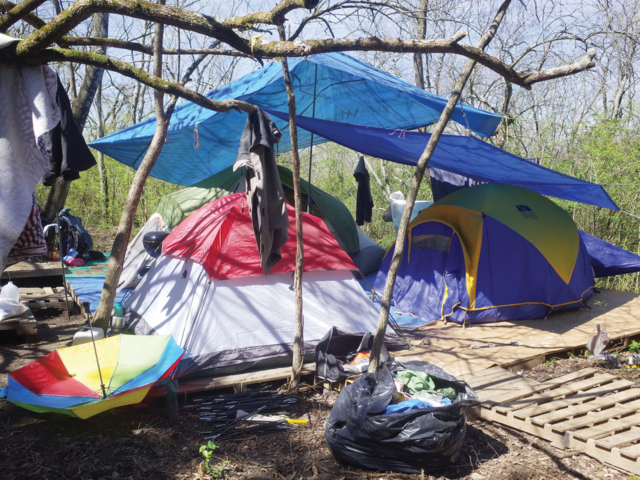
Former homeless encampment at Fort Negley
A major issue for people experiencing homelessness when they’re trying to find housing is determining exactly where to start. As it stands, they’re often shuffled from organization to organization, told to go one place and then redirected to another. Some people give up, and almost everyone spends a great deal of time in the pipeline waiting for housing.
On July 3, Metro Council voted to create a policy that for some people could be the difference between finding housing and staying on the streets. The ordinance (Ordinance BL2018-1199) brings together the former Metro Homelessness Commission and the city’s Continuum of Care Governance Commission. Both organizations were essentially tasked with ending homelessness, but often found themselves making decisions independently of each other. The Metro Homelessness Commission has also been renamed as the Metro Homeless Impact Division.

Judith Tackett, director of the Metro Homeless Impact Division
“It’s always been the same goal with the two boards, but it was always complicated because even internally with staff there were more coordination steps than should even be necessary,” says Judith Tackett, director of the Metro Homeless Impact Division. “And then you have people on the streets hearing, ‘Here’s where you go, then here’s where you go,’ and so on until they possibly give up, which is honestly a huge problem.”
The work of Metro Homeless Impact Division will largely remain the same as that of the Metro Homelessness Commission, but the barriers the organization had to go through in previous situations will be reduced. The Metro Homeless Impact Division will be a part of the larger group, now called the Nashville-Davidson County Continuum of Care Homelessness Planning Council.
“The goal is to have a system in place to reduce the amount of time people are on the streets while they’re working on housing — to reduce how long they’re outdoors,” Tackett says, adding that this has been the goal all along, but that the new structure should help the city get there more quickly.
Liz Allen Fey, former chair of the Metro Homelessness Commission, says that for the past 10 years, the ability to ease homelessness in Nashville has been negatively affected by having two separate Metro entities working on the same issues. One goal both groups were working toward is creating a coordinated entry system — a new requirement from the U.S. Department of Housing and Urban Development. Coordinated entry is a multi-pronged effort centered on prioritizing people with the greatest need and creating low-barrier opportunities for housing.
“With one body, we can harness our collective energy and look to leverage greater local and national resources to create a true coordinated entry system along with the housing and services needed,” Allen Fey says.
We can’t expect to see significant changes in the city’s relationship with its homeless population overnight. The ordinance is just the beginning of the process of bringing both groups together — a three-hour meeting slated for July 18 will include merging the previous boards together as one.
Sean Muldoon is the clinical services manager for Operation Stand Down Tennessee, a nonprofit that provides social services for veterans. Muldoon was also the chair of the Continuum of Care Governance Commission board, and he says that initially, the board members from both groups will remain in place.
“The great part of this partnership is that both boards’ members are already passionate about ending homelessness in our community, committed to the process, and working toward solutions,” says Muldoon. “Our immediate task, therefore, is to use that energy to identify and enact a singular strategic vision and plan, clarify and consolidate processes, and get to work for those experiencing or living at risk of homelessness.”
Tackett, director of the Metro Homeless Impact Division, says that rather than people spending so much time working between government organizations, “the real coordination should be happening with the service providers, so that when people need help, they know where to go.”
While having a simpler governance structure will allow for better coordination on the ground, the new ordinance won’t be a silver bullet, Tackett says. She says the most recent city budget cycle left the then-Metro Homelessness Commission short on the resources it needs to be truly effective.
“I have been very open about it,” Tackett says. “I have asked for a larger staff in this past budget, and, of course, I didn’t get it. But having this new structure will hopefully set a clearer picture on where we’re coming from. It’s not just going to be, ‘Judith Tackett and her team needs this,’ it’s going to be an ask made through community input that shows why we need additional dollars for certain resources.”



Post a comment as anonymous
Report
Watch this discussion.
(0) comments
Welcome to the discussion.
Log In
Welcome to the discussion.
Keep it clean. Please avoid obscene, vulgar, lewd, racist or otherwise abusive language. Comments featuring hate speech or threatening or violent content will not be tolerated.
PLEASE TURN OFF YOUR CAPS LOCK.
Be truthful. Don't knowingly lie or mislead.
Be proactive. Use the “report” link on any comment that violates our comment policy.
Share with us. We'd love to hear your feedback.