

Nashville Symphony Orchestra musicians will be working harder for less money during the 2013-14 season.
After months of tense negotiations, the musicians decided on Tuesday to ratify a contract that cuts their pay by 15 percent. This new collective bargaining agreement takes effect immediately and lasts just one year.
"In effect, the musicians and the Nashville Symphony have agreed to talk and play," says Drew McManus, a Chicago-based orchestra expert and consultant. "I imagine that a new round of talks, which may be either formal or informal, will probably start up as early as September."
Under the new agreement, the musicians will continue to play a 44-date season. They'll receive smaller paychecks, though, for each performance. Minimum base pay will drop from $60,000 a year to around $51,000.
"Given what they were initially facing, that's not necessarily a bad deal," says McManus.
Indeed, according to an email obtained by the Scene from union negotiators to NSO musicians outlining the situation, management initially sought to slash more than $2 million from the musicians' $6 million annual budget. That would have reduced the minimum base salary to around $42,000.
At the same time, management proposed shrinking the size of the orchestra's full-time roster from 83 musicians to 67. The 16 players removed from full-time status would have been converted to long contract status, basically turning them into glorified part-timers earning about $25,000 a year.
Not surprisingly, by the middle of July, management and the musicians were so far apart that negotiations stalled. "The musicians were prepared to go public and fight this," says a source familiar with the negotiations who requested anonymity due to a media blackout that surrounded the talks. "In the end, Alan Valentine had to step in and bring the two sides back to the negotiating table."
Valentine, the NSO's long-time president and CEO, sat on the sidelines during much of the negotiations. Myles MacDonald, the orchestra's interim COO, negotiated for the Nashville Symphony Association, while Chris Durham, a veteran negotiator for the American Federation of Musicians, and a committee of five musicians represented players.
Reached by the Scene Wednesday morning, Valentine downplayed his role in easing the path to a settlement once the two sides reached an impasse.
"It's true — I wasn't at the table for most of the negotiations," Valentine says. "I did get involved at one point, because I've known the union negotiator, Chris Durham, for 30 years. I talked with him, and then I went back and talked with our team, and we were able to get everybody back together again."
In the end, Valentine says, the musicians' side understood the organization had serious financial problems that had to be solved.
"Unlike a lot of other orchestras denying there's a problem, our musicians were willing to make compromises and take positive steps to help the orchestra restructure," Valentine says.
"In everyone's opinion, including the musicians and our staff, it made sense to enter into an agreement for just one year. It allows us time to engage in the next step, which is fundraising. This is a prudent move, because we don't want to make promises now that we might not be able to keep in a year.
"However, based on all of our financial restructuring, we are cautiously optimistic about our financial situation as we move forward."
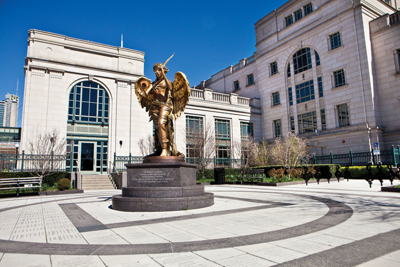
The agreement seemingly ends a year of fiscal storm and stress for the embattled symphony organization. Still reeling from the setback of the May 2010 flood, the NSO board raised creditors' concerns earlier this year when it declined to renew a letter of credit totaling $100 million in bonds used to build its gleaming downtown facility, the Schermerhorn Symphony Center.
That led to a public standoff in June between the NSO and its lenders, which resolved only after the threat of a public auction of the Schermerhorn on the courthouse steps. That fate was avoided by an 11th hour settlement in which Bank of America agreed to write off between $30 million and $40 million in construction-related debt.
Over the past six months, Valentine says, the orchestra has reduced its debt by 75 percent and its debt service by 90 percent. In addition, he says, it has restructured its food and beverage service; personnel costs are down 15 percent; and the overall operating budget has been reduced by $6 million a year. And the orchestra will maintain its roster of 83 full-time musicians.
"We have accomplished all of this without strikes, lockouts, foreclosures or bankruptcy," Valentine says. "Everything we've done the past six months sets the stage for what comes next."
For Nashville's classical music fans, this latest breakthrough comes just in time. The NSO's 2013-14 season officially starts next Thursday, when music director Giancarlo Guerrero leads the orchestra in a program featuring the music of Prokofiev and Shostakovich — at the Schermerhorn.
Email editor@nashvillescene.com.



Post a comment as anonymous
Report
Watch this discussion.
(0) comments
Welcome to the discussion.
Log In
Welcome to the discussion.
Keep it clean. Please avoid obscene, vulgar, lewd, racist or otherwise abusive language. Comments featuring hate speech or threatening or violent content will not be tolerated.
PLEASE TURN OFF YOUR CAPS LOCK.
Be truthful. Don't knowingly lie or mislead.
Be proactive. Use the “report” link on any comment that violates our comment policy.
Share with us. We'd love to hear your feedback.