
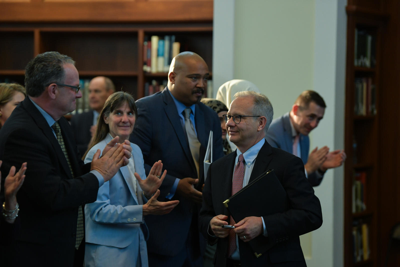


Mayor David Briley at the 2019 State of Metro Address
For this week's print issue of the Scene, I wrote a column about Mayor David Briley's tenure in the office, a period I described as a "mostly aimless ... plodding 15-month exercise punctuated by self-inflicted controversies."
The mayor's office has a different view. Or at least that's what is implied by the email I received from Briley's press secretary, Thomas Mulgrew, who (kindly) passed on a list of what Briley "has done in the 15 months he has been in office."
The point of my column was not that Briley has done nothing while in office, but rather that his administration has seemed to lack any sort of coherent vision or, you know, a plan. A meandering approach to leading the city will no doubt lead to some things that aren't bad, but it will also have the mayor stumbling in public more frequently than one might hope.
The list of accomplishments provided by the mayor's office includes some items critics will dispute. His headline-grabbing affordable housing plan, for instance, was found lacking not just by mayoral opponents but advocates on the ground too.
In any case, it's worth knowing what the Briley administration sees as its accomplishments. Here is the list as the mayor's office sent it:
Making Fort Negley Park whole again· Twice now fully funding Nashville General Hospital
· Getting the MLS deal done with the city’s first-ever Community Benefits Agreement
· Creating the Nashville GRAD scholarship program so that more students will get their degrees and certificates from Nashville State and TCAT
· Launching the city’s biggest-ever investment in affordable housing, Under One Roof 2029, which will put $500M in public money into affordable housing over the next decade and will draw another $250M in private dollars to help address the issue
· Pulling together multiple federal, state and local agencies to create Project Safe Nashville, the city’s largest-ever interagency effort to fight gun crime
· Saving the Morris Memorial Building from potential demolition
· Championing and committing to the 100 units of permanent supportive housing and services center downtown for those experiencing homelessness. The RFP for this is out now and will close on June 21
· Supporting the creation of the Homelessness Planning Council and Homeless Impact Division which has resulted in:
o 10% increase in federal funding
o 14% decrease in PIT count (first decrease in years)
· Making a 3 percent COLA a reality for Metro employees and bringing every Metro employee under the pay plan up to at least $15 an hour
· Giving more than a third of all new revenue in the FY2020 budget to schools, so that teachers and staff may also see a 3 percent COLA
o The Mayor is also in the process of finalizing a MOU with the district that will include a multi-year pay plan
· Creating the city’s first-ever Equal Business Opportunity Program
· Becoming the first city in the South to make LGBT-owned businesses a recognized category for Metro Procurement
o Both of these executive orders are part of the Mayor’s mission to have Metro Government reflect the diversity of Nashville in its hiring practices, contracting and economic development opportunities, and through the delivery of equitable programs, services, and policies
o Further on the diversity front, I think it’s important to recognize the diversity inside the Mayor’s Office. For example, his senior staff is 50% female, 30% African-American and 20% LGBT
In a follow-up email, Mulgrew adds "
the Root Nashvilleinitiative (500,000 trees planted by 2050) and
the new Preds agreementwhich take virtually all the risk away from Metro/the taxpayer and keeps the team in Bridgestone for the next 30 years."
While we're adding context to the discussion, there are some things I didn't mention in my short piece that are worth throwing out there. The biggest one is that Briley has resisted a long-delayed property tax increase, prompting another attempt from Metro Councilmember Bob Mendes to add one to the budget and heating up speculation that the mayor's office is just trying to wait until after the election. Another is the bizarre episode during this state legislative session during which Briley, who opposes school vouchers, stood by the lobbyists contracted to represent Metro despite the fact that those same lobbyists were also working on behalf of the pro-voucher push at the legislature. Yet another is the fact that this pro-transit mayor is cutting underfunding the city's transit system.*
It's not clear yet whether any of Briley's opponents in this year's mayoral election will be able to present a vision of their own that is compelling enough to voters to overcome Briley's incumbent advantage. But there's no escaping the fact that he's given them an opening.
Note: This post was updated to more accurately reflect the effect of the mayor's budget on the WeGo Public Transit. The organization is losing $3.8 million in state funding and is receiving $8.7 million less from the mayor's budget than it requested.



Post a comment as anonymous
Report
Watch this discussion.
(0) comments
Welcome to the discussion.
Log In
Welcome to the discussion.
Keep it clean. Please avoid obscene, vulgar, lewd, racist or otherwise abusive language. Comments featuring hate speech or threatening or violent content will not be tolerated.
PLEASE TURN OFF YOUR CAPS LOCK.
Be truthful. Don't knowingly lie or mislead.
Be proactive. Use the “report” link on any comment that violates our comment policy.
Share with us. We'd love to hear your feedback.