

The Tennessee General Assembly gaveled back into session Tuesday, gearing up for debates on education and immigration amid a potentially tight budget cycle.
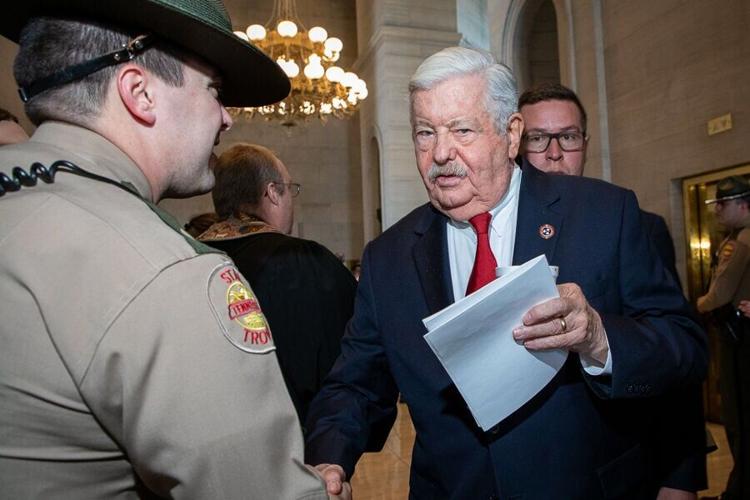
During the first House floor session of the year, House Speaker Cameron Sexton (R-Crossville) asked state troopers to escort four protesters from the gallery. Prior to the session, faith leaders and clergy members sang outside both chambers, emphasizing unity and brotherhood.

Recent Americans for Prosperity events reveal the priorities of Tennessee’s Republican supermajority
Although it was just the first day of the 2026 session, the House passed House Bill 884, which would effectively expand the state's definition of adult-oriented businesses to include commercial establishments. Rep. Chris Todd (R-Jackson) sponsored the measure, saying on the House floor he had the support of his district to come forth with the bill. Rep. Justin Jones (D-Nashville) meanwhile noted the state had higher priorities than this legislation, and that those priorities should have gone first.
“Full disclosure, it's weird that that's our very first bill,” said Rep. Jeremy Faison (R-Cosby). “But it really wasn’t the first bill filed this year. It was a bill that was carried over, just rolled from last year.”
Republican lawmakers have already noted their plans to expand vouchers, or Education Freedom Scholarships. On Tuesday, the application opened for new families wanting to receive state funding to send their child to a private school for the 2026-27 academic year. Funding for that currently sits at $7,295 per student per year.
How much an expansion will cost is still up for debate, but the state’s revenue projections might not keep up with the need for Tennessee — which currently sits at nearly $80 billion in infrastructure needs statewide. Those needs run the gamut from schools to roads to wastewater systems.
“Although year-to-date totals continue to exceed our estimates, we will continue to monitor economic conditions and consumer demand to meet our budgeted targets,” Finance Commissioner Jim Bryson said in a December press release about the state’s revenue projections entering 2026.
November saw $49.9 million less than the budgeted estimate, according to the Tennessee Department of Finance.

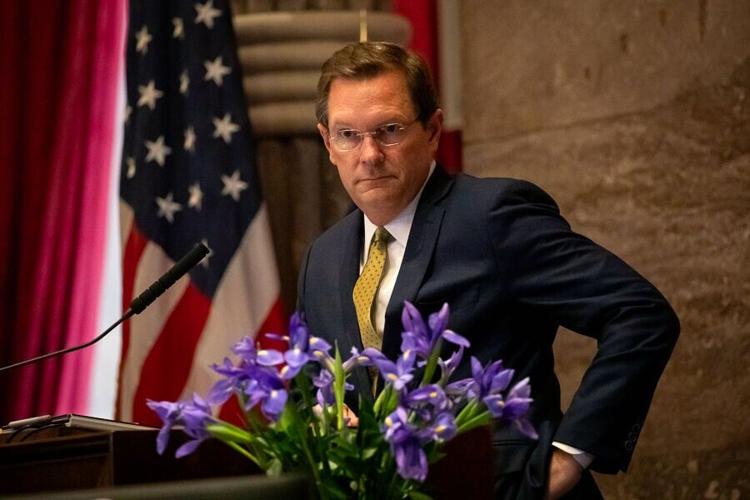
Lt. Governor Randy McNally steps into the Senate for the first day of legislative session, Jan. 13, 2026
Meanwhile on the Senate floor, things remained more tame as Lt. Gov. Randy McNally ordered the legislative body into session for the year.
A slew of bills passed on first introduction, including several pieces of immigration legislation — two of which were spearheaded by Senate Majority Leader Jack Johnson (R-Franklin).
Senate Bill 1465 would make certain immigration enforcement records confidential, shielding them from being released to the public by state and local government officials. The bill would make it a felony if such records were publicly released.
Johnson also brought forth SB 1587, which would make it a misdemeanor for a person who resides in the U.S. illegally to operate a motor vehicle, further requiring the arresting law enforcement agency to notify federal immigration authorities. This comes in the wake of a law passed last session that also made it a misdemeanor for undocumented immigrants to use an out-of-state driver’s license in Tennessee.
Sen. Brent Taylor (R-Memphis) has introduced SB 1486, a bill that requires a memorandum of understanding between local law enforcement agencies and federal officials regarding the enforcement of federal immigration laws. The legislation would require the local law enforcement agencies to comply with immigration detainers ordered by federal immigration authorities.
Other bills of note include those that would authorize certain franchise tax credits for businesses contributing to charities, impose a tax on electric vehicles, create restrictions on child labor when it comes to online content creation and create criminal penalties for those who train AI technology that encourages the act of suicide, criminal homicide or other manners.

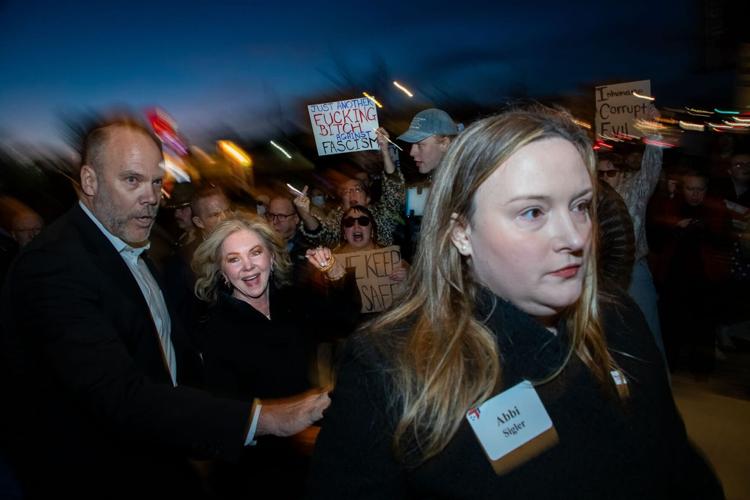
Protesters confront Sen. Marsha Blackburn outside the Tennessee State Museum, Jan. 13, 2026
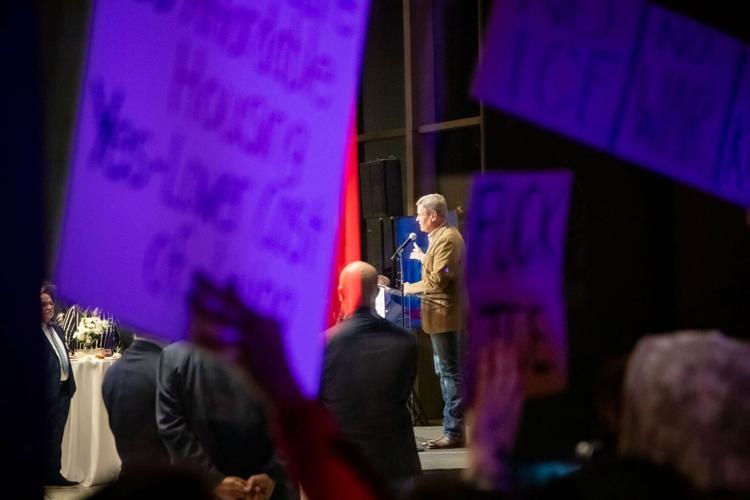
More than 100 protesters descended on the Tennessee State Museum after the close of legislative business Tuesday to protest outside an opening-night event attended by business leaders, lawmakers and other government officials. Protesters gathered at the entrance of the building and shouted down attendees, many driven by news that the state’s Republican supermajority has been partnering with the White House to expand Tennessee’s immigration crackdown.
Among those in attendance were Gov. Bill Lee, U.S. Sen. Marsha Blackburn, state Majority Leader William Lamberth, Knox County Mayor Glenn Jacobs and various state legislators and local officials.
Additional reporting by Hamilton Matthew Masters.



Post a comment as anonymous
Report
Watch this discussion.
(0) comments
Welcome to the discussion.
Log In
Welcome to the discussion.
Keep it clean. Please avoid obscene, vulgar, lewd, racist or otherwise abusive language. Comments featuring hate speech or threatening or violent content will not be tolerated.
PLEASE TURN OFF YOUR CAPS LOCK.
Be truthful. Don't knowingly lie or mislead.
Be proactive. Use the “report” link on any comment that violates our comment policy.
Share with us. We'd love to hear your feedback.