
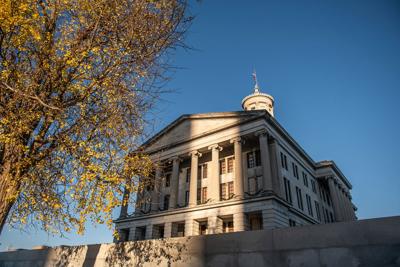

The Tennessee General Assembly returns this week for its 2026 session, during which immigration and the expansion of school vouchers are likely to take center stage amid a tightened budget.
On Jan. 6, Americans for Prosperity Tennessee — a conservative political action organization — hosted a legislative preview event in Knoxville, where Republican lawmakers gave new insight into the legislature’s pending assault on immigration.
As reported by the Knoxville News Sentinel, one of those lawmakers — state Rep. Jason Zachary (R-Knoxville) — revealed for the first time publicly that the state is working directly with Stephen Miller. Miller, who is President Donald Trump’s homeland security adviser and deputy chief of staff for policy, is responsible for crafting the Trump administration’s immigration policy. In a video taken at the Knoxville AFP event, Zachary can be seen saying that state House Speaker Cameron Sexton (R-Crossville) has been working with the White House for six weeks, and that approximately 10 pieces of immigration legislation will be filed in the first weeks of the session. Zachary calls the immigration legislation “one of the primary objectives in the session.”
“It is strong legislation, and the president is behind us,” Zachary said. “The president has promised his support on social media for us, and we are being told Tennessee will go first. …We had a leadership meeting about four or five weeks ago with the [state] Senate and the House. Everybody is on board.”
The policy push comes nearly one year after a special session of the legislature saw the passage of a bill, sponsored by Senate Majority Leader Jack Johnson (R-Franklin) and House Majority Leader William Lamberth (R-Portland), that established the state’s centralized immigration enforcement division. In the spring, Gov. Bill Lee appointed former federal agent Ryan Hubbard to lead the division as the state’s first chief immigration enforcement officer.

Veteran federal agent Ryan Hubbard to lead new division, which is largely exempt from the state’s Public Records Act
Lawmakers will also debate a bill introduced by Johnson in June that aims to criminalize the “doxxing” of federal agents and allow for the removal of elected officials — an escalation against Nashville Mayor Freddie O’Connell, who has been targeted by Republicans following his statements in opposition to an immigration enforcement operation in Middle Tennessee in May.
Johnson’s bill, sponsored in the House by Sexton, would make the “criminally negligent public release of certain confidential records” a class-E felony, and would pave the way for the removal of public officials from office.
“I want to build upon that legislation that we passed that’s been very effective to say that anyone — a local elected official, anyone else, a mayor, a county mayor, a city alderman, a city, a county commissioner, anyone else — if you dox or expose any personal information about any Immigration and Customs Enforcement officer, you will go to jail,” Johnson said at a Jan. 8 AFP event in Franklin. “You will be charged with a felony. We’re not going to create a disincentive for these hardworking men and women to come into our state and do their job and get these violent people out of our communities.”
State Rep. Gabby Salinas (D-Memphis) has filed House Bill 1482, which would prohibit ICE from entering school or church property without first providing notice.
“No child or person should fear being abducted or risk having their family ripped apart when they leave their home,” says Salinas in a release. “We are losing friends, neighbors, caretakers, and community members daily.”
The Republican supermajority also aims to expand the state’s Education Freedom Scholarship program, also known as school vouchers. The program, which passed during the aforementioned 2025 special session, is another top priority for AFP. State Rep. Charlie Baum (R-Murfreesboro), who teaches economics at Middle Tennessee State University and supports the state voucher program, says the state would need approximately $145 million to expand the program to twice its size. State Sen. Dawn White (R-Murfreesboro), who serves as the Senate Education Committee chair, said on Jan. 6 that she’s “all for expansion” of the program. Lamberth said on Jan. 5 that “not one red cent from those [new] scholarships comes from our public schools.”
During numerous AFP events, Republicans spoke about paving the way for cuts to state regulations. Discussions are also underway around the future of cannabis following President Trump’s executive order to reclassify the plant from a Schedule 1 to a Schedule 3 drug, with the president saying that cannabis has “legitimate medical uses.” Tennessee Democrats are now calling for state cannabis reform amid uncertainty over what the impact of rescheduling will be in the state and across the nation.
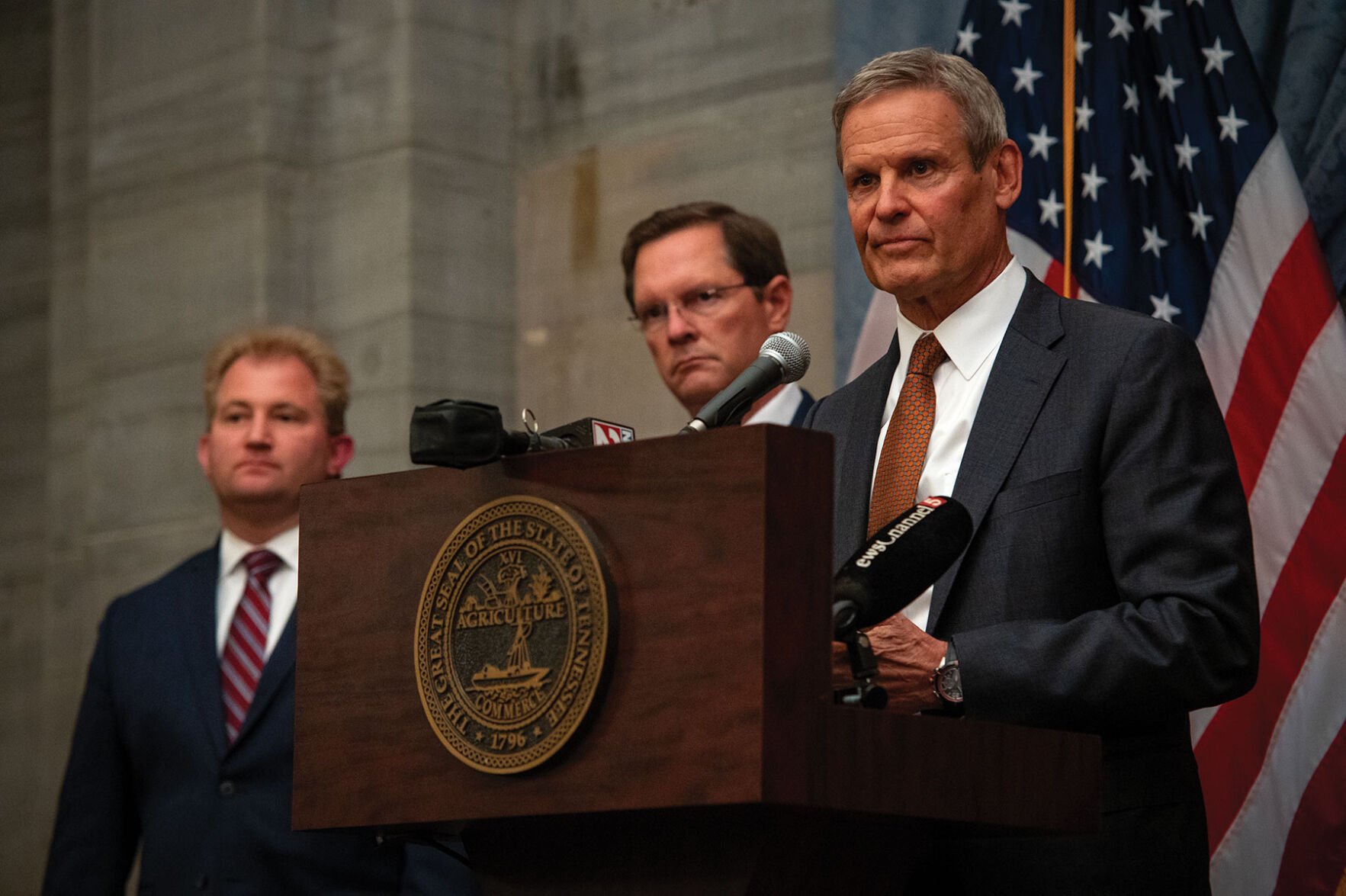
Democratic lawmakers accuse governor of ‘cruelty’ in opting out of $84 million in federal funds for low-income families
State Sen. Ferrell Haile (R-Gallatin) said during a Sumner County AFP event that any state reform regarding cannabis “has to be concerning medical only.”
“We’re not prepared for when this comes off the schedule,” Haile said. “It’s going to be the Wild West. We’ve experienced that with hemp. We’ve had to pull back on that already. We want to be in better shape with this, and so that’s the reason that we want to look at this. … It will be whatever recommendations come out of the cannabis commission, and they have certainly done a lot of work and research on that.”
The state’s House Democrats have listed among their top priorities “eliminating the grocery tax” (language that has been co-opted by Republican Lamberth), “prohibiting algorithmic pricing,” “fighting for free school-based meals and summer food programs” (Gov. Lee recently rejected federal food assistance funding for children), “lowering health care costs and capping vital [prescription] drug prices,” and “modernizing transportation infrastructure to reduce reliance on gas taxes.”
The Scene will have a more detailed breakdown of the priorities, bills and challenges of this year’s session in an upcoming issue.



Post a comment as anonymous
Report
Watch this discussion.
(0) comments
Welcome to the discussion.
Log In
Welcome to the discussion.
Keep it clean. Please avoid obscene, vulgar, lewd, racist or otherwise abusive language. Comments featuring hate speech or threatening or violent content will not be tolerated.
PLEASE TURN OFF YOUR CAPS LOCK.
Be truthful. Don't knowingly lie or mislead.
Be proactive. Use the “report” link on any comment that violates our comment policy.
Share with us. We'd love to hear your feedback.