
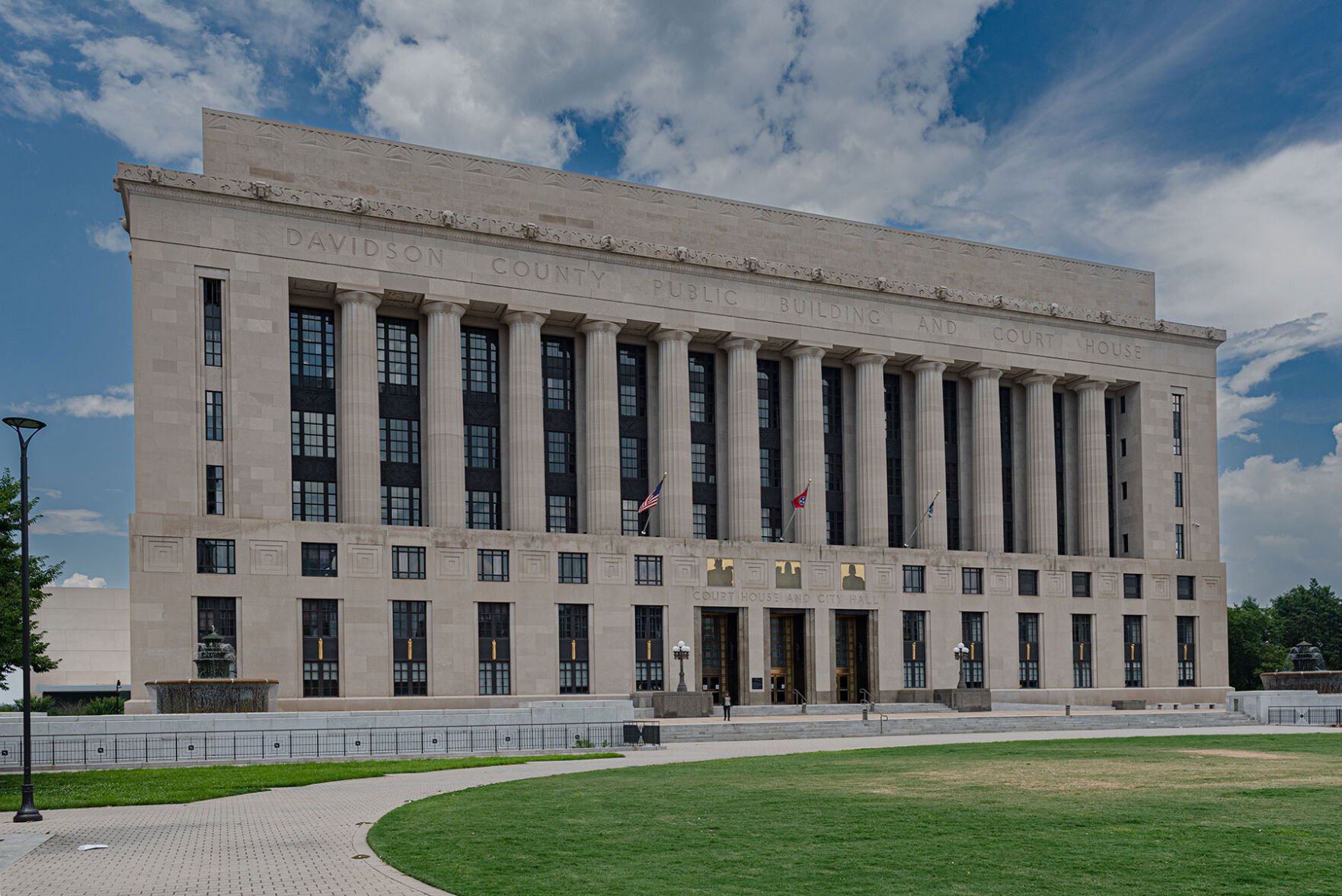

Hypotheticals dominated arguments Thursday morning as Tennessee Supreme Court justices weighed legislation passed by state lawmakers in 2023 that appears to target Nashville’s airport authority and Metro Council.
Metro attorneys Allison Bussell and Melissa Roberge argued on behalf of the city in the two separate but related cases that have dragged through litigation and appeals for almost three years. Attorneys gave back-to-back oral arguments at the Supreme Court chamber, just across the street from the state Capitol — where both pieces of legislation were passed.

New state laws aren’t passing constitutional muster
The state took repetitive losses in 2023 for violating “home rule” protections in the Tennessee Constitution, with four bills aimed at the city’s sports authority, airport authority, NASCAR-related fairgrounds renovations and Metro Council size. The state constitution voids “any act of the General Assembly private or local in form or effect applicable to a particular county or municipality,” a powerful clause that Metro attorneys used in lower courts to defend targeted state laws. Court losses in 2023 apparently influenced further efforts in the 2024 and 2025 legislative sessions to interfere with Nashville’s local governance. Three of the court’s five justices — Sarah Campbell, Mary Louise Wagner and Dwight Tarwater — were appointed by Gov. Bill Lee.
Opposite attorneys from the state, Bussell (defending the Metro Council size) and Roberge (defending the airport authority) again tried to convince justices that targeted laws violate the constitution.
“This court must decide what the home rule amendment protects and what it doesn’t,” Roberge argued in her opening statement. “Look at who the statute applies to using reasonable and rational considerations. What you don’t do is indulge in the theoretical, the illusory, the merely possible.”
State attorneys Matt Rice and Madeline Clark explained both laws as broad criteria that happen to apply to Nashville specifically, but not necessarily. During the airport authority argument, Rice faced direct scrutiny from justices about why the law narrowly affected only Nashville.
“Would you agree that the staggering provision in this legislation could only apply to Davidson County?” asked Justice Tarwater.
“We take the position that it applied to Davidson County at the moment the law was enacted,” explained Tennessee Solicitor General Matt Rice, “and that it could have also applied to Shelby County, because Shelby County could, at any point in time, adopt a metropolitan form of government.”
“OK,” responded Tarwater with a chuckle. “I guess that’s a possibility.”
During her oral argument, state attorney Clark used an extended babysitting metaphor to make a point about two dependent portions of the council-reduction bill, which aims to reduce the body's size from 40 members to 20.
The crux of the council-reduction case lies in whether a previous special carve-out for consolidated city-state governments from the 1970s — the constitution’s “exemption clause” — continues to protect Metro from direct structural changes ordered by the state legislature. Metro maintains that it does, while the state argues against a “Metro Nashville only” exception. Metro Nashville is the only consolidated city-county government exceeding the 20-member cap set forth in the state’s 2023 bill. A state appeals court previously upheld the 20-member council cap.



Post a comment as anonymous
Report
Watch this discussion.
(0) comments
Welcome to the discussion.
Log In
Welcome to the discussion.
Keep it clean. Please avoid obscene, vulgar, lewd, racist or otherwise abusive language. Comments featuring hate speech or threatening or violent content will not be tolerated.
PLEASE TURN OFF YOUR CAPS LOCK.
Be truthful. Don't knowingly lie or mislead.
Be proactive. Use the “report” link on any comment that violates our comment policy.
Share with us. We'd love to hear your feedback.