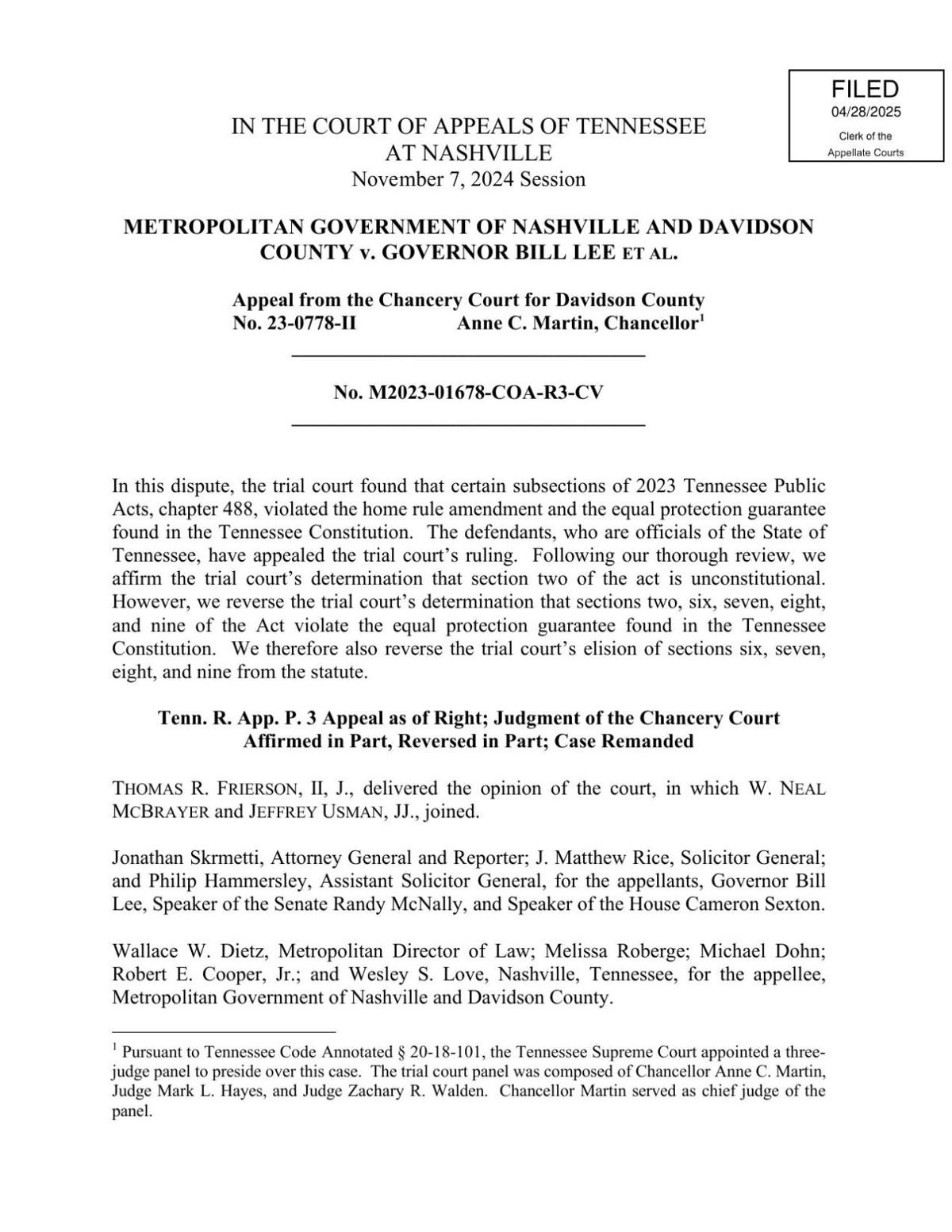

The battle for state control over the Metro Nashville Airport Authority saw another update Monday, when an appeals court affirmed a previous trial court ruling saying part of an act passed by the Tennessee General Assembly is unconstitutional. The appeals court also, however, reversed the trial court’s decision over a part of the act that would return some language to the legislation — meaning the state received a small win in the decision, and the fight may not be over yet.
“The Court unanimously ruled in Metro’s favor on by far the most important argument: that the State’s hostile takeover of MNAA violated the Home Rule provisions of the Tennessee Constitution,” Metro legal director Wally Dietz says in a statement. “Metro will continue to maintain appointment authority for members of the Authority. Multiple courts have now ruled in our favor on Home Rule arguments from the legislature’s overreach from two years ago. We are digesting the other parts of the opinion.”

In 2023, the legislature passed a law giving most of the board appointments to state leaders instead of Nashville's mayor. That prompted Metro Nashville to sue the state government to maintain control, arguing the state violated the Tennessee Constitution’s Home Rule — protection against legislation aimed at a local government. Originally, a three-judge panel ruled in favor of Metro, striking the law down and keeping the city-controlled board in place. The state appealed the opinion, and arguments were heard in November.
The panel of judges agreed that the removal of the mayor’s appointments in favor of a state-appointed board would violate the Home Rule amendment.
“Because section two of the Act implicates the Home Rule Amendment and does not require approval by a majority of the municipality’s local legislative body or voters, it is unconstitutional and void,” Judge Thomas Frierson writes in the appellate court opinion. “We therefore affirm the trial court’s determination.”
The initial ruling also found that sections two, six, seven, eight and nine of the act violated the state constitution’s equal protection guarantee. Metro made the argument that the legislation “treated MNAA differently than the other airport authorities,” according to the appeals ruling, but that the state said that was “constitutionally permissible” since the airport “is different in a variety of important ways.”
The appeals court ruling sided with the state’s argument and reversed the trial court’s opinion about the additional sections of the act.
“When assessing the constitutionality of such legislation under a rational basis standard, actual distinctions between Nashville International Airport and other airports can potentially provide a rational basis for the statutory differential treatment between it and other airport authorities,” the ruling states.
The appellate court sent the case back to the trial court for further proceedings. Legal costs are to be split between the state and the city.