
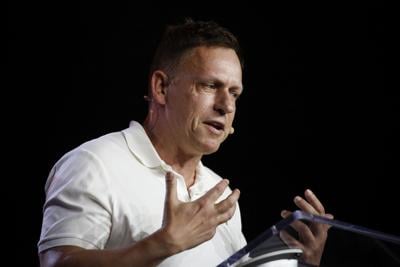

Billionaire Peter Thiel delivered another widely attended lecture on the “Antichrist,” his second of four, at the Grand Lodge of Tennessee in downtown Nashville this week. Hundreds bought $100 tickets for the fall series. After a Sept. 28 talk that blurred together history, theology and conservative politics, Oct. 5's lecture, titled “The End of Empire,” revealed a devout Christian obsessed with divining the unknowable future. Both Thiel and host Davis Hunt, who runs local blog The Pamphleteer, make free speech and debate central to their politics. The Scene was barred from attending and instead relied on recordings for our reporting.
Thiel made an ungodly sum betting on Silicon Valley tech and helped grow some of the world’s most influential and successful companies, cementing his status among the world’s most prescient investors over the past three decades. Meanwhile, Christianity has waned and fears of technology-enabled power (particularly an artificial intelligence takeover) have tormented the national mood. This week, the profiteer of America’s current digital hegemony had a simple message for an audience fearing the end times: Pray harder.
“So by scaring you, I've shown you just how powerful the Antichrist's arguments will be,” said Thiel, responding to the impact of his first Antichrist lecture. “And if you were too scared, maybe you need to pray a little harder and anchor a bit more on your faith.”

The tech billionaire’s Christian theology quickly veered off into a meandering theory of everything
Evangelical, nondenominational Christianity has flourished in Middle Tennessee. Thiel’s message fits that mold. For more than an hour on Monday, he cherry-picked examples of historically significant literature and political moments that reinforce his Christianity. At points he connected his exegesis to politics and modern culture, taking care to deride liberals and Danish activist Greta Thunberg — an apparent fixation for Thiel, who has referenced the young climate activist in both Antichrist lectures. He cast intense expressions of human empathy — “woke-ism” and effective altruism — as roads to American fascism, regularly returning to faith, hope, love, prayer and the Bible as moral guides.
“This is the challenge with the people making AI in Silicon Valley,” preached Thiel, early in Monday’s talk. “Almost none of them have any other faith on which to anchor or relativize discussions about the technology.”
Thiel easily referenced the wealthiest individuals, ranked, in both Germany and the United States, dividing them by earned and inherited net worths and reminding the audience of his own place among them. Later, Thiel situated his infamous 2009 essay arguing that democracy and freedom are incompatible as within the legacy of great thinkers of the Enlightenment, an era Thiel alternatively praised and criticized throughout the evening.
His wide-ranging topics warn against powerful centralized power, specifically a world government or totalitarian empire that has nowhere left to expand, as the looming Antichrist. A moral imperative to prevent such danger may justify violence, Thiel argues, once redirecting the audience to consider “Christ’s more militant comments.”
“ The undercurrent of all these lectures is that it’s certainly not moral to despair,” explained Thiel during the Q&A portion. “It's not right to think that something like the Antichrist is inevitable or there's nothing you can do about it.”
Academic Mark Howard studies Silicon Valley politics and the ideology behind modern venture capital. Howard has pinned Thiel as the seminal figure in both, and behind an “anti-democratic” worldview shared by people like Vice President J.D. Vance, who has personal and professional ties with Thiel. Howard spoke to the Scene about what lies behind the billionaire’s grandiose declarations.
“ He's often quite direct and not secretive in that sense — he does just come out and announce exactly what he's thinking, and I think often you should take him at face value,” Howard tells the Scene. “In the context of the apocalypse, where he's talking about civilizational collapse, I think we should read what he says not as some kind of posturing. I think he really means it. And if he's ever suggestive of the idea of bringing about some kind of civilizational collapse, I think you should believe him.”
An international lecture circuit can help Thiel convert believers, offering intellectual clout rather than financial or political benefit.
“ The word I would use is 'persuade,'” Howard continues. “I think he wants to persuade people that this era of disruption that we're in — not just technological disruption, everything is being disrupted and overturned — is going to get worse in order to get better, and that people like him are well-placed to guide society and civilization into the next phase.”
After two hours in the lecture hall Monday night, Hunt encouraged the crowd to continue discussion a few blocks away at Kid Rock's Big Ass Honky Tonk.



Post a comment as anonymous
Report
Watch this discussion.
(0) comments
Welcome to the discussion.
Log In
Welcome to the discussion.
Keep it clean. Please avoid obscene, vulgar, lewd, racist or otherwise abusive language. Comments featuring hate speech or threatening or violent content will not be tolerated.
PLEASE TURN OFF YOUR CAPS LOCK.
Be truthful. Don't knowingly lie or mislead.
Be proactive. Use the “report” link on any comment that violates our comment policy.
Share with us. We'd love to hear your feedback.