
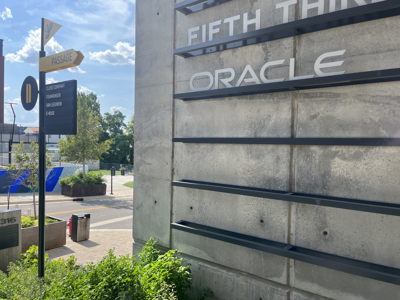

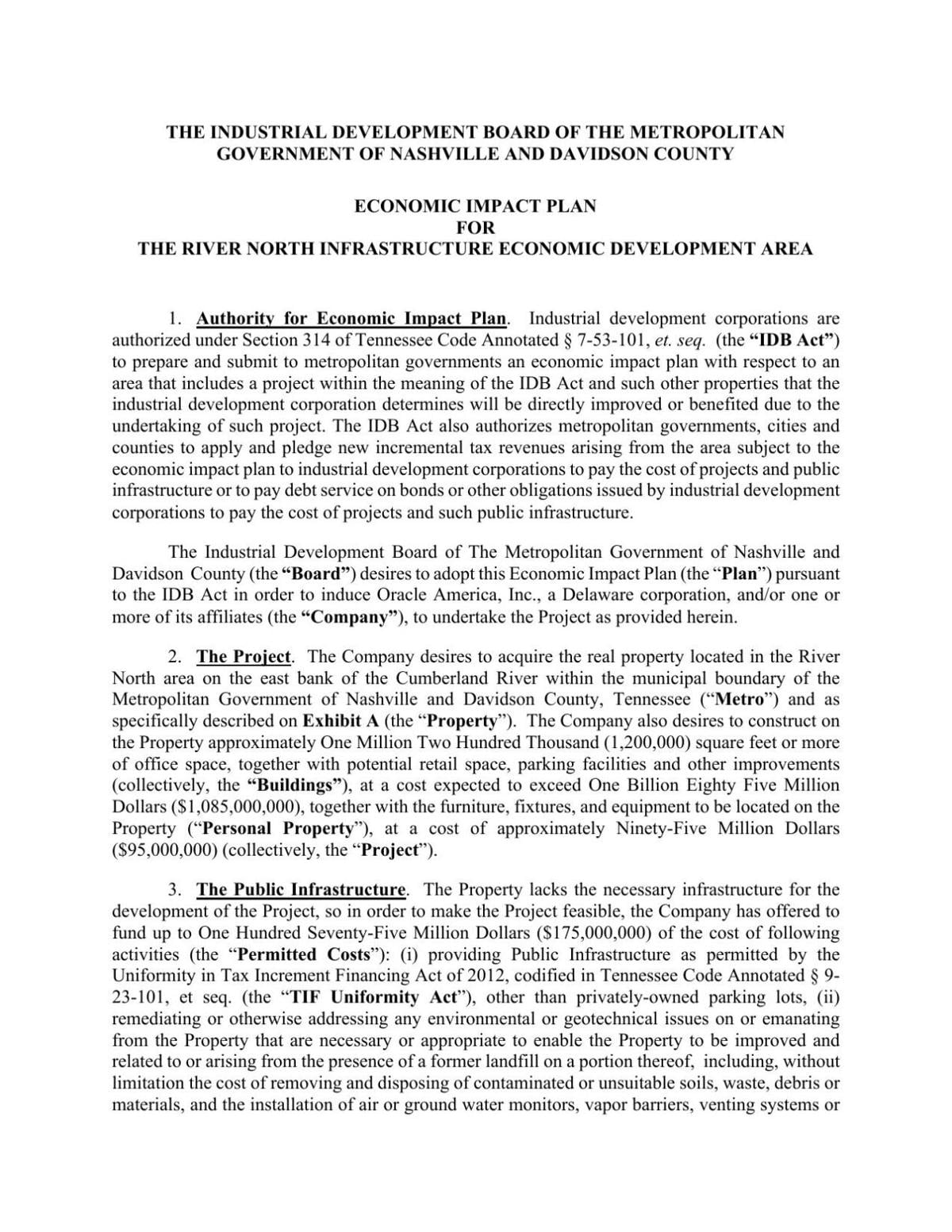
Tech giant Oracle announced a blockbuster Nashville relocation in 2021 with fanfare, handshakes and promises. The state inked a $65 million incentive package and the Metro Council cleared development obstacles, crafting a creative property tax arrangement to reimburse the corporation for spending on East Bank infrastructure up to $175 million.
Glossy construction renderings and business boosterism helped raise the city’s East Bank fever that year — a major focus for then-Mayor John Cooper — just in time for the citywide debate about taxpayers subsidizing the new $2.1 billion Titans Stadium blocks away. In 2024, Oracle CEO Larry Ellison announced that the city will soon become Oracle’s global headquarters.
Not everything has gone according to schedule. The corporation has struggled to fill out its local workforce, juicing relocation packages in some cases, and now faces a critical stretch as jobs pledges come due and its East Bank campus takes shape. Still, senior vice president Scott Twaddle cites slow and steady growth as a sign of Oracle's overall positive momentum.

Meet Nashville’s new neighbor, a backend tech giant owned by an eccentric billionaire
“We continue to grow our presence in Nashville, recruiting talent locally, regionally, and from across the country as we build a leading cloud and AI hub in this dynamic city," Twaddle tells the Scene in a statement. "We’re excited about our future here, and we remain committed to creating thousands of high-quality jobs and delivering meaningful economic impact for the community.”
Oracle and Metro have altered development plans in the five years since announcing the East Bank campus, triggering some locals to flash back to the city’s Dell PILOT passed by Metro in 1999. More changes, including a possible default on its jobs promise if current hiring trends hold, may erode what was heralded as a signature local economic development deal by both the city and state.
Supporters praised initial agreements as Oracle betting big on Nashville. Such a consequential contract was also Nashville’s bet on Oracle, a company that has, over the past year, hitched its future to global tech's ongoing artificial intelligence race.
By many metrics, Oracle is losing — or more accurately, not winning — this race. At least not yet. The company’s stock has tumbled to roughly half its peak public valuation in September 2025. Oracle cut 21,000 jobs in the spring and is preparing another round of layoffs before Sept. 1 according to multiple sources. TikTok, owned in part by Oracle, shuttered its Nashville offices last week along with layoffs and little explanation.
Oracle's groundbreaking came in May, roughly six months after its PR push to announce the start of campus construction. In March, the company signed a lease in the Neuhoff District to accommodate 2,000 seats across three Nashville locations. (Oracle employees also currently work in Capitol View.) The company has said it aims to have 8,500 employees in Nashville by 2030. The Neuhoff move communicates Oracle's expectation that its East Bank complex will remain a work in progress.
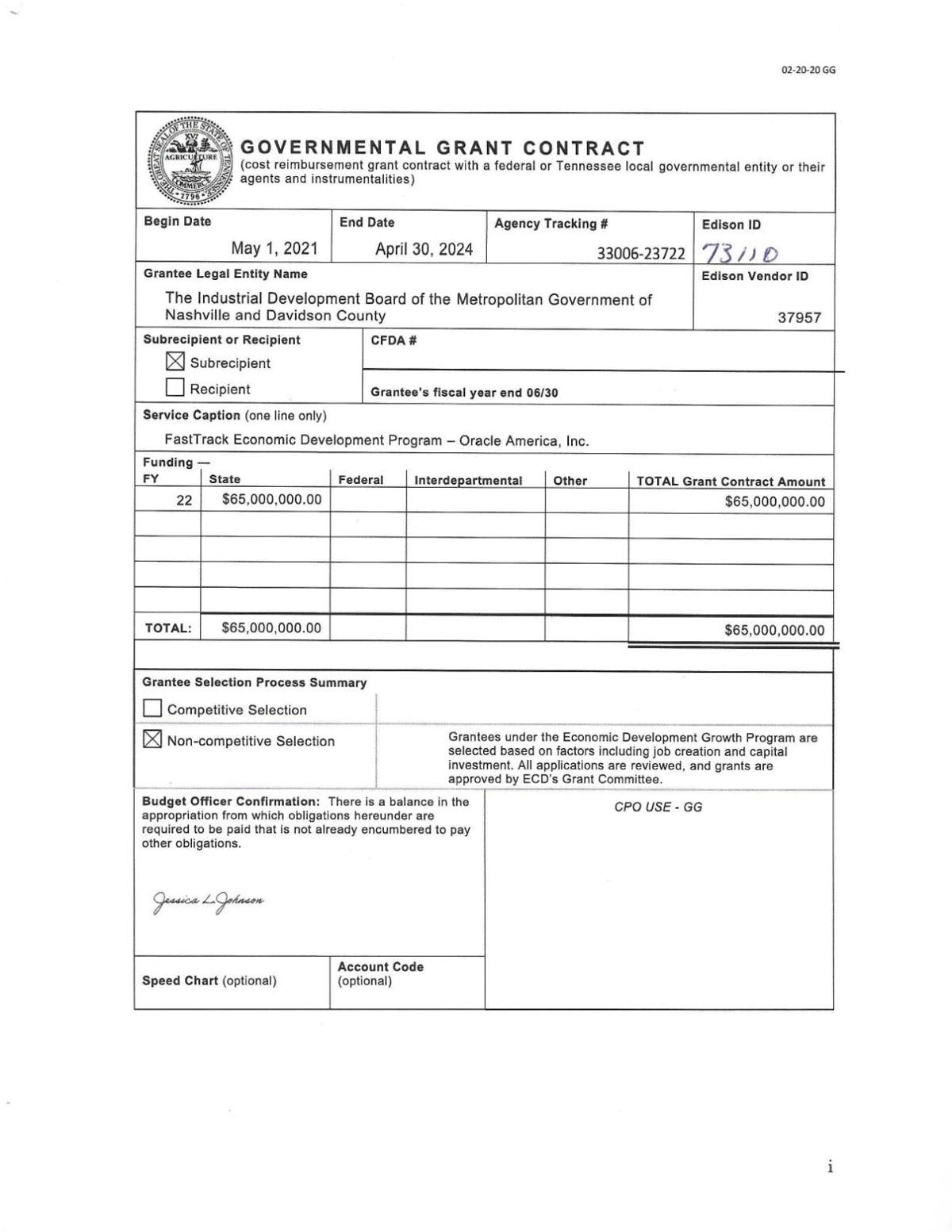
The Scene reviewed two contracts — one each with Metro's Industrial Development Board and the Tennessee Department of Economic and Community Development (both embedded below) — that outline the Oracle deal. The 2021 contract signed with TNECD started a clock that could claw back part, or all, of Oracle’s $65 million incentives if the corporation fails to meet certain job-creation deadlines.
“TNECD incentivized Oracle to create 5,989 jobs,” a TNECD spokesperson tells the Scene. “If the company fails to create at least 90 percent of those jobs by Dec. 31, 2029, they will be required to repay a portion of the funds. If the company creates fewer than 50 percent of the committed jobs, they will be required to repay all of the grant funds.”
So far, Oracle is lagging behind the pace necessary to meet the obligations tied to its massive incentive package. Annual reports, signed by Oracle executive vice president Lisa Hickman-Lott, put the company’s total new jobs at 827 in addition to a 2021 baseline of 91 employees. New local job creation has slowed since 2022, when the company reported 355 new local employees; reports to the TNECD list 71 new jobs in 2023, 168 in 2024 and 188 in 2025.
The company must hire at least 1,500 people in 2026 and 2027, with an average salary of $110,000, to make good on its promise of adding 2,500 Oracle jobs by the end of next year. Another pledge — 8,500 jobs by 2030 — looms after that. The IDB contract does not include any clawback language that might penalize Oracle for failing to meet these deadlines.
A year after signing its deal, the city had spent millions reordering the East Bank roads to include River North Boulevard, Waterside Drive and Marine Drive, meant to service Oracle's eventual buildout. Mega-sized Wayward and Oxbow apartment complexes, isolated today by construction and the Cumberland, are now courting tenants to fill several hundred new units.
Five years on, Oracle has changed its plans on the East Bank according to a presentation from Nashville Department of Transportation and Multimodal Infrastructure in April. Cooper sold the project to Nashville, alongside major pedestrian upgrades to the longtime industrial wasteland; one, a thruway connecting Cleveland Street to the East Bank across I-65, has been canceled. Instead the city will extend Marine Drive under I-24, with construction set to begin in August 2027. Oracle will also reduce the size of its office, initially sited at over 1 million square feet.



Post a comment as anonymous
Report
Watch this discussion.
(0) comments
Welcome to the discussion.
Log In
Welcome to the discussion.
Keep it clean. Please avoid obscene, vulgar, lewd, racist or otherwise abusive language. Comments featuring hate speech or threatening or violent content will not be tolerated.
PLEASE TURN OFF YOUR CAPS LOCK.
Be truthful. Don't knowingly lie or mislead.
Be proactive. Use the “report” link on any comment that violates our comment policy.
Share with us. We'd love to hear your feedback.