
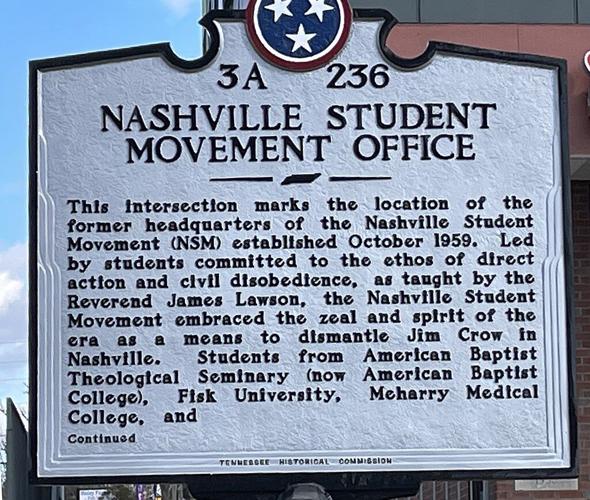
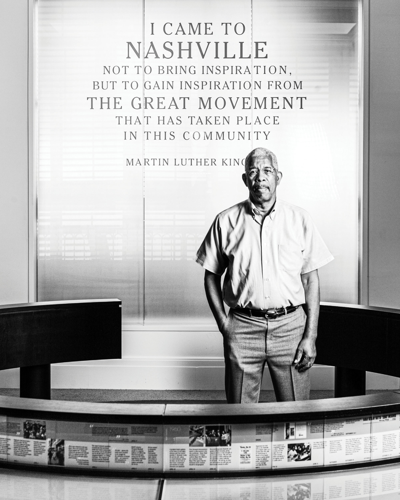

As Scene culture editor Erica Ciccarone reported last week, Ernest “Rip” Patton has died. I’m not going to reiterate everything that Erica said. You can read it for yourself. He was — like Kwame Lillard, who died in December — a genuine hero. And like all of Nashville's civil rights heroes, he seemed inadequately recognized by the broader city during his lifetime, and it remains to be seen how he will be honored now.
Matthew Walker Jr., another civil rights movement icon who was born and raised and died in Nashville, has been gone five years, and there’s no street named for him. No talk of renaming a park in his honor. Hell, any city with a good sense of poetic justice would have named a pool in a park after him years ago. We, as a whole city, have done nothing.
So I am somewhat pessimistic about whether the city will honor Dr. Patton at all, and if we do, whether it will matter.
I am of two minds about this. One is that it means very little for us to honor Black Nashvillians after they’re dead, as we actively destroy Black neighborhoods and make it hard for living Black people to live here. If Black people want to scoff at the city for performative bullshit now, after people are dead, we as a city probably deserve it.
But I lean more toward it being important for the city to take its lumps and hear those critiques and still honor civil rights activists. Putting people’s names in public spaces at least lets others know that they were someone worth remembering, might even be someone worth Googling. We were one of the epicenters for one of the most transformational movements for social change this nation has ever seen. What’s the worst that could happen? We have a bunch of streets named for people Nashvillians should know? We give high school- and college-age kids the knowledge that people their age changed this city and the whole nation? We as a city are reminded that there’s a popular thing and a right thing and those aren’t always the same thing? That the people oppressed by society’s wrongdoing know something’s wrong and want it changed?

Rip Patton, photo from the book Breach of Peace: Portraits of the 1961 Mississippi Freedom Riders by Eric Etheridge
As a white person in Nashville, I do think that white Nashville is still very committed to a racial myth in which white people are so great and have all these advantages and should want social justice out of a kind of magnanimity — of course we, who have so much, should share with the poor unfortunates who have so little. Those unfortunates could be any underprivileged community — immigrants, Latinos, LGBTQ folks, etc. — but for now we’re looking at this specific case. It’s condescending, but it’s a condescension that at least allows room for some social change.
But at this point, I am convinced that white Nashville is committed to this myth not just because it makes us feel good and lets us be main characters in the story of someone else’s liberation, but because we do not want to admit to ourselves or other white people the ways in which we’ve been screwing over white people through racism.
This is, I think, easiest to see in the schooling situation in Nashville in the 1950s. Yes, Black schools were deeply neglected by the school system and had inadequate resources compared to white schools. This is true. But Black teachers often had master’s degrees or doctorates. I have heard stories of professors at TSU teaching at Pearl High School when needed. And white teachers were not held to those standards.
If desegregation had been planned to benefit everyone — including white students — all students would have had access to the resources they needed, and all students would have had access to the best teachers. White students would have had those Black teachers with master's degrees or doctorates. But it was more important to us as a racist society to reinforce the idea that white schools were better than Black schools and white teachers better than Black teachers and that Black teachers could not have authority over white children than it was to make sure white students got the best education they could.
You can still see a similar dynamic now. The two best working Nashville historians we have right now are Linda Wynn and Learotha Williams. That’s just a fact. I’ve been to the Nashville Conference on African American History and Culture, which Dr. Wynn is one of the founders of, and by and large the white students there are from MTSU. I know Dr. Williams has been invited to speak all over town, but how many local white educators are bringing white Nashville students to Dr. Williams’ classrooms at TSU? How many white kids with a love of Nashville history are being encouraged to go to TSU to study under Dr. Williams?
People teaching Nashville history to white Nashville kids are still not bringing white Nashville students into predominately Black spaces where they would learn from the best working Nashville historians we have right now. We still do not value their expertise more than we value our own comfort to our own detriment.
And we fail to honor these Nashvillians who fought to give us all a more just city — and a more just country — to our detriment.



